

I’m glad I haven’t written too much about the Michelin Man or buffets. We did talk about Michelin’s old UK Headquarters, but that’s about it.
So technically this issue is a brand mascot story. But it’s much more about trust.
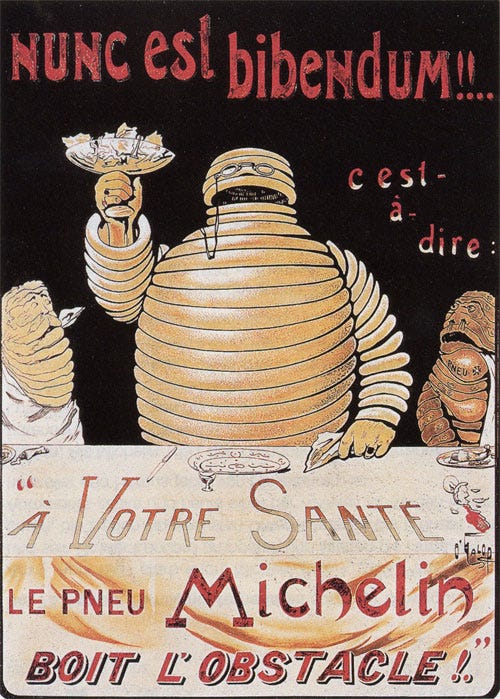
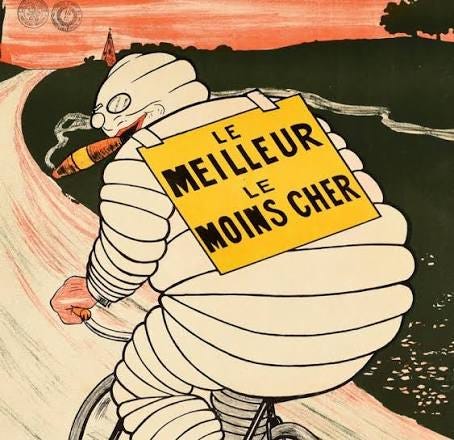
In the very first ad for the legendary Michelin Man, he’s at a banquet, raising a goblet of nails and broken glass (as you do) and toasting to his ugly old tire friends.
Welcome to 1898. Ads were different back then.
THE MICHELIN MAN STARTED AS A BEER AD
Imagine being Édouard and André Michelin at the 1894 exhibition in Lyon when, after looking at a stack of old tires on of them said, “with arms it would make a man.”
It took another four years and then seeing a poster from Marius Rossillon for a Munich brewery. The poster showed King Gambrinus, the patron saint of beer with a line from Horace: Nunc est bibendum. Now is the time to drink.
The only note for Rossillon: make the king a pile of tires. Let him toast a bunch of junk from the road.
The tagline practically wrote itself: “the Michelin tire drinks up obstacles.” For the nerds reading apparently this is Horace riffing on the defeat of Cleopatra. So kind of a two-thousand-year-old dunk on a dead queen.
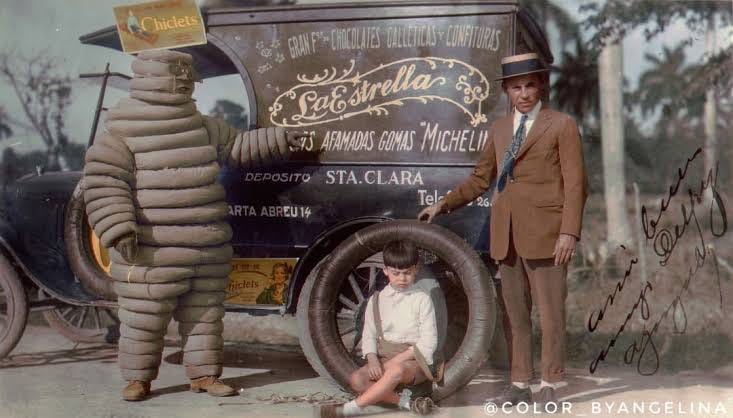
A race driver named Léon Théry saw him and reportedly yelled “Voilà Bibendum!” Since he didn’t know Latin he shouted at André Michelin the only word that sounded like a guy.
THE WORLD’S MOST FAMOUS FOOD GUIDE IS A TIRE PROMO
The story everyone in marketing knows is that a tire company in a country with fewer than 3,000 cars wasn’t going to amount to much. So in 1900 they handed out 35,000 free guides packed with maps, mechanics, gas stations and places to eat. If you can encourage more driving, you wear out more tires. So dumb.
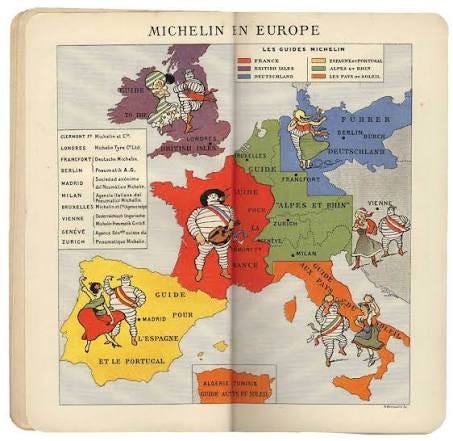
This whole playbook helped invent content marketing.
And the interesting thing they discovered along the way was that giving that content out for free wasn’t working. The story goes that the guides were being used to prop workbenches up in tire shops. The takeaway? People only respect what they’ve paid for.
So they started charging. They pulled the ads out, hired anonymous inspectors and started handing out stars. The first one came in 1926. The concept of three lands by 1931. By 1936 the definitions were locked. One star, worth a stop. Two, worth a detour. Three, worth a special trip.
The stars were driving instructions. Carmy Berzatto in The Bear was destroying himself over tire-wear logistics.
A HOT BLONDE IS THE LAST HONEST CRITIC IN AMERICA
Admit it, you thought I was talking about Sydney Sweeney again.
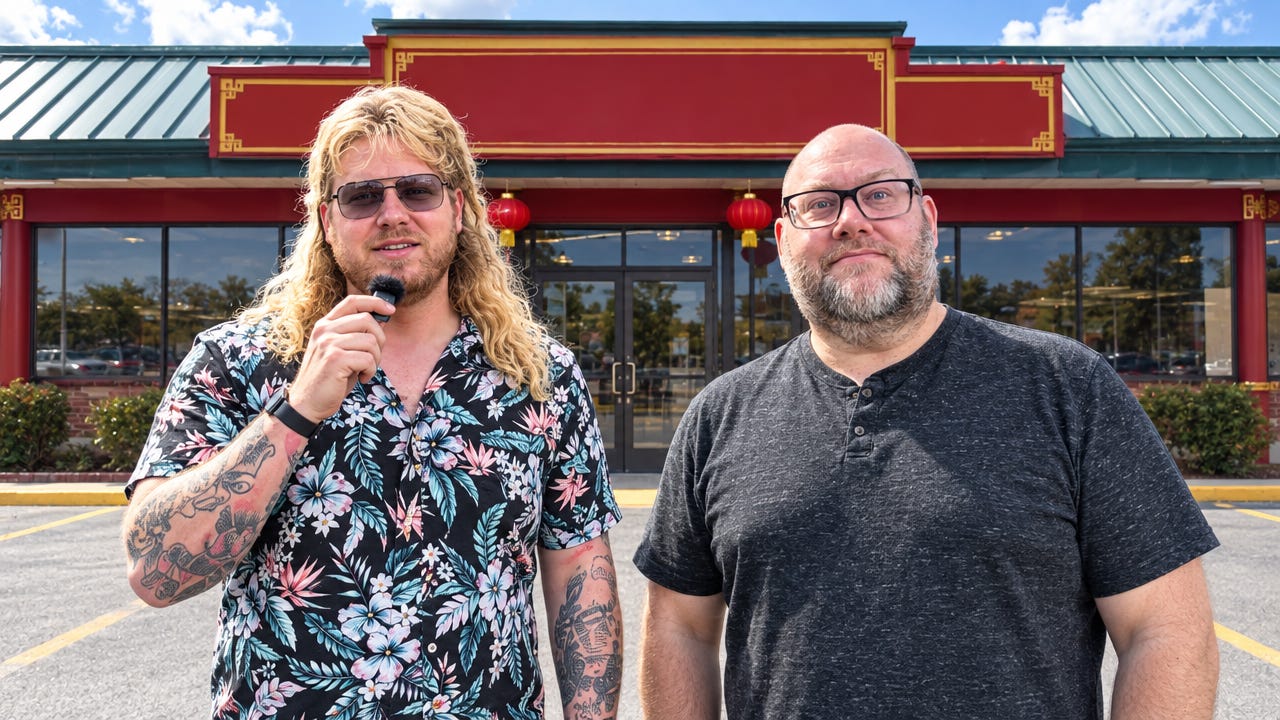
Right now a mulleted-mail carrier in sunglasses and a Hawaiian shirt is more than 100 days into eating at every Chinese buffet he can until he gets food poisoning.
His name is Brandon Elliott.
The internet knows him simply as Mullet Review, or by his self-appointed title, Hot Blonde.
It started in May with him and his mom at a Ginza Buffet in Milford, Ohio, the place they went when he was a kid. Since then he’s worked through some of the most disgusting-looking buffets in Ohio, Kentucky, Tennessee, North Carolina and Indiana. He picks them no matter how shocking their Google reviews are.
Every video runs exactly the same. Introduce the joint. Tell us how much he paid with a long, awkward pause. Then explore the buffet, careful to get the crab rangoons, the pizza, the chicken nuggets and anything that looks wet, disgusting or off-putting. Then he goes to the bathroom and takes his flip flops off.
Finally he delivers a verdict and the challenge lives for another day.
On Day 99, at the Everything OK Chinese Buffet in Frankfort, Indiana, his girlfriend noticed from behind the camera that the peanut butter chicken was raw. 8.8 million views.
He kept going anyway.
When he likes something, it counts. On Day 87 he gave Grand Buffet in Knoxville a rare five stars, for a spread that ran from sushi to spaghetti and meatballs to chicken livers. He spent half the video saying it looked like a Golden Corral in disguise. Locals chimed in. It was a former Golden Corral.
A creator in Chengdu has started copying his format. His review of her review: “99% accurate.”
PENCILS DOWN
André Michelin figured out in 1920 what brands are still paying consultants and agencies to relearn. People trust what costs something.
The Michelin inspector pays in secret. Hot Blonde pays on camera and shows you the number. $33.50 for two in Frankfort.
One wears a suit and a fake name. The other wears a mullet and flip flops.
Neither is selling you the food. The minute Michelin pulled the ads, the guide became worth buying. The minute a food creator takes a comped meal, there is no objective impartiality.
Which is awkward for an industry currently figuring out how much of its content it can let a machine make without ever mentioning it.
Trust was never about the polish. It was always more about the proof you were actually there.
Just look at this guy’s consistency. Same template, same counter, same stacked yellow-and-red headline, over a hundred times in a row. Some brand team will spend their whole budget and not reach the same brand consistency as him.
Plus he still hasn’t gotten sick. The counter keeps going. 110 visits and counting. Who are you really going to trust?
COCKTAIL OF THE WEEK: SCORPION BOWL
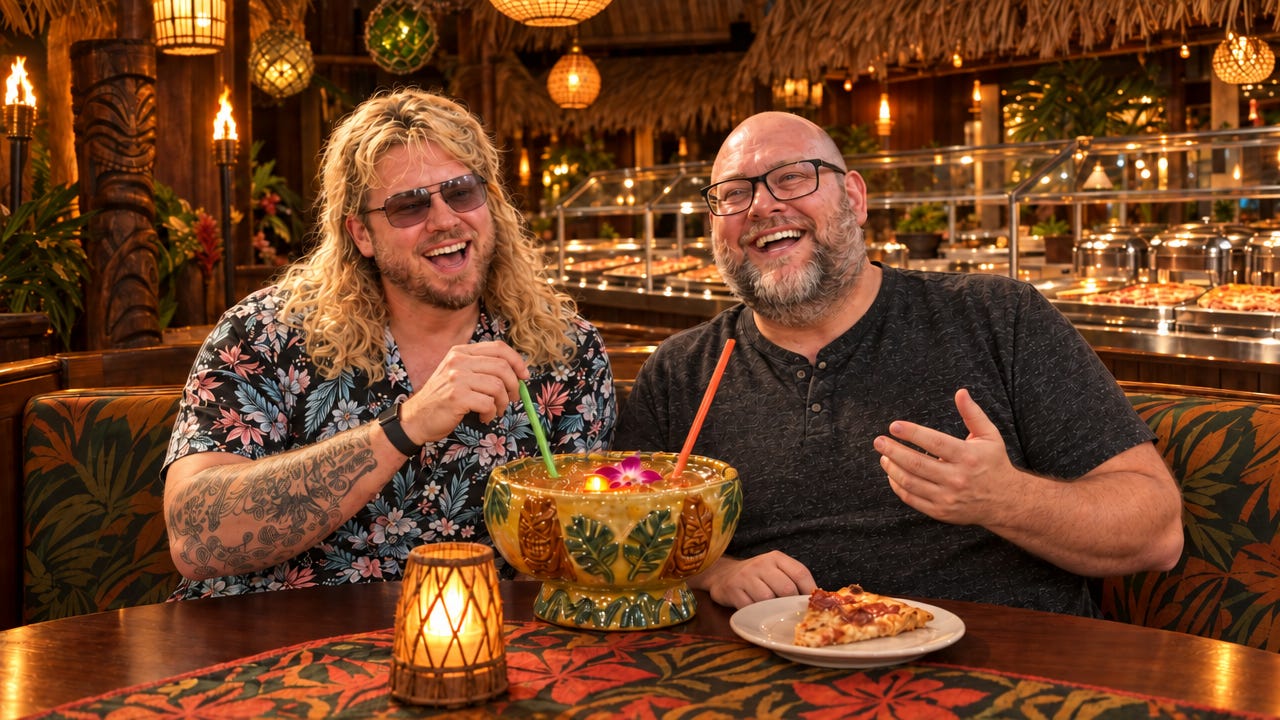
If Hot Blonde ever hits a buffet with a bar, this is what should show up. A giant ceramic bowl painted with hula girls, something orange in the middle and a fistful of long straws for the table.
This is the Scorpion Bowl.
In the late 1930s Trader Vic reportedly tried a version of this classic in Honolulu made with okolehao, a Hawaiian moonshine distilled from ti root. One 1938 Honolulu gossip column describes a party that went through three gallons of the stuff.
Absolutely deadly.
Vic went home to Oakland, swapped the moonshine for rum, put it in a custom bowl and called it his. His 1946 party version had 15 ingredients, including a half a bottle of white wine. It served 12.
From there it spread. When tiki hit the suburbs, bartenders and managers from places like Trader Vic’s, many of them Chinese-American, left to open or run their own restaurants and brought the recipes with them. Supply catalogs sold everybody the same bowl. By 1999 the owner of the Hong Kong in Cambridge was telling the Harvard Crimson that every Chinese restaurant in America had one on the menu.
Nobody ever gave it a star. Nobody had to.
Scorpion Bowl (for the table)
6 oz light rum
1 oz brandy
6 oz orange juice
4 oz fresh lemon juice
1 1/2 oz orgeat
Blend it up with a couple of scoops of crushed ice, pour into the biggest bowl you own, fill with ice and hand out long straws. No orgeat? What are you? A rookie? Fine, almond syrup works. Want some fire? Float a squeezed lime shell, add a splash of overproof rum and light it on fire.
Bibendum would like that. He was always smoking in those early days.
The Drink Cart is the newsletter version of sitting at a really good bar with someone who thinks too much about advertising and won’t shut up about it. Subscribe to get it on Wednesdays and Fridays.
Love the Michelin guide backstory.
Such a great piece (they all are).