


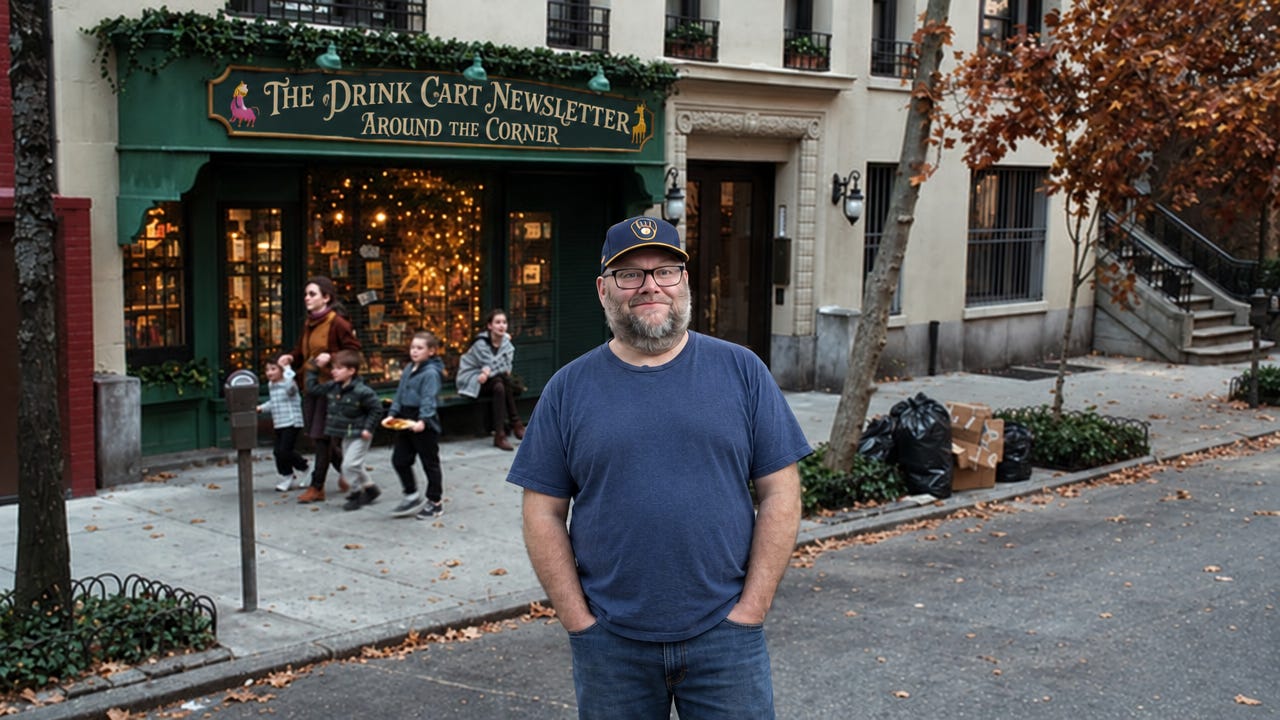
The most famous voice of the ‘90s internet only got paid $200.
Today one of those factory sealed 3.5 floppy disks is going for $65 on eBay.
Elwood Edwards recorded the now iconic (if you’re of a certain age) “You’ve got mail” in 1989 on a cassette deck in his living room. His wife worked for the company that became AOL, overheard Steve Case say the software needed a voice and volunteered her husband. They would have used AI today.
Then his voice went on every AOL disc ever pressed. Edwards said he used to stand in line at CompUSA, look at the towers of free AOL CDs and think his voice was on every one of them and nobody had a clue. He could have been stockpiling 1996 $1000 vintage Troy Aikman AOL disks for his retirement. With no residuals, he later drove for Uber.
Warner Bros. named a movie after his three words and he still only got two hundred bucks.
Funny thing about these newsletters. You show up in someone’s inbox twice a week and talk about nothing. Trapper Keepers. Cranberry logs. Whether Bob Uecker ever really got the front row.
And somehow all this nothing means more to me than twenty years of somethings that came with a brief. This is your fall edition of the Drink Cart Newsletter Around the Corner. You’ve got Drink Cart.
FALL IS A MARKETING DEPARTMENT
You’ve Got Mail is the most fall movie that has ever falled. This is indisputable.
And no, I’m not going to dignify the many links and articles saying Tom Hanks is the villain in this movie. That’s like saying the scion of the Candy Cane fortune in Hallmark is a villain for trying to buy the failing Candy Cane story in a Hallmark movie.
It’s a movie of snappy dialogue, the peak of big box stores, a lot of turtlenecks and a young, almost unrecognizable Dave Chappelle playing a sidekick. There was the iconic dial-up screeching like a fax machine in labor. The now classic Dreams by The Cranberries.
And Meg Ryan as Shopgirl, Tom Hanks as NY152 and Brinkley the dog doing more acting than half the cast.
And the line that explains this entire issue, where Joe Fox asks Kathleen, “Don’t you love New York in the fall? It makes me wanna buy school supplies.”
Of course he did. He owned a chain of big box book stores from the times before Amazon destroyed them all. So Nora Ephron basically wrote a long form back-to-school ad and hid it in a rom-com. Genius level stuff.
The film is a remake of a 1940 movie called The Shop Around the Corner, which is the name of Kathleen’s failing bookstore.
To celebrate this I’ve captured a century of fall ads. The pencils, the pumpkin pie, the fall classic and the coffee.
SEPTEMBER BELONGS TO STAPLES
One of the most famous back-to-school spots ever made is basically a Christmas song. A dad pirouettes down the aisles of a Staples to Andy Williams’ “It’s the Most Wonderful Time of the Year” while his kids trail behind looking like they’re being walked to their own sentencing.
Cliff Freeman & Partners made it in the mid-’90s and it won a Clio and an Effie. Years later Staples Canada did research and found 33% unaided recall linking the song to the store.
Staples brought it back this past summer. The dad still dances. The song still plays. And by the end the kids are smiling, and one of them is holding a balloon. Somebody looked at the best insight in back-to-school advertising and decided to run it again.
Mead launched this nostalgia object in 1978 and has sold more than 75 million of these. Every one shipped with a feedback card that got you a free notebook if you mailed it back. That was a seventh grader’s version of “you’ve got mail,” just with a stamp and a six-week wait.
Teachers banned them for being distracting and too fat for the desks. Two former Mead guys are still fighting over who invented it, which feels like a Fox Books vs. Shop Around the Corner situation with binders.
I’m torn. Us Canadian kids had more of the Hilroy Note Totes and those fine looking Laurentian pencil crayons. Turns out Hilroy shared a parent company with Mead, so we were all buying the same thing anyway.
To give you a sense of the pop culture power these stupid things had on us, just imagine a young Aunt Becky from Full House in one of their ads. You know before the whole college admissions bribery scandal.
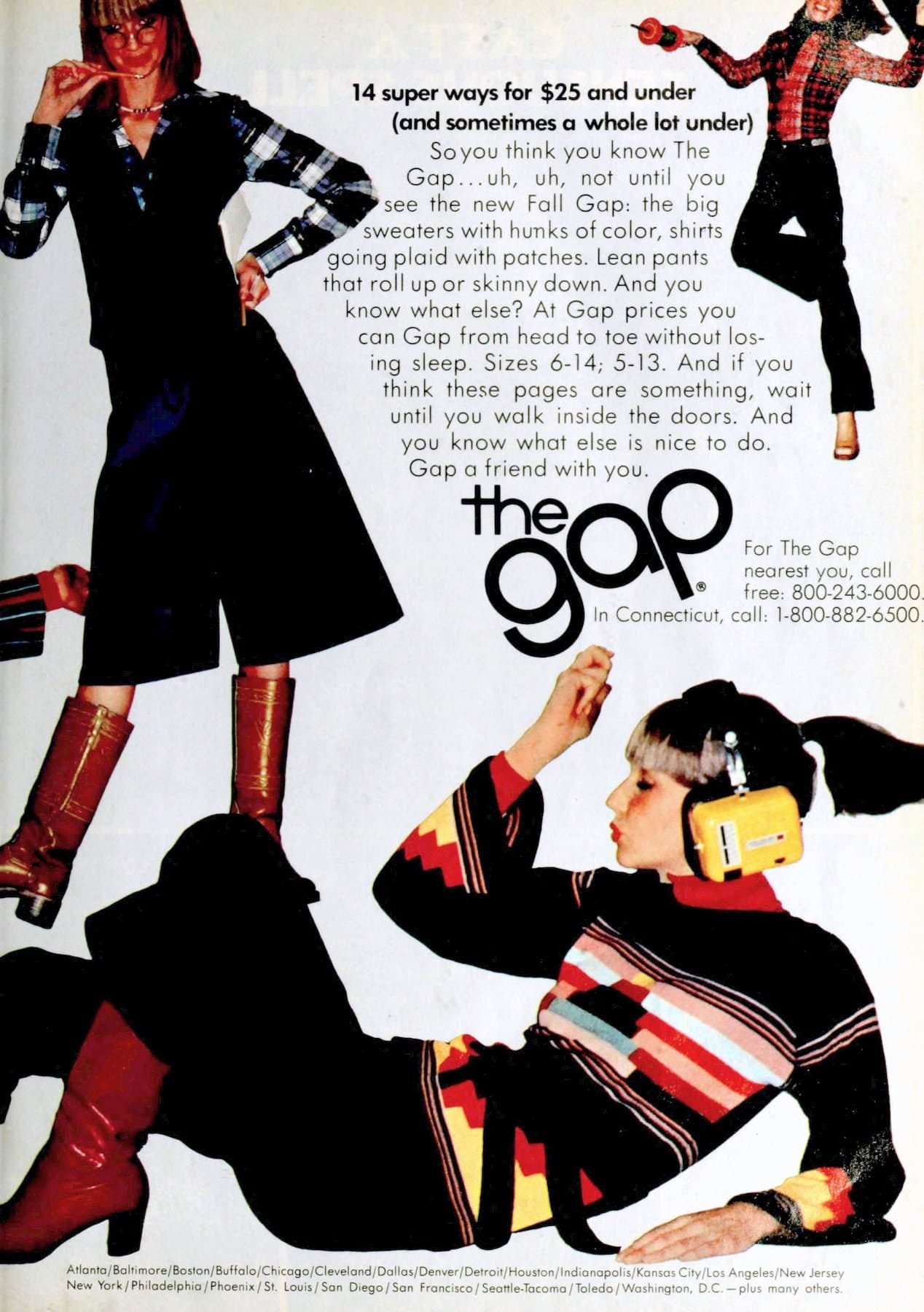
Then there’s the most literal slogan the season ever got: Fall into the Gap. It’s too bad that Doris Fisher named the store after the generation gap, not the season.
Their 1977 fall ads promised big sweaters with hunks of color and plaid shirts with patches, which is basically Kathleen Kelly’s entire closet.
One early print ad was a pair of unzipped jeans over the headline “The Gap is Open.”
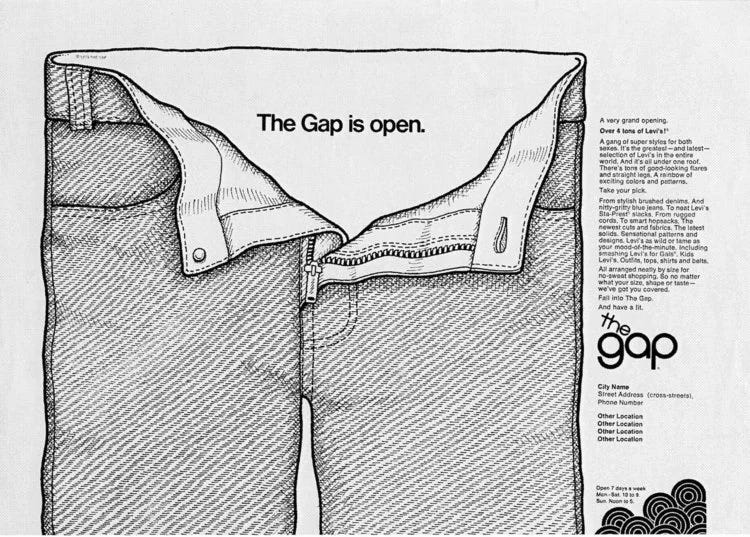
Joe Fox (“Eff-Oh-Ex”) would’ve approved. Kathleen would’ve drafted a strongly worded email, then passive-aggressively not sent it. Her ex partner Frank would’ve written 3,000 words on his typewriter about how the Gap was the end of civilization.
A GODDAMN PIAZZA
Joe Fox has a whole bit about Fox Books being where you go for cheap books and good cappuccino. Technically he said, “we were great. I said you could sit and read for hours and no one will bother you. I said we have a hundred and fifty thousand titles. I showed them the New York section. I said we were a goddamn piazza! A place in the city where people can mingle and mix and be.”
Every fall ad in the grocery store is running the same play. Get people in for the things they need. Sell them the things they don’t. Libby’s figured that out in 1912.
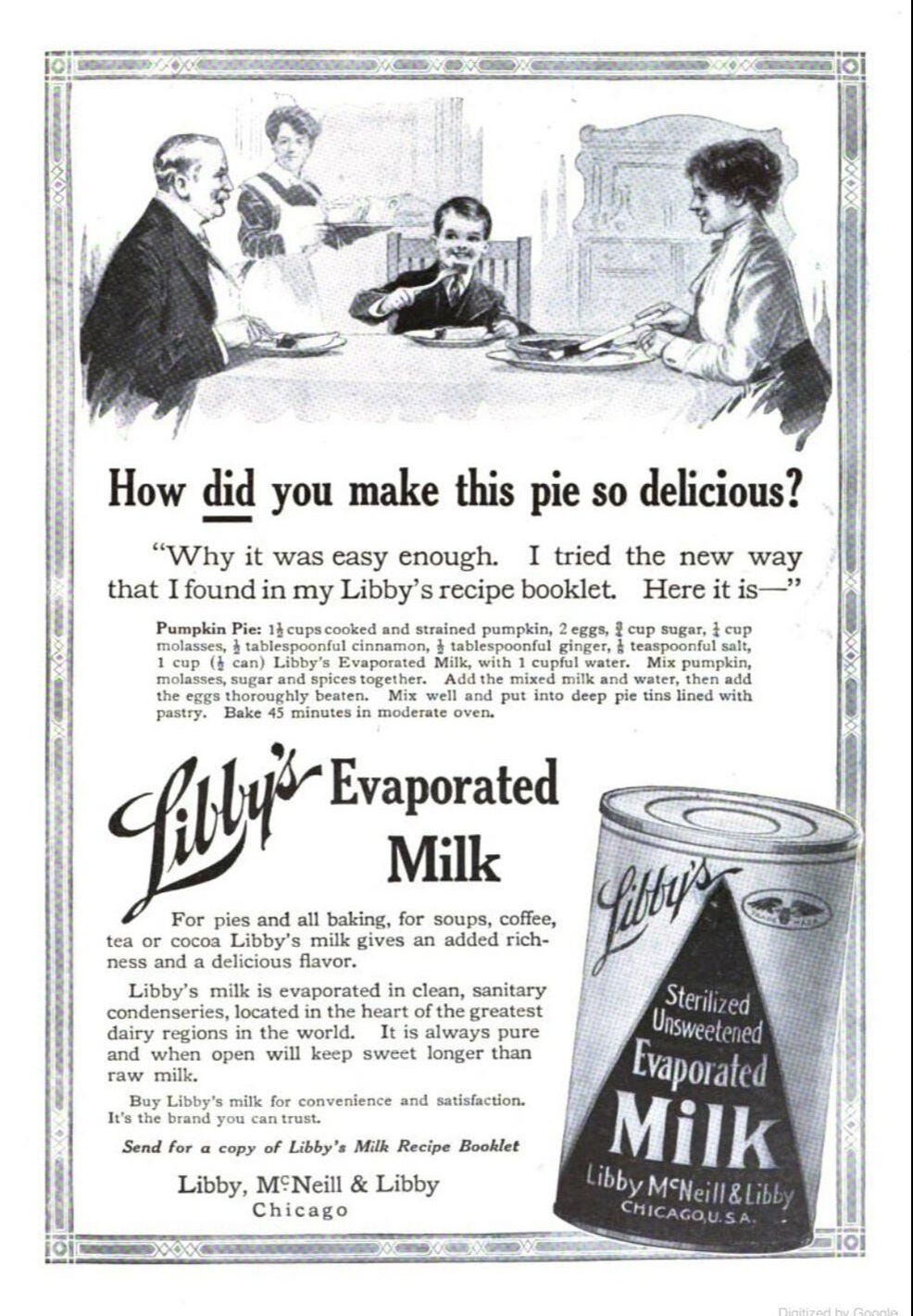
It ran a pumpkin pie recipe as full-page magazine ads to sell evaporated milk. By 1950 it had moved the recipe onto the label, so if you wanted it, you had to buy the can. It’s the original gated content. When Libby’s changed the recipe in 2019 the pumpkin pie community lost its mind. Apparently you never mess with the pumpkin pie people. I’m not sure there has been a Hallmark about Big Pumpkin Pie? Think about it.
It’s hard to believe that Stove Top Stuffing showed up only in 1972. Good old patent number 3,870,803. Just think, out of billions of humans, you have been alive for this.
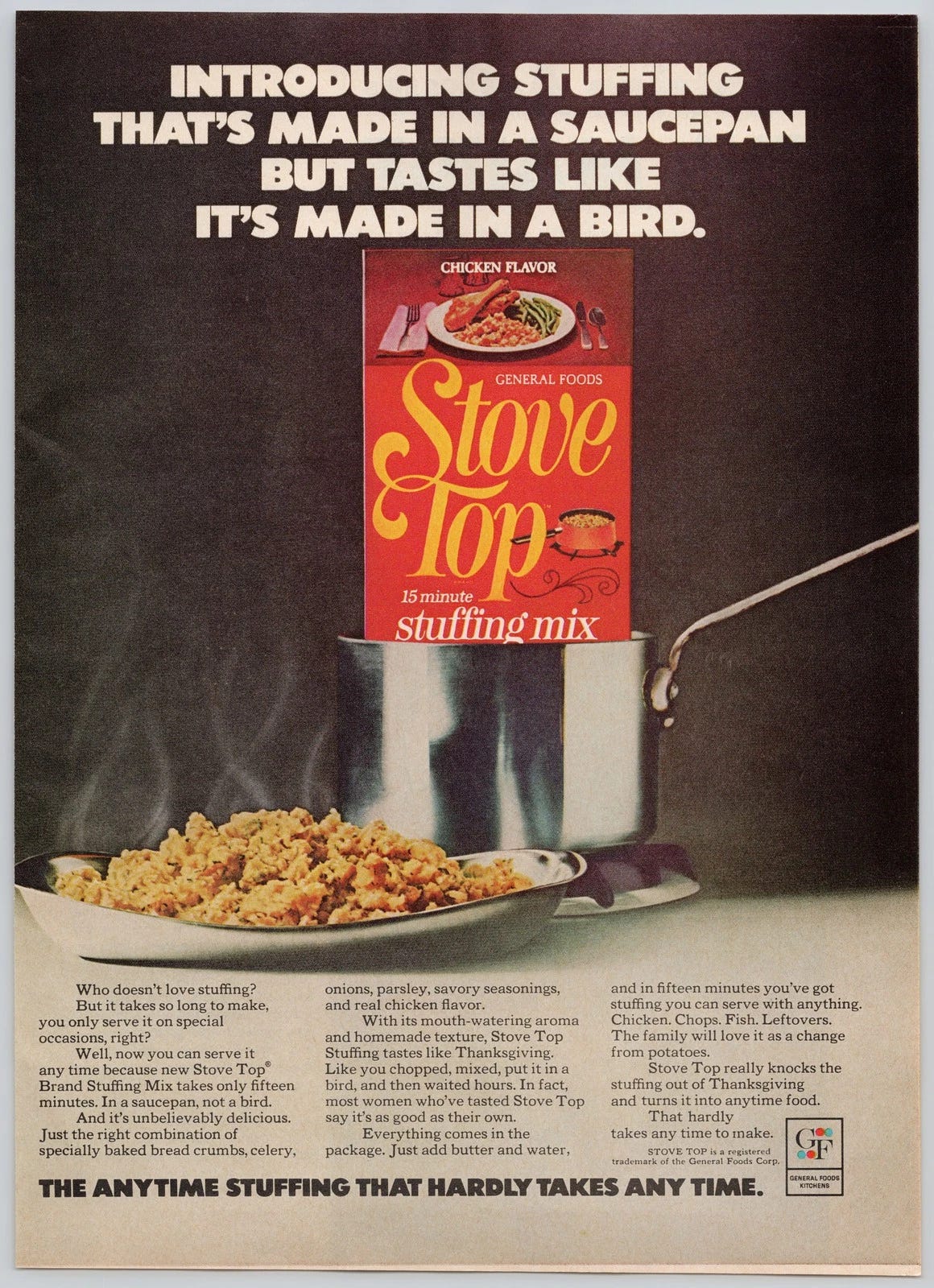
Ruth Siems, the General Foods home economist, worked out the exact crumb size and is first on that patent.
The pitch was simple: have stuffing instead of potatoes. By the mid-2000s Kraft was moving about 60 million boxes every Thanksgiving. That’s actually insane.
A lot of people also swear it was called “Stouffer’s Stove Top.” A classic Mandela effect that probably drove the brand manager off the cliff for decades.
It’s funny since we’ve only really had canned cranberry sauce since 1941, the jellied log that slides out with the can’s ridges still on it. Fun fact: In 1959 a government warning about a weed killer used on some cranberries landed about two and a half weeks before Thanksgiving.
The San Francisco Chronicle ran “A Nation Without Cranberry Sauce!” Cranberry fans in Modesto hung the health secretary in effigy. The White House served applesauce.
The cans are reportedly still packed upside down on purpose so the log slides out clean.
In 1981 Butterball opened a hotline with six home economists, who answered about 11,000 calls that first season. Operators aren’t rated on call volume. Their only job is to answer the question, however long it takes. Every so often they have to deliver the worst news of the holiday, roughly “if it were me, I wouldn’t serve that turkey.”
It’s the most Kathleen Kelly business model in America. Personal, patient, a little old-fashioned and somehow still open.
SHAMELESS PLUG: LIVE, NO DIAL-UP REQUIRED, OCTOBER 29
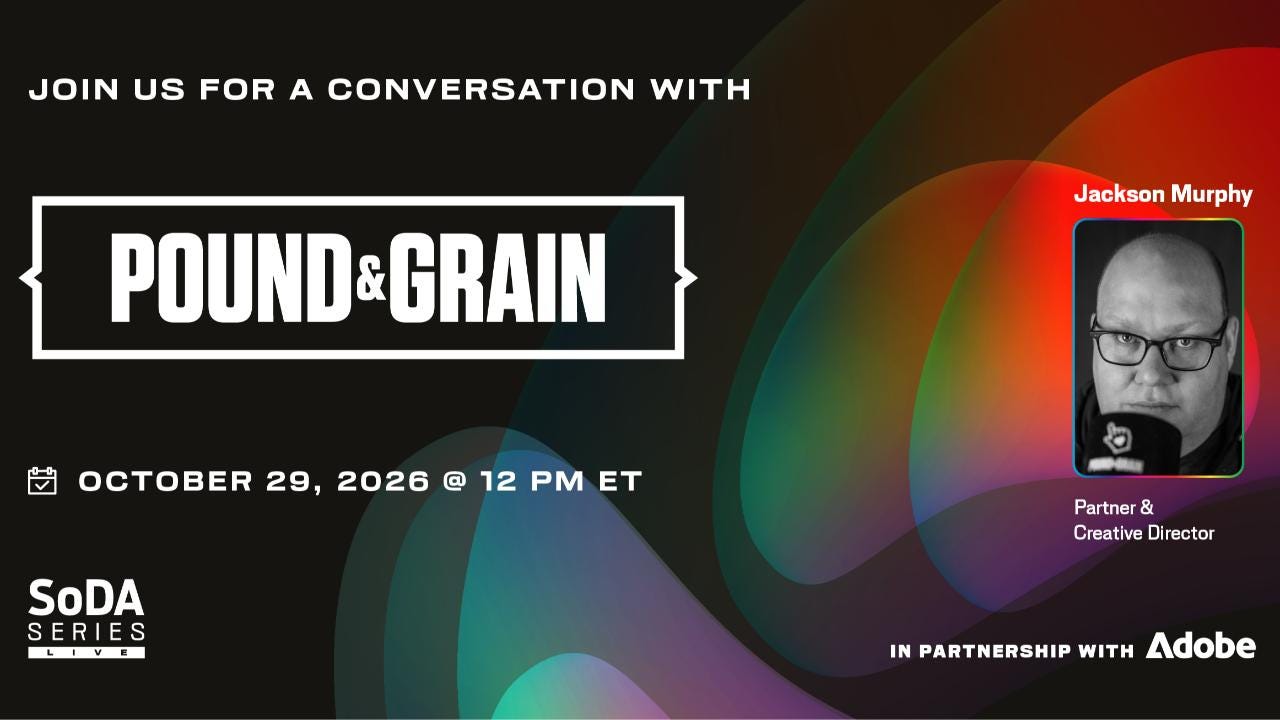
Don’t you love advertising in the fall? It makes me want to talk about old ads on a livestream. Join me on the SoDA Series LIVE with Pound & Grain and Adobe, 12 PM ET.
FALL IS ALSO A BALLGAME
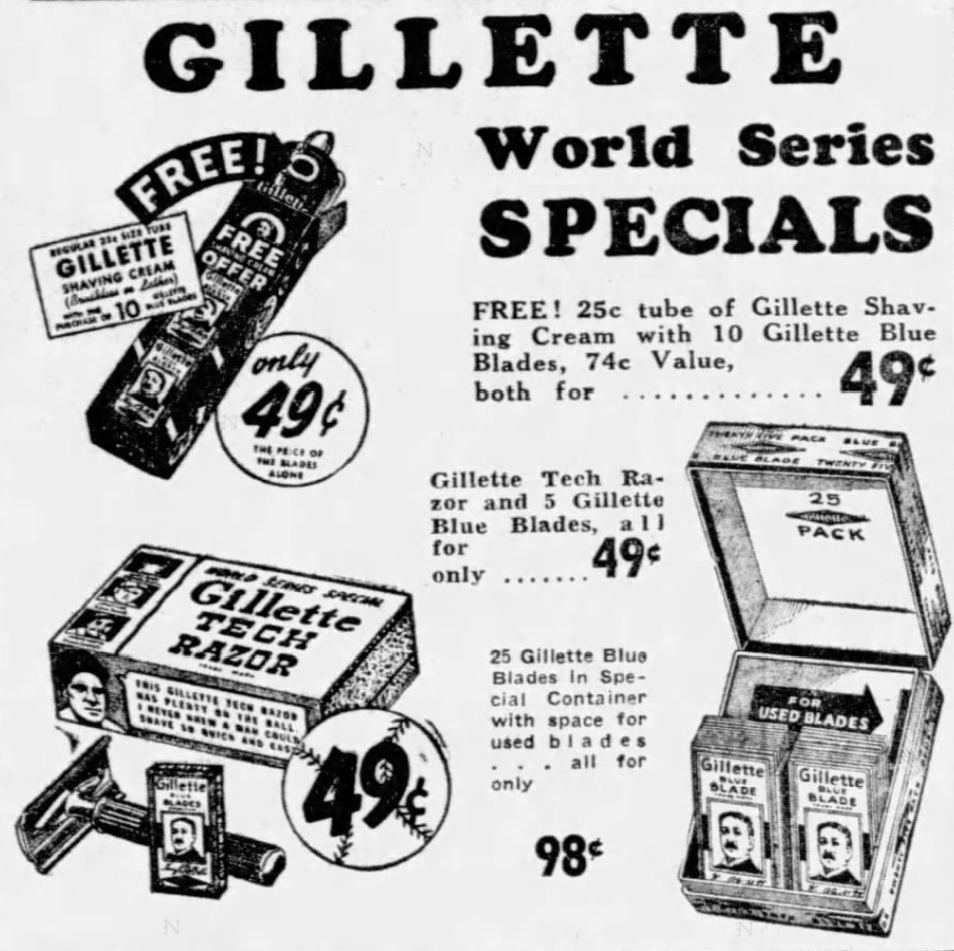
In 1939 a razor company paid $100,000 for the World Series radio rights.
The Yankees swept the Reds in four, and Gillette’s World Series razor sets still sold more than four times what the company predicted.
This move turned into the Cavalcade of Sports, the first televised World Series in 1947 and an MLB sponsorship that lasted until 2018. For about 80 years October was brought to you by a brand that just wanted you to shave.
Another brand that leveraged baseball and football was Miller Lite. They figured out how to sell diet beer to guys by never saying diet. McCann’s research found the old low-cal beer was a hit with blue-collar drinkers, so art director Bob Lenz went looking for a retired athlete.
They rented a Manhattan bar for three days, and nobody scripted the line that built the entire category. Late on day three Matt Snell said Lite was everything you ever wanted in a beer “and less.”
The creative director later admitted low-cal was seen as a sissy product. “Less filling” was genius, it meant you could drink more of it.
Then in 1984 Miller wanted Bob Uecker. Problem: Pabst sponsored the Brewers. So Uecker went to Bud Selig, they gave Pabst a shot at matching, Pabst couldn’t, and Uecker went rogue.
That gave us the greatest baseball ad line of all time, “I must be in the front row,” and the cheap upper-deck seats in Milwaukee that are still called Uecker seats. It’s also how he got cast as Harry Doyle in Major League. When he died in January 2025, fans left cans of Miller Lite at his statue.
Last Thursday the Brewers swept the Dodgers and are going to the World Series for the first time since 1982. Uecker was behind the mic on that run. He’d been the voice of the team since before most of the roster was born, and this is the first time they’ve made it back without him in the booth.
Somewhere up in the last row of the upper deck there’s a bronze Bob Uecker statue with the worst seat in the house and the best view of the whole thing.
THE STARBUCKS PROBLEM
You’ve Got Mail has the most famous anti-chain rant in rom-com history. Joe Fox explains that Starbucks exists so people with no decision-making ability whatsoever can make six decisions just to buy one cup of coffee.
Then the anti-chain movie keeps sending its characters to Starbucks. Over and over. Roger Ebert said you never once think “product placement,” because you can’t imagine them anywhere else. That’s the best review a placement has ever gotten. The actual store at 81st and Broadway has since closed, which feels like something Kathleen would write about too.
That rant is from 1998. Five years later Starbucks gave everyone a seventh decision.
The Pumpkin Spice Latte started as a 2003 test in 100 stores in Vancouver and Washington, D.C. It almost lost to chocolate caramel, and the working name was the Fall Harvest Latte.
Peter Dukes and his team poured espresso over pumpkin pie and ate it in a room called the Liquid Lab. Today Starbucks runs a private Facebook group called the Leaf Rakers Society, where about 42,000 people celebrate fall year-round. Fall now starts in August. Joe Fox would have hated all of it and ordered two. I just saw a post about pumpkin spice sausages.
The movie ends in Riverside Park in the fall. Brinkley runs in, Kathleen finds out who NY152 is and says she wanted it to be him. Twenty-eight years later, you just want it to be fall every time.
COCKTAIL OF THE WEEK: THE COFFEE COCKTAIL
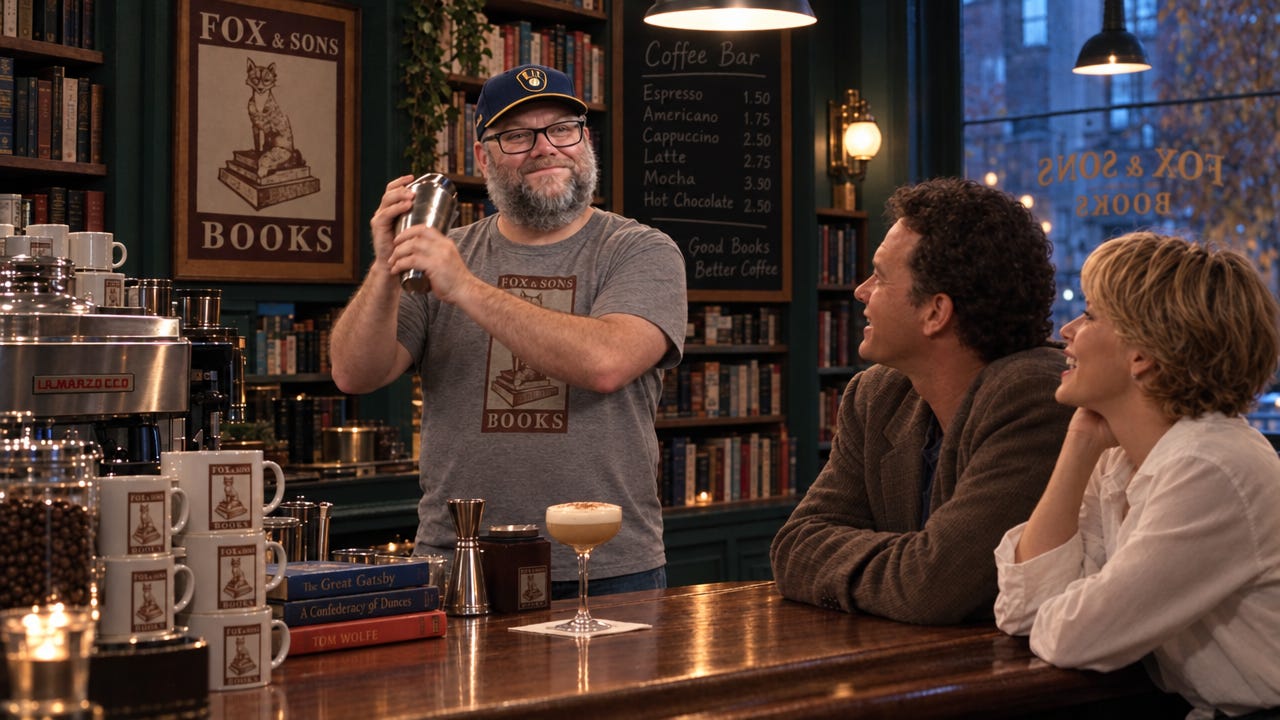
Joe Fox thinks the problem with coffee is too many decisions. Here’s a coffee with zero decisions and technically no coffee.
The Coffee Cocktail goes back to at least the 1880s. It shows up in Jerry Thomas’s 1887 Bar-Tender’s Guide, where Thomas admits the name is a misnomer and says it’s called that because it looks like coffee when it’s made properly.
This is port, brandy, sugar and a whole egg, shaken until it turns the color of a café au lait. Cocktail historian David Wondrich points out it was also the first popular “cocktail” to skip bitters, so the name is wrong twice.
One account credits a New York bartender called “Major” Flynn at the Shakespeare Inn on Broadway, about 70 blocks downtown from where Joe Fox ordered his tall decaf cappuccino.
It’s the original Pumpkin Spice Latte. A drink named after a flavor it doesn’t have.
2 oz tawny port
1 oz cognac
1/2 oz simple syrup
1 whole egg
Dry shake hard without ice, then shake again with ice. Strain into a small wine glass and grate fresh nutmeg on top.
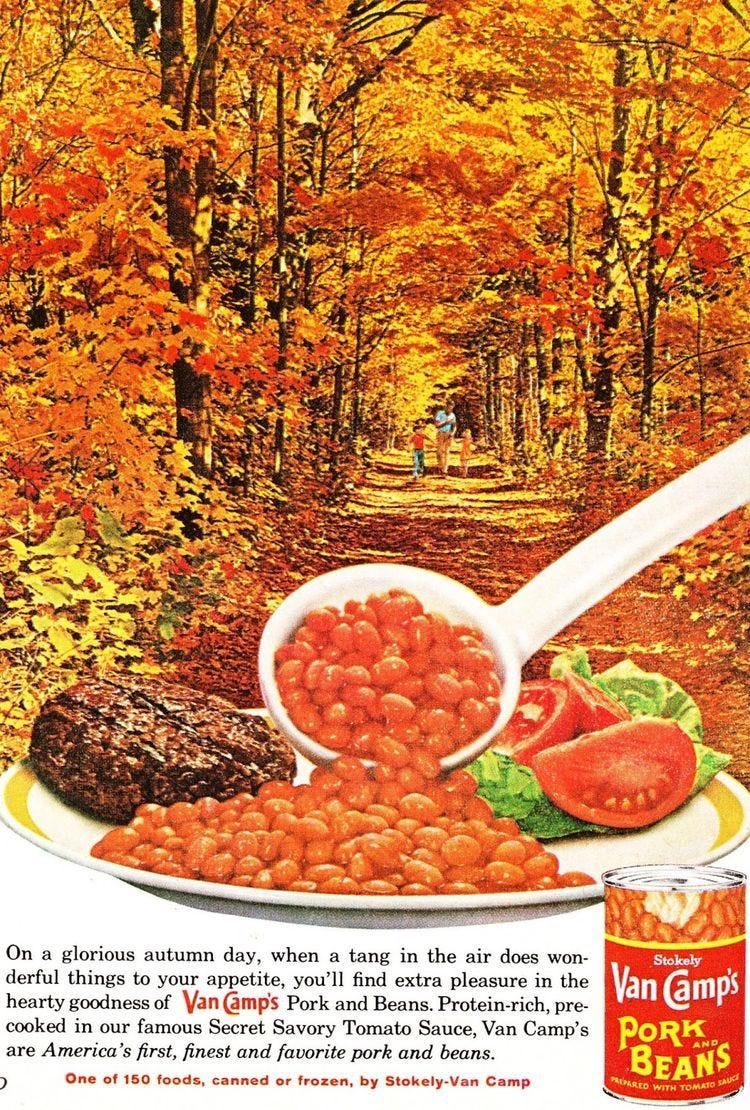
Kathleen Kelly would’ve walked through these exact leaves in a cardigan, waiting for an email. Van Camp’s had other plans. “A tang in the air does wonderful things to your appetite.” That tang is the giant ladle of beans hovering over the forest. That poor unsuspecting family.
The ads you remember. The stories you don’t. The Drink Cart is written by a former bartender with over 20 years in advertising who won’t shut up about either. Subscribe for the stories behind the ads you grew up on, every Wednesday and Friday.