

Big week for people who get to do marketing in this country.
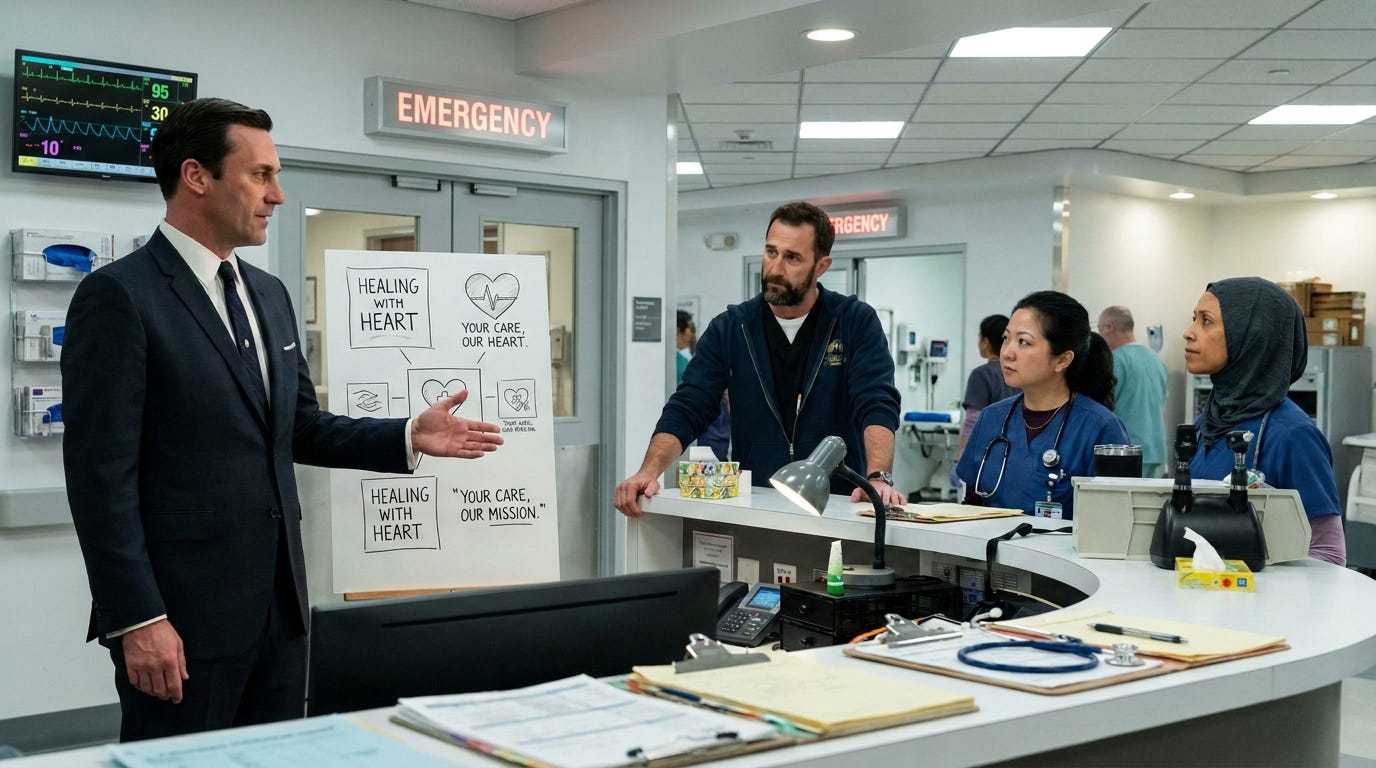
I read news that Kate Torrance left SickKids after eleven years running brand to become chief brand and growth officer at CAMH.
What a strange sentence to read. Fundraising I get, hospitals have always passed the hat. But hospitals now have brand departments competing for share of donor wallet like they’re launching a new condiment?
A health care system that needs brand strategy departments quietly undermines the whole idea of free health care doesn’t it?
Somebody should pitch it to HBO and The Pitt. Fifteen hours of trauma cases, then a marketer from the brand team walks in to present the refreshed visual identity in the ER. Who are we kidding, i’d watch.
Meanwhile in Ottawa, word leaked the government is considering former NDP leader Jagmeet Singh as CEO of Destination Canada.
They say the job brings in a billion dollars of economic activity. A massive annual salary.
And they want to appoint a former politician with zero marketing experience. A man who lost three straight elections as leader? A man whose biggest accomplishment was propping up the Liberal government long past its expiry date.
I wouldn’t normally say this, but there must be better qualified people than this?
Which brings me to the strangest marketing job in history.
A job where the only qualification was looking believable doing nothing.
The Maytag repairman.
Advertising’s best fake employee. And the decades his company spent making a complete liar out of him.
A CAMPAIGN BUILT ON NOTHING, LITERALLY
By the early 60s every washing machine did the same thing. Same cycles, same boxes, same white enamel.
Leo Burnett Chicago had been running a cute dependability campaign for Maytag since 1961 using real customer testimonials. In Canada they had a radio call-in show where a repairman answered appliance questions live on air.
Then according to agency legend, in 1967 a Burnett copywriter named Vincent Vassolo found the sharper idea.
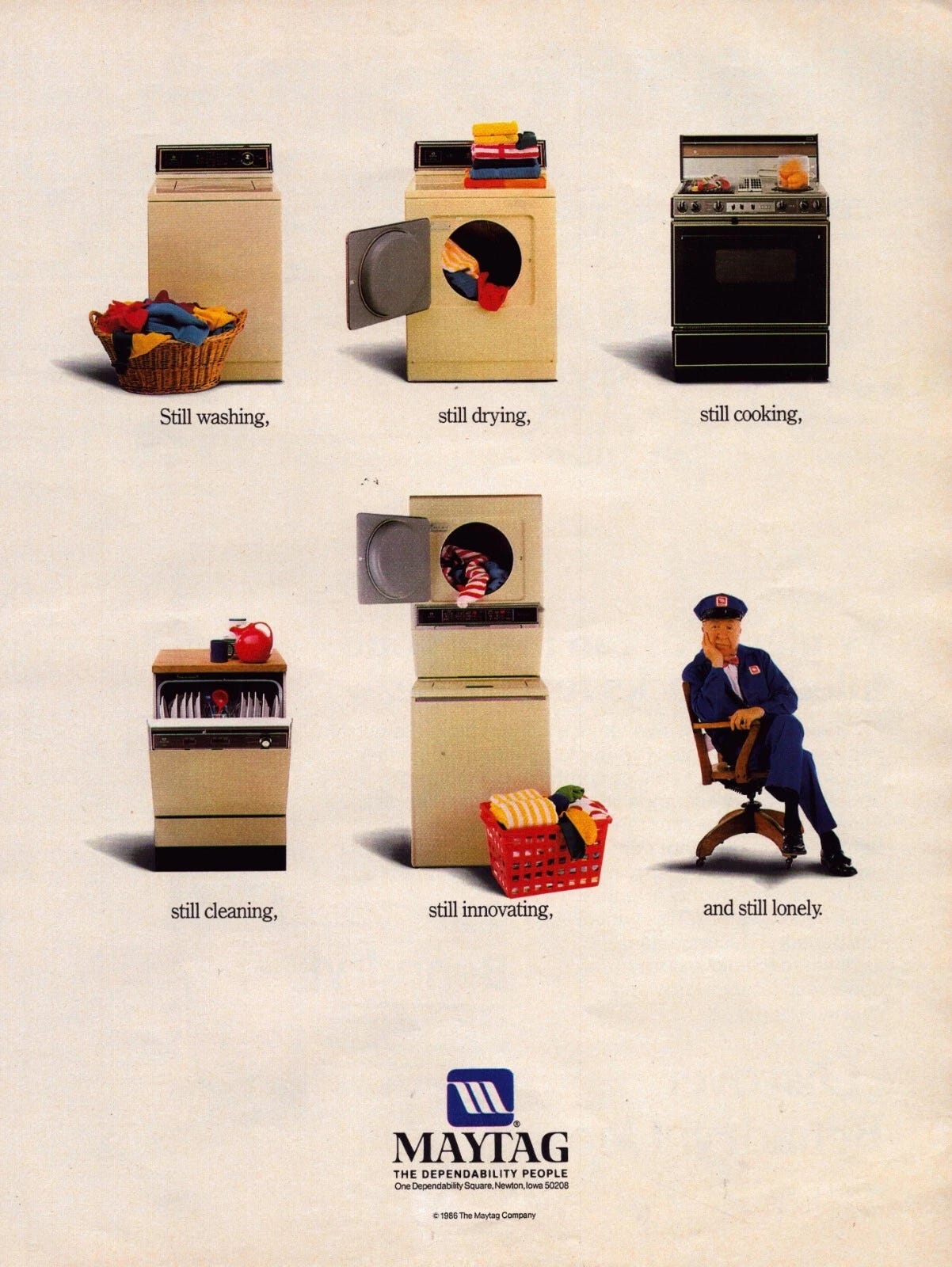
Don’t show the machine working. Show the consequence of the machine working. A repairman with no repairs.
They called him Ol’ Lonely. The loneliest guy in town.
At the same time Burnett was selling Marlboro with a cowboy who represented everything a smoker wanted to be. Maytag got the better gig. A man who represented everything the product made unnecessary.
It worked. Maytag charged a premium for decades on the strength of a guy playing solitaire.
THE MAN IN THE UNIFORM WAS AN ACTUAL LEGEND
The original Maytag Man, Jesse White, wasn’t some casting-call rando. He originated the orderly in Harvey on Broadway in 1944. Dozens of films. Hundreds of TV appearances.
Then 68 commercials over 21 years. Crosswords. Solitaire. Bead work. A phone that never rings. The man was unbothered, moisturized, in his lane before any of us had the words for it.
In 1986 the campaign made its boldest swing in two decades: they gave him a dog. A basset hound named Newton, after headquarters in Newton, Iowa. An emotional support animal for a fictional employee. Now the loneliness had a witness, and the witness also looked depressed.
White’s last TV appearance before he died in 1997 was an episode of Seinfeld. Half a century in show business and the uniform is the whole obituary. That’s what a great campaign does to an actor — it eats everything else on the resume.
EVERY MAN WHO WORE THE PATCH
1967–1988: Jesse White. The original. 68 commercials, one facial expression of magnificent defeat.
1989–2003: Gordon Jump. Arthur Carlson from WKRP — the man behind the greatest turkey drop in broadcast history. As God is my witness, he thought the washers could fail. And if you’re a Jump Maytag era fan, you can pick up a rare autographed t-shirt. Just $28.
2003–2007: Hardy Rawls. The bridge era. The Pierce Brosnan of appliance spokesmen — did the job fine, nobody’s favourite.
2007–2014: Clay Jackson. Whirlpool ran a nationwide open casting call. Two thousand people showed up. The winner: a Richmond real estate agent who auditioned on a whim. American Idol for a fictional appliance technician, and a real estate guy won.
2014–present: Colin Ferguson. The gritty reboot. Slimmer, tailored uniform, dimple chin and — the important part — no longer lonely. The new Maytag Man doesn’t wait for repairs. He IS the machine. Sits under the sink. Tumbles laundry in midair. Full method.
MEANWHILE, BACK AT MAYTAG
Here’s what was happening behind the man with nothing to do.
In 1992, Maytag-owned Hoover UK ran what’s now formally studied as the worst sales promotion in history. Two free round-trip flights — eventually to New York and Orlando — with any £100 purchase.
The math was not mathing. Over 600,000 claims. Flights cost more than the products earned. One customer whose new washer broke held the Hoover service van hostage in his driveway. Maytag fired three executives and paid out roughly $72 million.
The dependability company. Undone by its own marketing incompetence.
Then the product followed. The late-90s Neptune washers grew mold, failed constantly and triggered a class action covering more than two million consumers — while the ads still promised the repairman had nothing to do.
He had plenty to do.
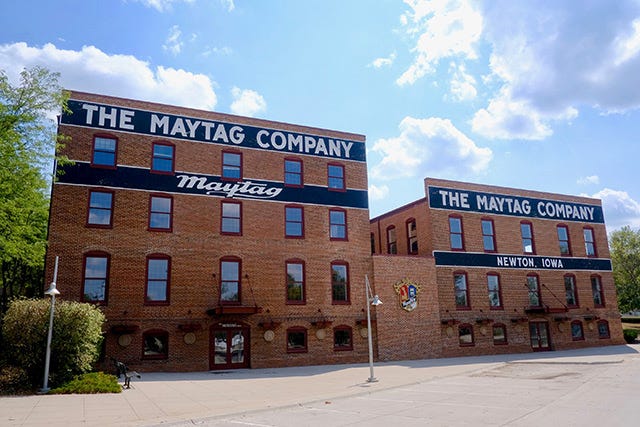
By 2006, Whirlpool bought the company for $1.7 billion, closed the Newton plant that had anchored it since 1893 and cut 4,500 jobs. The saddest part: the town the dog was named after lost the factory.
Which brings us back to 2014. When the new Maytag Man stopped being lonely, the official line was modernization. Read it again knowing the history. You can’t run “you’ll never need a repairman” after Neptune. The loneliness only works if it’s true. So they retired the promise and kept the uniform. Changed the subject and hoped nobody checked the lore.
Ferguson’s still out there. Twelve years in, fronting Maytag Month promos and working appliance trade shows in character as the human embodiment of a Maytag fridge.
And with companies like Dos Equis un-retiring the Most Interesting Man after eight years, legacy mascots are getting dusted off everywhere. Don’t be shocked if Whirlpool eventually asks the obvious question. The machines break now. The loneliness is available.
AD LESSON
A promise-based brand is a loan against the product. Maytag borrowed against dependability for decades, and the campaign was so strong it kept making payments long after the company defaulted. Historians compare it to Schlitz — a brand kept breathing by advertising alone after the product gave out.
Usually told as a branding triumph. It’s also the warning. When the gap between promise and product becomes so big, it’s like the aircraft carrier commander, call sign Stinger if you don’t remember, in Top Gun telling Maverick, “your ego is writing checks your body can't cash.”
Nobody sues the brand that never made a claim.
The campaign was never the problem. It was perfect. That’s what made the rest of it so expensive in the end.
COCKTAIL OF THE WEEK: THE RUSTY NAIL
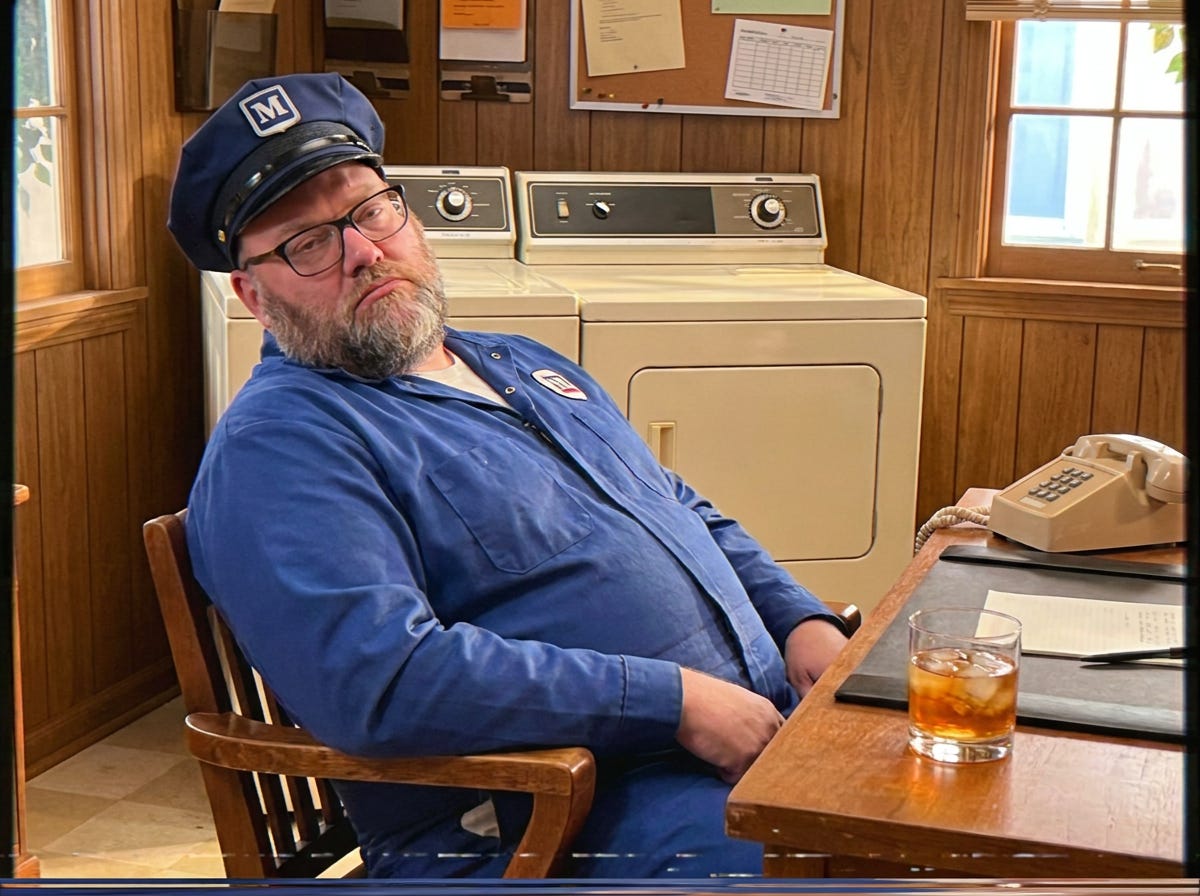
A drink for a repairman with nothing to fix.
Tool name, two ingredients and no moving parts.
Scotch and Drambuie, that’s it, and its cultural peak lands exactly on Ol’ Lonely’s debut. The origin’s disputed, like every good cocktail’s. The recipe knocked around for decades — one claim traces it to the 1937 British Industries Fair — until the Rat Pack adopted it at the 21 Club and Drambuie’s own chairwoman, Gina MacKinnon, blessed the name in 1963.
The Rusty Nail
2 oz blended Scotch
3/4 oz Drambuie
Lemon twist, optional
Stir with ice, strain into a rocks glass over one big cube. Express the twist if you’re using it.
The Drink Cart is the newsletter version of sitting at a really good bar with someone who thinks too much about advertising and won’t shut up about it. Subscribe to get it on Wednesdays and Fridays.
These Friday newsletter alway remind me how influential advertising was in my childhood. The mascots and spokesmen are endless!