

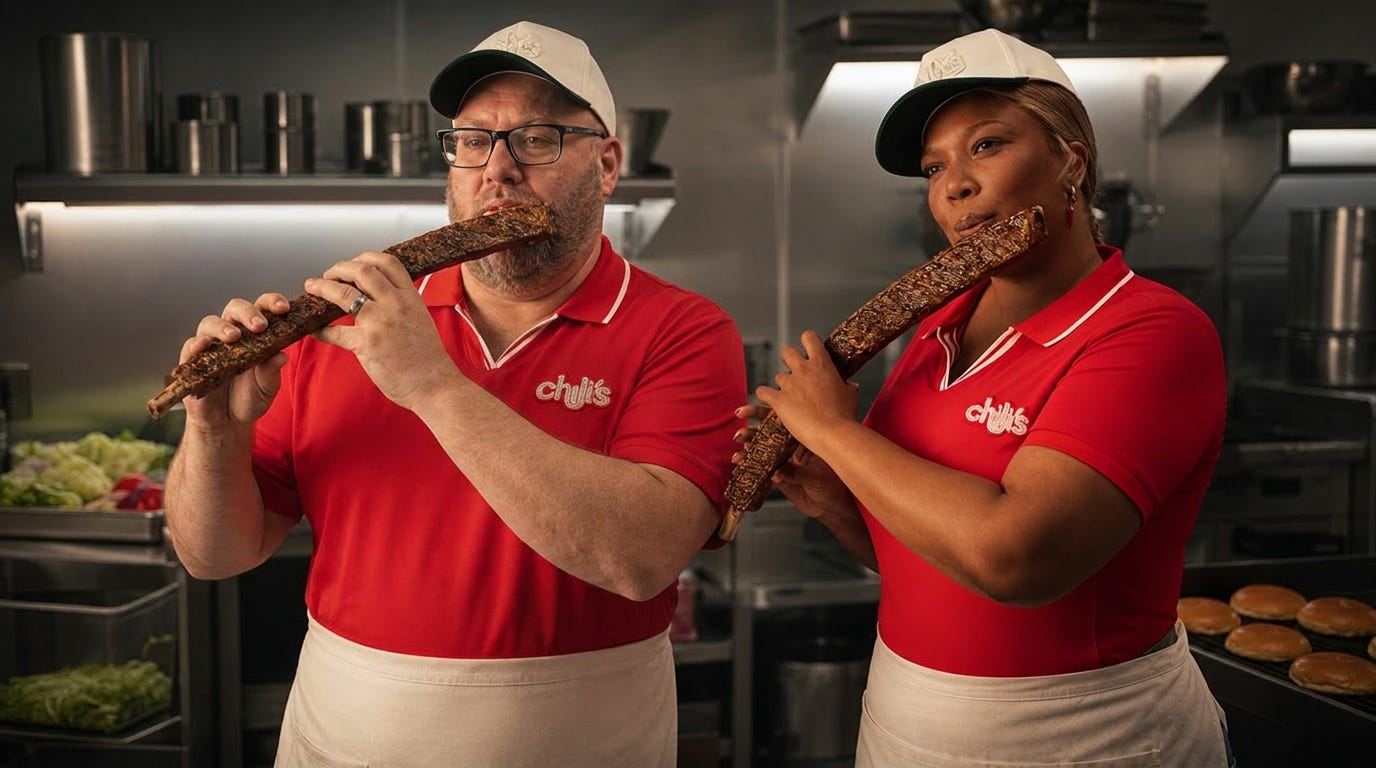
I’m not sure how I expected my week to go. But when AI said this to me about to make the image above, I knew I might be on the right track.
“I have started generating the cinematic still of the soulful rib-flute duet. The image will feature the man from your reference photo on the left alongside a partner at the prep line, both dressed in red Chili’s polo shirts and focused with absolute, reverent concentration as they perform their pork-flute duet.”
-
Let’s begin where any serious analysis of modern advertising must begin.
Someone fabricated a flute in the shape of a baby back rib.
A woodwind you could carry into an actual orchestra, shaped like a slab of pork you’d order with a side of fries.
Someone designed it. Someone approved it. Someone, presumably a grown adult with a mortgage and a dental plan, spent a full workday making sure the finger holes were spaced correctly on the pork flute.
Then a four-time Grammy winner raised it to her lips and played it. Like angels whispering in our ears.
All for a casual dining chain best known for unlimited chips and salsa.
I need you to sit with how stupid this is.
The stupidity is the entire argument.
It’s the whole theory. Stay with me.
THE RIB FLUTE IS THE MOST IMPORTANT OBJECT IN ADVERTISING THIS YEAR AND I WILL NOT BE TAKING QUESTIONS
We’ve spent decades canonizing the ads that reach for something bigger than the product.
Coca-Cola gathering a hillside of strangers to sing about world peace.
Budweiser sending its Clydesdales to bow at the Manhattan skyline after 9/11. An ad that aired exactly once, because airing it twice would’ve cheapened it.
Apple casting a sledgehammer-wielding runner as the savior of human freedom in a Ridley Scott epic that turned a computer launch into the fall of Big Brother.
World peace. National grief. Human liberty. This is the most hallowed shelf in the business. These are the ads we hand down like scripture.
And here comes Chili’s with a flute carved to look like a rib, and it is more alive than any of that.
That’s not an accident. That’s a brand remembering what it is.
Chili’s is not a cathedral. Chili’s is a place where the 1,150 calorie lava cake arrives with a hardened crown of chocolate.
The correct register for Chili’s is not reverence. It is a pork-shaped woodwind solo.
They found the exact frequency of their own ridiculousness and they tuned an instrument up to 11 on it.
BEFORE THE JINGLE YOU KNOW THERE WAS ONE YOU’VE MERCIFULLY FORGOTTEN
Here’s the part that makes the whole thing funnier. This wasn’t Chili’s first swing at singing about ribs.
Back in the mid-80s, when baby back ribs were a new menu item, Chili’s ran an earlier spot. A bluesy, sax-soaked number where a voice croons “I love my baby, baby, baby back ribs” before sliding into spoken word about how they smoke ‘em and char-broil ‘em “right down to the bone.”
It is, by every available measure, un-haunting. You could not get it stuck in your head with a staple gun. Nobody remembers it. Nobody has ever hummed it on purpose.
Sit with that. The first attempt at the exact same idea was competent, professional and completely forgettable.
The version that colonized the American brain for thirty years was the one the creative director was ashamed to put his name on.
A MAN WROTE THIS AND HAS SPENT THIRTY YEARS HOPING IT ISN’T HIS LEGACY
You need the origin story the same way Batman insists on telling his every time they reboot the franchise.
The jingle came out of GSD&M in Austin in the late 90s.
Guy Bommarito was the executive creative director. “A Don Draper for the Southwest Airlines and Chili’s set,” wrote Vice. Bommarito loathed jingles on principle. He’s called them the lowest common denominator of the entire craft. Annoying. Unpleasant. The kind of work serious people avoided.
So when Chili’s demanded a tune for people to chew ribs to, Bommarito was so embarrassed by the assignment he refused to hand it down to his own department.
He wrote it himself. It took about five minutes. He got a lackluster green light, figured it would vanish in six weeks and moved on with his life.
Ron Howard Voice: It did not vanish.
And here is my favorite fact in the entire saga: Bommarito does not even like the ribs. Has barely eaten them. He once went on the record hoping that this jingle would not turn out to be the greatest achievement of his life.
A man actively rooting against his own masterpiece.
There is no purer artist in America.
THEY CARRIED IT TO A FUNERAL IN A SMOKER-SHAPED CASKET
Ad Age named it the song most likely to get stuck in your head. Number one. Above songs by people who were trying.
It’s hard to forget Fat Bastard singing it in Austin Powers: The Spy Who Shagged Me.
A fictional obese Scottish henchman did more for Chili’s brand recall in 1999 than most agencies manage in a fiscal year.
It’s harder to forget Willie McCoy. The deep bass voice behind the “barbecue sauce” that holds the whole song together.
When he passed, his funeral was filmed for the pilot of a TLC show called, with no irony whatsoever, Best Funeral Ever.
The send-off included pallbearers crooning the Chili’s jingle, a multi-tiered barbecue sauce fountain, dancers brandishing platters of fake ribs and a casket built to look like a smoker. Trust me, once you know this, you can’t not be thinking about it.
A man received a Viking funeral for a rib commercial. And he earned it.
America was so thoroughly convinced Boyz II Men sang the original that when Chili’s wanted to revive it in 2023, they just hired Boyz II Men, making the false memory retroactively true.
The actual a cappella version from the 90s was Take 6. Doesn’t matter. The country misremembered a pork ad with such collective conviction that the brand went back and cast the group everyone hallucinated.
THE ENTIRE THEORY: STUPIDITY TIMES CONVICTION
Here’s what I actually believe, and I believe it harder the longer I stare at the rib flute.
The reason most “fun” advertising dies on contact is the flinch. The half-step. The brand wants to be silly but also needs you to know it’s smarter than the silly thing it’s doing — so it winks. Winks are the worst. Nobody likes winks.
It puts the bit in air quotes so nobody can accuse it of trying too hard. And the air quotes are death. Air quotes are how a brand announces it’s embarrassed.
An embarrassed brand is a boring one.
The rib flute never flinched. Nobody on that set reached for the air quotes. Somebody engineered a functioning instrument in the shape of a barbecued bone. Somebody defended that line on a budget. And a freelance crew that genuinely calls itself It’s Advertising Time — a name I refuse to believe is real, and yet — shot the whole thing dead straight.

So here’s the Rib Flute Universal Theory of Advertising, and you can have it for free. The power of an idea equals how dumb it is multiplied by how completely you commit to it.
Half-commit and the dumbness just sits there and embarrasses everyone in the room.
Commit all the way: real budget, straight face, custom tooling and the dumbness converts into something people quote for thirty years.
The flute isn’t good despite the stupidity. The flute is the stupidity.
I know this because at some point in the last year in a deck I pitched the idea of steak pants. Actual pants. Themed to steak. I stood in a Teams call and argued for a pair of steak pants with a completely straight face, because the instinct was the right one. unhinged committed, unflinching. And I got to say “About Steakin’ Time.”
I won’t tell you how that pitch went. I’ll only tell you that Chili’s just shipped a rib flute, and I am sick about it in the most admiring way possible.
I wish I’d asked for a rib flute years ago.
Lizzo could have phoned this in. Instead she treats a thirty-year-old rib jingle like a single off the album.
Shot-for-shot callbacks to the original spot. A full a cappella rendition where she sings every part herself. The reverence is total. She did not come to dunk on the dumb thing. She came to honor it harder than any reasonable person would, and then she pulled out the pork flute.
That’s the highest form of the craft. Not the manifesto. The total, unembarrassed, fully commitment to an idea so dumb it loops all the way back around to magnificent.
We take the most disposable object imaginable and we build a cathedral around it.
Which, conveniently, is also the entire history of this week’s drink.
PETA MADE A PROTEST VIDEO AND THAT IS HOW YOU KNOW THE RIB FLUTE WORKED
Here’s my favorite piece of evidence. PETA made content about the rib flute.
Somewhere a PETA staffer clocked in, got assigned the rib flute, sourced stock footage of pigs in cages and cut it against Lizzo’s solo.
Somebody wrote the copy — “beyond grotesque” — and somebody approved it. A team spent a working day building a campaign to condemn a flute that may or may not produce a single note. That may or may not even be a real rib.
Which is, in its own way, also committing to the bit. They saw a pork-shaped novelty woodwind and treated it as a moral emergency, full production values, no air quotes.
They built their own rib flute in response to the rib flute. A double rib flute? My god. This must have been how Oppenheimer felt.
That’s the tell. Nobody protests an ad that didn’t land. A dumb idea, fully committed, doesn’t just get remembered. It gets picketed.
End of lesson.
THE COCKTAIL: A MANHATTAN BUILT ON A BEAUTIFUL LIE
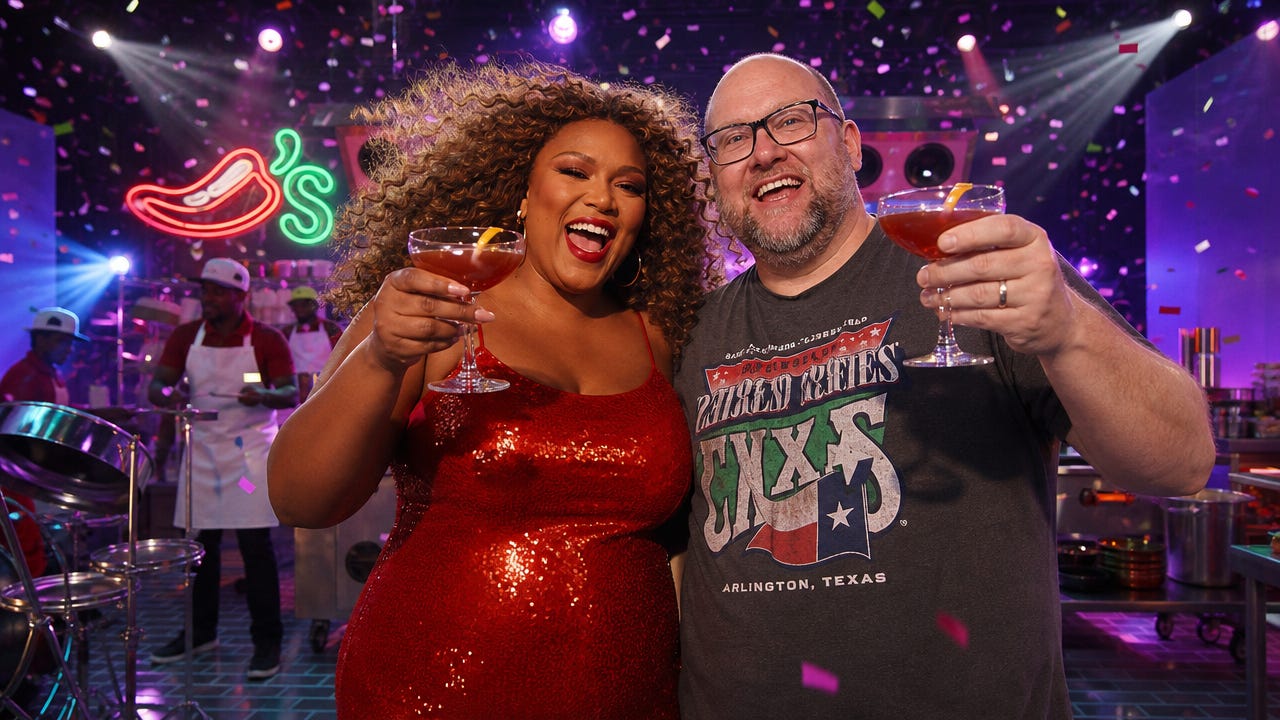
Today we’re drinking the Monte Carlo.
A Manhattan that fired the sweet vermouth and hired Bénédictine in its place. A simple cocktail of rye, that honeyed herbal liqueur and a couple dashes of bitters. First written down in David Embury’s 1948 cocktail bible.
I’ve talked about it before, but this really shows that Bénédictine is the rib flute of the liquor cabinet.
The bottle wants you to believe it descends from monks. The legend, stamped right into the brand: a Venetian Benedictine monk concocted a secret elixir at the Abbey of Fécamp in 1510, the recipe vanished in the chaos of the French Revolution and was miraculously rediscovered three centuries later.
Except that is complete rib flute fantasy.
In 1863 a wine merchant named Alexandre Le Grand invented a liqueur. That’s it. That’s the story. But “salesman makes new drink” is a terrible story, so Le Grand built a better one.
He fabricated the monks. He fabricated the lost recipe found in his own library. He stamped D.O.M. — an actual monastic motto — onto the label, talked the real Benedictine order in Rome into licensing him their name and coat of arms, and then, for the finish nobody asked for, built an enormous palace in Fécamp with stained glass windows dramatizing the legend he’d made up.
Historians will gently point out there’s no record the king he claims blessed the stuff ever even visited the town.
He built a literal palace to honor a monk who is, generously, semi-fictional. Chili’s built a rib flute to honor a jingle a guy wrote in five minutes and resents to this day. Same move. Manufactured reverence is the oldest trick we have and it works every single time.
So the Monte Carlo is reverence stacked on reverence stacked on a sales pitch. A stone-cold classic cocktail, reinvented with a 19th-century salesman’s gorgeous fairytale standing in for the vermouth.
Drink it slowly. You’re tasting a brand legend that’s mostly invention and entirely delicious. Like the rib flute. Like all of it.
Here’s the cocktail recipe:
2 oz rye
3/4 oz Bénédictine
2-4 dashes Angostura bitters
Stir with ice, strain into a chilled coupe or over one big cube. Lemon twist or a cherry — go with your gut.
Raise it to the monks who never existed and the jingle that won’t die.
The Drink Cart is the newsletter version of sitting at a really good bar with someone who thinks too much about advertising and won’t shut up about it. Subscribe to get it on Wednesdays and Fridays.