

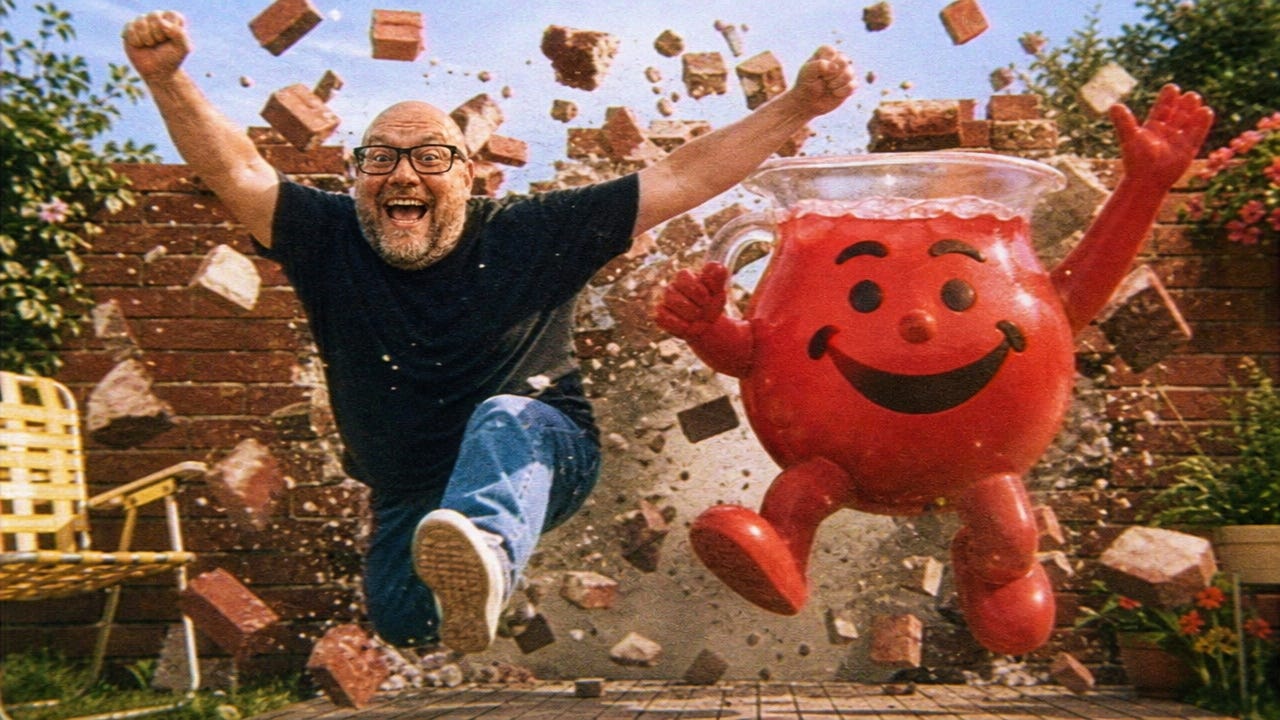
A six-foot jug of cherry sugar-water whose entire job was bursting through drywall to the delight of thirsty children.
Somehow he ended up permanently welded to the worst mass murder-suicide in modern history. Awkward.
He didn’t even do it. A competitor did. The bastards.
The country never cared, and it never let go.
THE DRINK CAME FROM A MAIL-ORDER HUSTLER, NOT A BOARDROOM
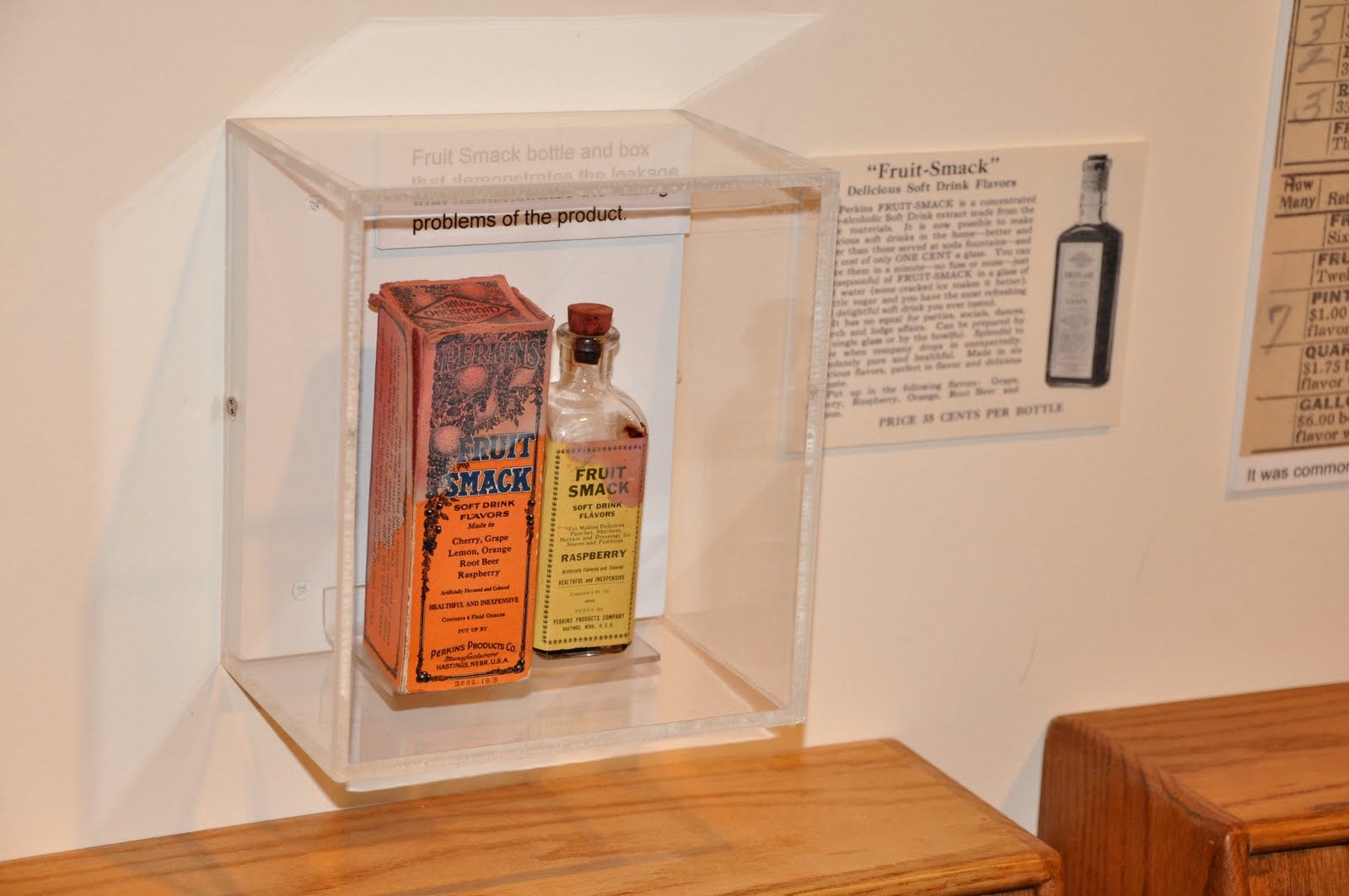
Before there was a man there was a powder, and before the powder there was Edwin Perkins — a small-town Nebraska kid who’d been mixing and mail-ordering product out of catalogs since he was a teenager. Perfumes. Patent remedies. A cure for the tobacco habit. Somewhere in that pile was a liquid fruit concentrate he called Fruit Smack. Not quite as catchy as the now famous Kool-Aid.
The problem with Fruit Smack was logistics. Liquid is heavy, glass bottles shatter in the mail, and shipping ate whatever margin the stuff had. So around 1927, watching what Jell-O had pulled off by powdering dessert, Perkins boiled his syrup down to a dry powder you could fold into an envelope.
He renamed it Kool-Aid.
Then the Depression hit.
So Perkins slashed the price to a nickel a packet while the rest of the grocery aisle was raising prices or folding.
He turned Kool-Aid into the one small pleasure a broke family could still put on the table. It didn’t survive the Depression in spite of being cheap sugar-water. It won because of it.
Volume went vertical. He sold to General Foods in 1953, rich and quiet, and a year later the new owners went looking for a mascot face.
A FACE A KID DREW ON A FROSTED WINDOW
In 1954 an art director named Marvin Potts at Foote, Cone & Belding got the assignment.
The story goes that he watched his young son draw smiley faces in the condensation on a cold window, and that was the whole idea. A glass pitcher with a fat grin on its side, brimming with red.
They called him “Pitcher Man.” He was one of several designs Potts put up. He was the only one that stuck, which is how it usually goes. You sweat over ten options and the client points at the one you sketched in thirty seconds.
In the 1960s Kool-Aid got cute and briefly benched their own pitcher for borrowed celebrity clout chasing. Turns out, when you rent a bigger star than your product, kids remember the star and forget the juice. A cardinal sin of mascot advertising.
The pitcher came back, because the pitcher was the only one who couldn’t upstage the brand. He was the brand.
ARMS, LEGS AND A WALL HE COULD NOT STOP DESTROYING
The transformation came in 1974 out of Grey Advertising, credited to Alan Kupchick and Harold Karp. They bolted arms and legs onto Pitcher Man, handed him a personality and a running start, and the modern Kool-Aid Man was born — no longer a logo, now a linebacker.
The voice, that booming OH YEAH, came from a Grey composer named Richard Berg, who also wrote the jingle. Three people in three rooms perfecting three variables: Potts the face, Grey the entrance, Berg the sound.
The formula never changed and never needed to. Thirsty kids cup their hands and yell Hey Kool-Aid. The big red jug detonates through a solid wall it was never invited through, roars OH YEAH, and pours.
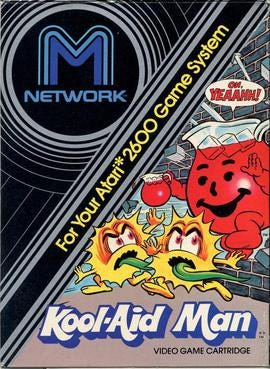
By the eighties he was a full-blown icon. Kool-Aid Man had brand recognition among kids that occasionally beat Ronald McDonald, his own 1983 Atari and Intellivision games, a comic book, a museum display back home in Hastings, where Nebraska would eventually name Kool-Aid its official state soft drink and throw an annual festival for it.
And those video games weren’t even for sale, at least not at first. You clipped Kool-Aid Points off the packets and mailed them in — 125 points for the cartridge, which works out to roughly 62.5 gallons of sugar water a family had to drink to earn one video game.
Or 30 points and ten bucks if your kidneys tapped out early. A brand so confident in its grip on American kids that it ran its own currency. Cash was for other companies. Kool-Aid dealt in points.
When Grey creative Steve Skollar got swept up in the New York trend of throwing elaborate birthday parties for kids, he asked Richard Berg — the voice, the man who recorded the OH YEAH — to actually wear the costume at his son’s sixth birthday.
First time the voice was ever inside the suit. Half the kids were terrified. Time later filed the Kool-Aid Man on its 2011 list of the creepiest mascots ever built, asking the only fair question anybody’s ever had — why does a guy this friendly have to destroy the house every single time he shows up.
THEN A PHRASE TRIED TO STEAL HIS LIFE
On November 18, 1978, more than nine hundred members of the Peoples Temple died at Jonestown in Guyana after drinking a powdered fruit punch laced with cyanide. The phrase drinking the Kool-Aid slid into the language to mean blind, fatal, cultish loyalty, and it has never once loosened its grip.
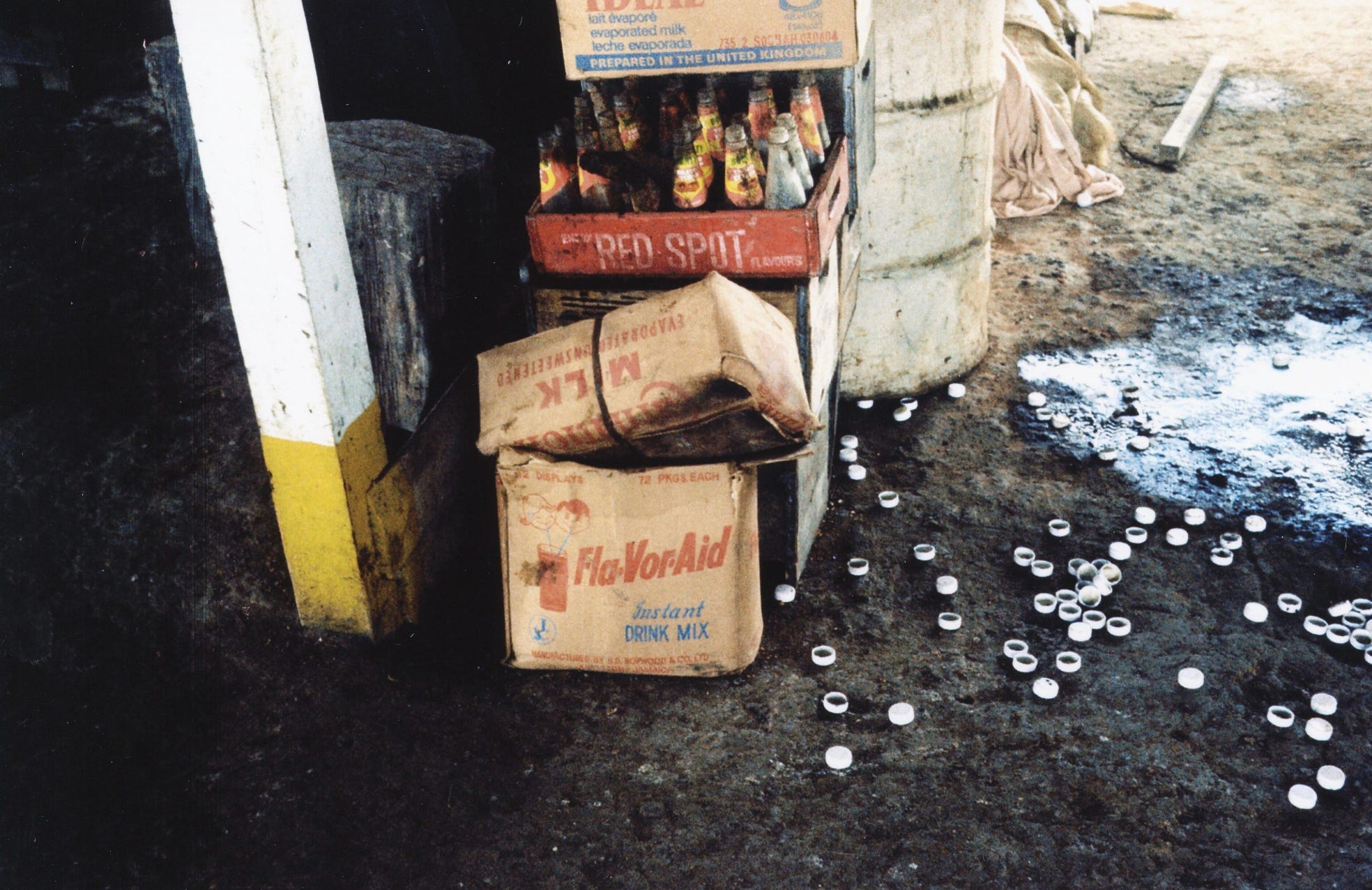
Except the drink was Fla-Vor-Aid. Yes, a cheaper knockoff, the store brand of the tragedy. That’s the version everyone reaches for now to sound clever, and it’s mostly true.
Reporters at the scene documented crates of Fla-Vor-Aid packets. But the honest, uglier footnote is that some accounts and photos put both brands in the pavilion, and nobody at the time was auditing labels. The language didn’t run a fact-check. It grabbed the name it already knew. Kool-Aid took the blame for one reason and one reason only: it was famous, and Fla-Vor-Aid wasn’t.
So the most exuberant, kid-safe, wall-smashing mascot in American advertising, a smiling jug whose whole reason to exist is bursting in to rescue thirsty children, spent the rest of his life shadowed by a mass death his brand almost certainly sat out.
He crashed through a thousand walls. He could not crash through that one.
THE RUMOR MILL KEPT A CLIENT ROSTER
Kool-Aid wasn’t even the rumor mill’s only account. The same era was murdering brands with stories they had nothing to do with, and the body count is worth a minute.
Start with Mikey. The picky kid from the Life cereal commercials — the one who hates everything, tries it anyway, and “Mikey likes it” enters the language. Somewhere in the late seventies a rumor started that Mikey was dead. Killed, the story went, by mixing Pop Rocks and soda until his stomach exploded.
People swore they’d seen the news report. There was no news report. The actor, John Gilchrist, was alive the entire time — is alive right now — and spent decades politely explaining that his stomach remained intact. A beloved kid mascot buried alive by a rumor his brand had nothing to do with. Same disease as Kool-Aid, different symptom.
And the murder weapon in that fake death? Also a General Foods product. Pop Rocks — same parent company as Kool-Aid, which means one corporation spent the late seventies fighting phantom deaths on two fronts.
The exploding-stomach panic got so bad that General Foods took out full-page newspaper ads and mailed letters to school principals across the country, begging America to believe its candy was not killing children.
A Fortune 500 company spending real media dollars to disprove a death that never happened. The rumor won anyway. It always does.
THE AD LESSON
Kool-Aid Man is a lesson in the part of brand reputation you don’t own. You can perfect every variable in the building — Potts perfects the face, Grey perfects the entrance, Berg perfects the OH YEAH, the whole machine engineered down to the last decibel — and then the culture takes your name out into the parking lot and does whatever it wants with it.
Drinking the Kool-Aid is now a permanent fixture in American English, deployed in boardrooms and on cable news by people who have no idea it should say Fla-Vor-Aid and would not change a syllable if you told them. Fame is a magnet. When something culturally enormous needs a name to stick to — even something monstrous — it reaches for the most recognizable one in the category and accuracy be damned.
That’s the cruel math of it: the exact ubiquity that made Kool-Aid a triumph is what nominated it as the default label for a horror it had no part in. Being the biggest name in your category means you answer for the whole category, including the things you didn’t do and the things that happened while you weren’t in the room. The brand was too famous for its own good.
COCKTAIL OF THE WEEK: THE KOOL-AID
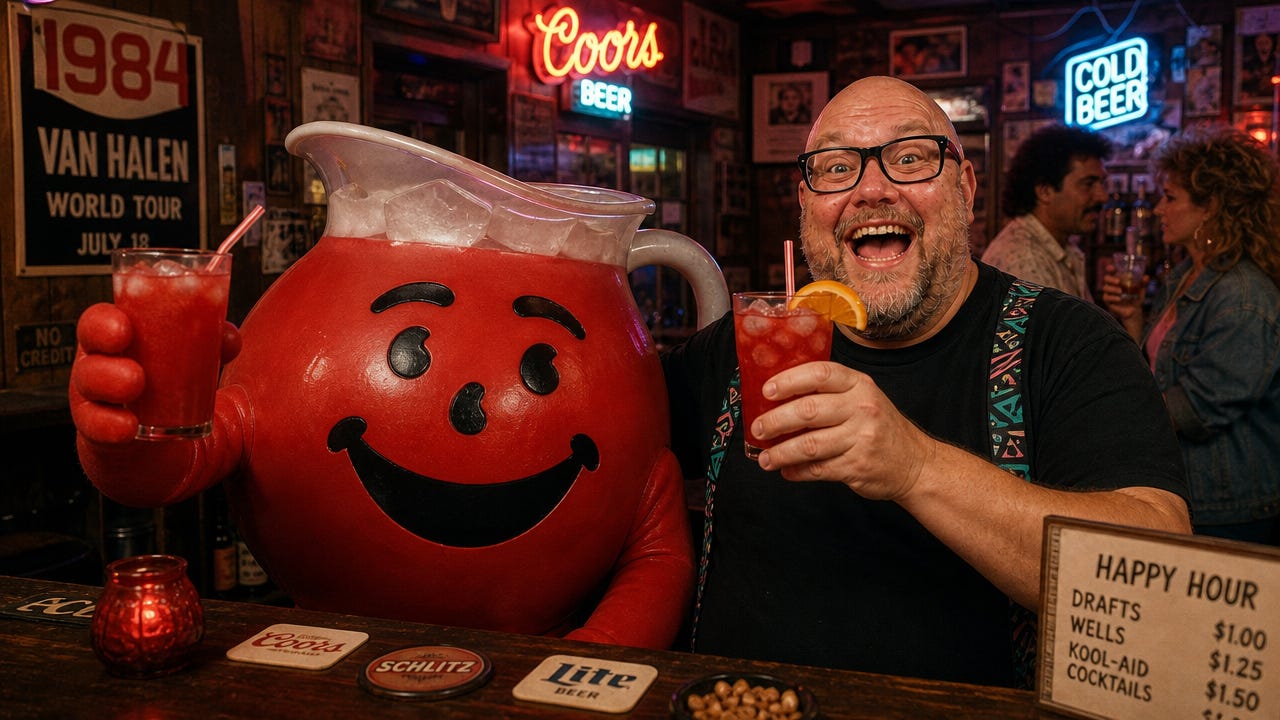
Before you push the cart away from all this, one more pour — because there is, sitting on the bottom shelf of bar history, an actual cocktail called the Kool-Aid, and it would be journalistic malpractice not to serve it in this issue.
It’s exactly what you’d hope. Sweet, red, artificial in the best possible way — a drink that exists for one reason, which is to taste like the powder. No contested origin story, no Prohibition lore, no bartender in a vest claiming it. Just a bar shot that grew up into a glass and never grew up in any other sense. It fits this issue like a costume: cherry-red on the outside, more going on than advertised.
THE KOOL-AID
1 oz vodka
1 oz amaretto
1 oz Midori
2 oz cranberry juice
Shake everything with ice and strain into a rocks glass over fresh ice. That’s it. Specs vary bar to bar because this thing was born as a shot and nobody was writing anything down . Morre cranberry stretches it into a highball, and if you’re missing the Midori (no one should have Midori) add a little more amaretto and cranberry and it still lands in the right cherry-adjacent neighborhood. Trust me no one will know.
ONE MORE NOSTALGIA STORY
In 1988 or 89-ish Kool-Aid launched a flavor called Sharkleberry Fin. It was pinktastic.
Strawberry, orange and banana. Fronted by a bright pink shark wearing sunglasses. Kool-Aid man got swim trunks and rode said shark.
Sit with that for a second. A sharkleberry is not a fruit. It has never been a fruit. A room full of adults at one of the biggest food companies on earth invented a fruit, named it after an apex predator, dressed the predator like he summers in Miami and shipped it to every grocery store in America.
And it worked. Kids lost their minds. And the shark got a whole entourage — a purple dinosaur, a crocodile with a saxophone, an octopus in a top hat. Decades later grown adults still hunt eBay for the packets, and when the flavor finally came back in 2014 the news broke on live TV during the Macy’s Thanksgiving Day Parade, announced by a host who had no idea what he was holding.
Those were good times.
Which brings us to what is even happening here? There was so much roller skating in the 70s and 80s. Absolutely bonkers.
The Drink Cart is the newsletter version of sitting at a really good bar with someone who thinks too much about advertising and won’t shut up about it. Subscribe to get it on Wednesdays and Fridays.
The fact that Jonestown used Flavor Aid is mind blowing. Such a burn for Kool-Aid.
Pass the Fruit Smack! Sharkleberry obvs.