


I use AI every single day. Not like Gary and Wyatt used their computer in Weird Science, but as a tool that has genuinely changed how I work. So understand that what follows isn’t an old ad guy yelling at the cloud.
It’s an old ad guy who knows exactly how good this stuff is, reads the federal government’s brand-new AI strategy and recognizes a familiar stench.
I’ve spent over twenty years in rooms judging this exact thing. Not policy, campaigns and ideas. And that’s what this is. The new line, “AI for All” isn’t a strategy, it’s a campaign.
Imagine it buried on slide 39 of 72 with a half-hearted political tagline for the big pitch.
I'm going to review it the way I'd review any campaign that crossed my desk. And the note is short: it's a bad ad for a bad idea.

Just a tagline, six pillars, a circular diagram with little icons and a pile of numbers so big and round they're clearly there to stop you asking questions. It's smoke and mirrors.
And the trouble with smoke and mirrors is the smoke clears.
IF THIS IS HOW THEY BUILD, BE VERY AFRAID
PrescribeIT. Canada Health Infoway’s national e-prescribing service. The “axe the fax” project, launched in 2017 to drag prescriptions out of the fax machine and into secure digital transmission between doctors and pharmacies.
The government funded it to the tune of more than $250 million — Conservative MPs put it closer to $298 million — running about $35 million a year. Thousands of pharmacies and doctors’ offices signed up.
And fewer than 5% of prescriptions in this country ever went through it. After eight years and a quarter-billion dollars, it could not beat the fax machine. It got switched off.
Why did it die? The government’s own answer: low adoption and no federal-provincial cost-sharing deal.
They built the tool, gave it away and couldn’t make anybody use it. When they started charging pharmacists twenty cents a prescription in 2025, the ones who were using it bailed.
Now read the AI strategy’s flagship move. The very first “AI mission” — the centerpiece, the one with a $200 million price tag, is pooling national health data. Driving AI adoption across the system. The entire plan rides on one number: getting business adoption from 12% to 60% by 2034.
Six days after they unplugged a national health system that couldn’t crack 5% adoption.
They could not get doctors to stop faxing. This week they are confident that they’ll somehow get the whole country to trust pooled health data running through AI.
THIS ISN’T A ONE-OFF. IT’S THE HOUSE STYLE.
So let’s talk about “AI for All.” Six pillars. The Prime Minister says it’ll shorten your ER wait and save your small business.
I’ve written that deck. Every copywriter has. It’s the one where the idea is thin so you make the numbers round and the verbs future-tense.
The way you judge a launch is the back catalog. PrescribeIT isn’t the only thing in the government’s discography.
Phoenix. The federal pay system. Pitched to save taxpayers $70 million a year on a $309 million build. It launched in 2016 and immediately stopped paying people. Over 200,000 public servants overpaid, underpaid, or not paid at all, some for years. The all-in cost is now north of $4.8 billion, and the auditor general says the replacement will run another $4.2 billion. For a payroll system. The thing every corner-store franchisee does on a laptop.
ArriveCan. Everyone’s favourite border app. Initial estimate: $80,000. Real cost: about $59.5 million. It’s “about,” because the auditor general couldn’t determine the actual number and called the bookkeeping the worst she’d seen in years.
The biggest contractor billed $19.1 million and had two employees. That’s a decimal point that went out for cigarettes and never came back.
The long-gun registry. Promised to cost taxpayers about $2 million. CBC’s investigation put the real tab somewhere near $2 billion. The computer system alone (budgeted around a million) blew past the hundreds of millions.
THE GOVERNMENT WOULD BE THE WORST AD HOLDCO YOU’VE NEVER HEARD OF
The federal government isn’t a brand. It’s a really bad advertising holding company.
Think about how a holdco actually works. One parent, a dozen agencies underneath it, each with its own name so the client never quite connects the disasters.
The work comes out of companies that would not get shortlisted any other way. Phoenix, or Infoway, or the ArriveCan shop, or the Element AI account team — different logos, different press releases, same parent company, same client (the tax payer) getting billed into oblivion. When one shop’s name goes radioactive, you don’t fix the shop. You spin up a new one with a fresh logo and pitch the client again.

That’s this. AI for All is the new shop. Sharp name, big reel, confident pitch. And it’s pitching the same client that’s already been burned by every other agency under the same roof. The holdco’s track record is public. The supercomputer is just the most expensive pitch they’ve ever walked into the room with.
And the tell, the same as every bloated holdco that’s lost the plot? They keep winning the business anyway. Not because the work is good. Because they’re the only agency on the roster. There’s no competitive review. There’s no other shop you can move the account to. You’re a captive client, and they know it.
THE PATTERN
Promised cheap. Came in catastrophically over. Didn’t deliver the thing it promised.
So when the same shop announces — and I quote the actual document — a “world-leading public supercomputer” by 2031, sovereign cloud, a national compute build-out scaling to 2.3 gigawatts, I’m not skeptical because I hate AI. I’m skeptical because they haven’t been able to accomplish that for anything.
The people who couldn’t make a payroll system add and subtract, who couldn’t get doctors to stop faxing, are going to somehow manage this on time and on budget.

Sure.
Businesses adopt AI when it makes them money, full stop. And buried in their own pages is the kill shot: 78% of Canadian companies that haven’t adopted say they don’t see how it helps what they make. Canada ranks 44th of 47 countries on AI literacy. 42nd of 47 on trust.
We invented the modern stuff — Hinton, Bengio, Sutton, the doc brags about all three, and we’re near dead last at using it.
You cannot strategy-document your way out of a culture problem. You can’t procure adoption.
YES, THEY’VE BACKED WINNERS. THE WINNERS ALL GOT ON A PLANE.
Now somebody in the comments is already typing “actually, government money built Shopify.”
Fine. Let’s do it, because the honest version is worse for them, not better.
Government money has ridden some genuine winners. AbCellera got up to $175.6 million from Ottawa in 2020 and IPO’d that December for US$555 million, with an antibody used on more than 2.5 million patients. Verafin out of St. John’s had federal BDC Capital money in its big round and sold to Nasdaq for US$2.75 billion — the biggest Canadian software exit since IBM bought Cognos in 2007. The Ontario pension fund’s VC arm co-led Shopify’s 2013 Series C, and Shopify became the most valuable company in the country. Quebec basically built the world’s largest video game studio with tax credits — Ubisoft Montreal, 4,000 people at its peak.
Here’s what every one of those has in common. Government shut up and wrote a check through professionals, or set a broad incentive and let the market pick. Not one of them happened because a minister pointed at a company and said “that one.”
And look where the winners live now. Verafin? Nasdaq owns it. Cognos? IBM, gone since ‘07. North, the Waterloo smart-glasses darling everyone loved? Google swallowed it. The Canadian success story is a conveyor belt to an American head office, and we stand there applauding the press release that calls it “a vote of confidence in Canadian talent.” Shopify is the lonely exception, which is exactly why we treat it like a national monument, it’s the one that didn’t get on the plane. Yet.
The losers never come back. There’s no redemption arc, no second act, no plucky comeback issue. Element AI anointed itself the face of Canadian AI, built the whole thing around Yoshua Bengio, an actual Turing-winning godfather the new strategy name-drops, collected the Trudeau photo ops, and raised something like US$257 million, including money from Quebec’s pension fund and a $20-million federal cheque.
Then it turned out the company did $10 to $12 million a year in revenue and a Deloitte review valued it at US$76 million, sinking to US$45 million. It got parted out to ServiceNow of California for US$230 million, the founders’ equity mostly wiped to zero, the federal funding quietly cancelled, the talent and the publicly-funded IP on the next flight south. Quebec’s own innovation minister shrugged that the business model “did not work.”
That’s the holdco’s flashiest launch to date. Spun up a glamorous new creative shop, gave it a press tour, couldn’t make the work and sold the talent to a bigger American holdco for parts. Element AI is the exact thing this strategy proposes to do again — anoint a champion, government as the anchor customer, build the national flag-bearer. The new plan is a sequel to the one movie everyone already agreed not to watch twice.
THE OLDEST LAW IN THE AD GAME
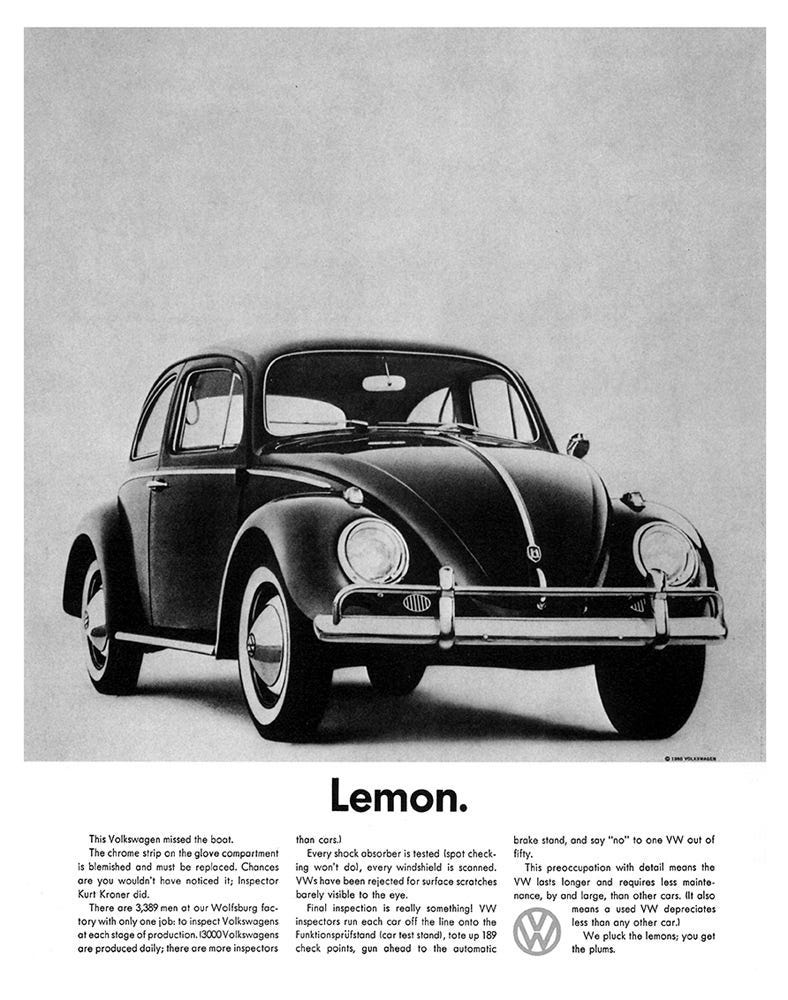
Bill Bernbach, who built modern advertising, said the truest thing anyone’s ever said about this job. A great ad campaign will make a bad product fail faster. And more will get more people to know it’s bad.
That’s the whole issue, right there. Because AI for All is, on its own terms, not the worst. But does the product work?
The product is the government’s ability to ship anything. And we have years of evidence telling us precisely how that product performs. A campaign isn’t going to fix that. It’s going to do what great advertising always does to a bad product — get forty million people to find out it’s bad, faster and at higher resolution than ever before. This will make our investment in hosting FIFA for 13 games look like child’s play.
The better they advertise the plan, the faster the rest of the country meets the thing behind the ad. It’s the oldest law in my business, finally getting tested on the biggest account in the country.
COCKTAIL OF THE WEEK: WORLD CUP FASHIONED

The World Cup is kicking off on Thursday and the defending champs drink the single most divisive thing behind any bar. Fernet con Coca. Fernando, if you’re from Córdoba. Argentina knocks back something like 75% of all the Fernet-Branca made on the planet. An entire football-mad country runs on it.
I had the pleasure of Soccer Dave putting me onto the proper way to scale this. The viajero, the traveler. You lop the top off a 2-litre Coke, burn the cut edge smooth with a lighter, load it with ice, dump in most of a bottle of Fernet, top with Coke and pass it around the circle like a mate gourd.
Think of it like the agency holiday party format. One bottle of Fernet, one big Coke, eleven creatives and a problem that solves itself. I doubt very much that something that fun is at Fan Fest.
For a civilized one-at-a-time version, I built it as an Old Fashioned instead of a highball. Call it the World Cup Fashioned. Argentina’s stadium drink doing the slow walk back to the trophy.
The World Cup Fashioned:
2 oz rye
1 oz Fernet-Branca
3-4 dashes Coca-Cola bitters
Stir with ice, strain over one big cube. Express an orange peel over the top and drop it in. Haven’t made your own cola bitters? A bar spoon of cola syrup and a dash of Angostura is close enough that nobody’s filing a complaint.
The Drink Cart is the newsletter version of sitting at a really good bar with someone who thinks too much about advertising and won’t shut up about it. Subscribe to get it on Wednesdays and Fridays.
Canada ranks 44th of 47 countries on AI literacy?!? Yikes.