

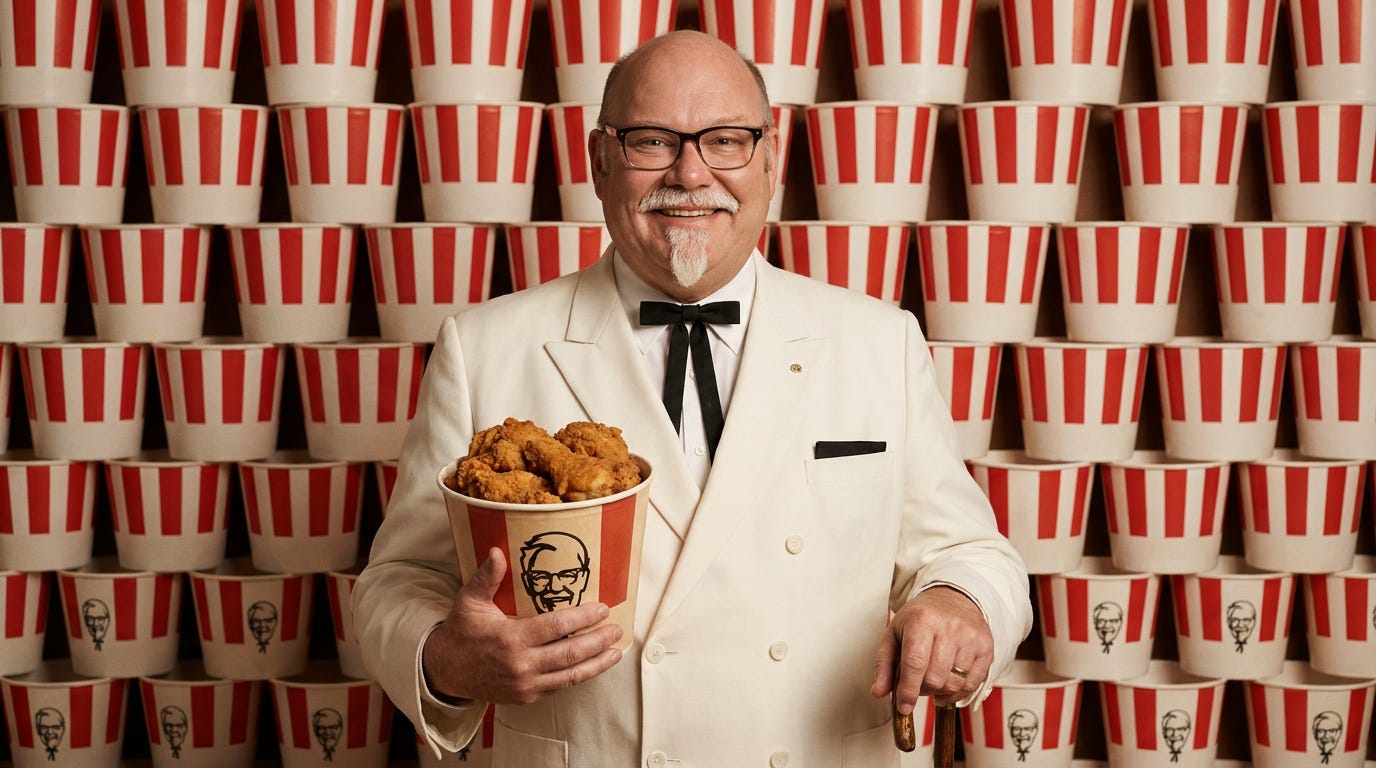
Today’s newsletter starts in May of 1931. On a dusty stretch of highway in North Corbin, Kentucky.
An area the locals called Hell’s Halfacre if you must know. So named because of all of the bootleggers, gunfights and general lack of electricity and such.
It was here that a 40-year-old Shell gas station owner named Harland Sanders was quietly waging a war in ads.
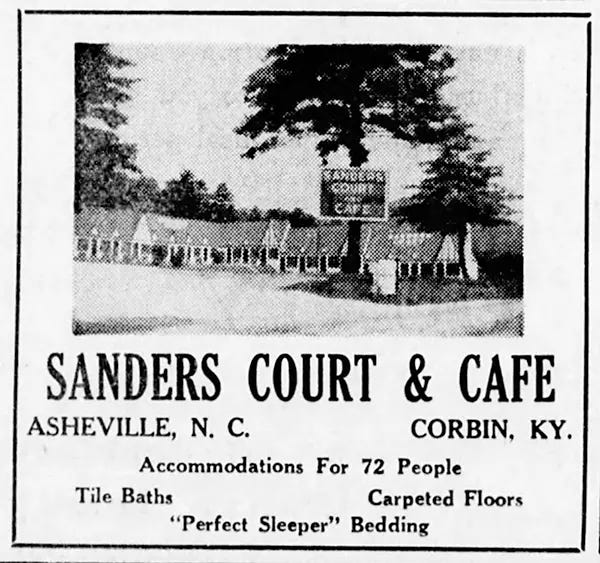
A back and forth signage war on an old railroad wall that pointed customers to his gas station. Something Matt Stewart who ran the local Standard Oil station kept painting over.
Sanders had already threatened Stewart with gunfire. So when his sign was being painted over again, he took it personally.
Sanders brought two Shell colleagues with him and when they arrived Stewart pulled out a pistol and shot one of them dead. Sanders fires back and hits Stewart in the shoulder. The other Shell man shot Stewart in the hip.
Stewart said, “Don’t shoot, Sanders! You’ve killed me!”
Except that Stewart lived. Got 18 years for murder and was eventually shot and killed by a deputy sheriff while on appeal.
Sanders was never charged. Turns out that the press has spelled his name Saunders and no one could put two and two together.
The competition was gone. Business was booming.
And Harland Sanders just won a gunfight over an ad.
THE ULYSSES S. GRANT OF FRIED CHICKEN
If you don’t know about Ulysses S. Grant then you don’t know about failure.
This was a man who failed at farming. Failed at real estate. He wasn’t very good at even working at his father’s leather shop. Everything he ever tried, he failed at. Except war.
Grant turned out to be the only man in America that could win the Civil War.
Sanders’ story sounds familiar with maybe more failure and chicken.
Dropped out of school in grade six. Lied about his age to enlist. Spent a year in Cuba as an army teamster. Got fired from a railroad job after a bar fight. Practiced law in Arkansas without passing the bar. Got into a fistfight with his own client in the courtroom. Started an acetylene lamp company just as electricity took off. Sold tires until he crashed his car. Operated a ferry. Tried to sell insurance but got fired from that.
Sanders wouldn’t get into the chicken franchise business until 1952. He was already 62.
Even that failed at first. The interstate highway bypassed Corbin. His first restaurant died. At 65 he auctioned it off, put a pressure cooker in the trunk, slept in the car and cooked for other restaurants for a nickel a bird.
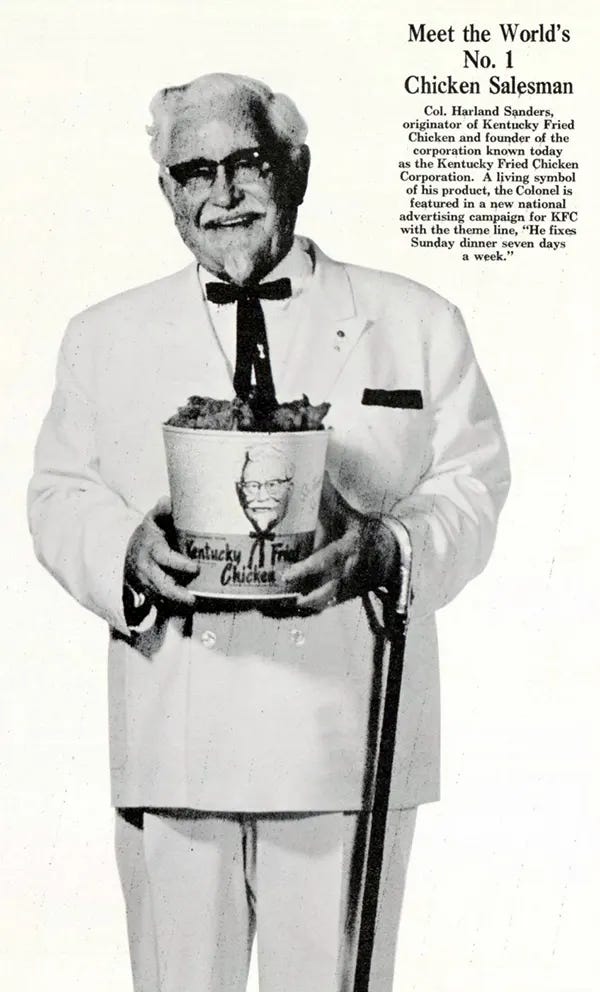
Somehow by 1964 there were 600 franchises.
All run by a man in a white suit.
THE INVENTION OF THE COLONEL
This brand mascot wasn’t created by the creative team in the agency.
It was made when a man put on a white suit, added a string tie and bleached his goatee.
A uniform Colonel Sanders put on in the 1950s and wore every day for the rest of his life.
The dirty little secret?
Harland Sanders wasn’t a colonel at all.
Kentucky’s governors handed out honorary titles to everyone. Elvis got one. Even Betty White got one. Sanders got his in 1935.
Worse, he wasn’t even from Kentucky.
Then in 1964 he sold the American rights to Kentucky Fried Chicken for $2 million.
He gets a lifetime salary (he was 73), the title of brand ambassador and the rights to sell the chicken in Canada.
John Y. Brown Jr., the lawyer who bought it, would later sell the company to Heublein for $285 million.
Brown’s whole marketing plan was just to roll out the very interesting Colonel Sanders and let him be interesting on TV. What’s My Line. I’ve Got a Secret. Carson.
Brown would later became governor of Kentucky.
THE KENTUCKY FRIED VODKA ERA
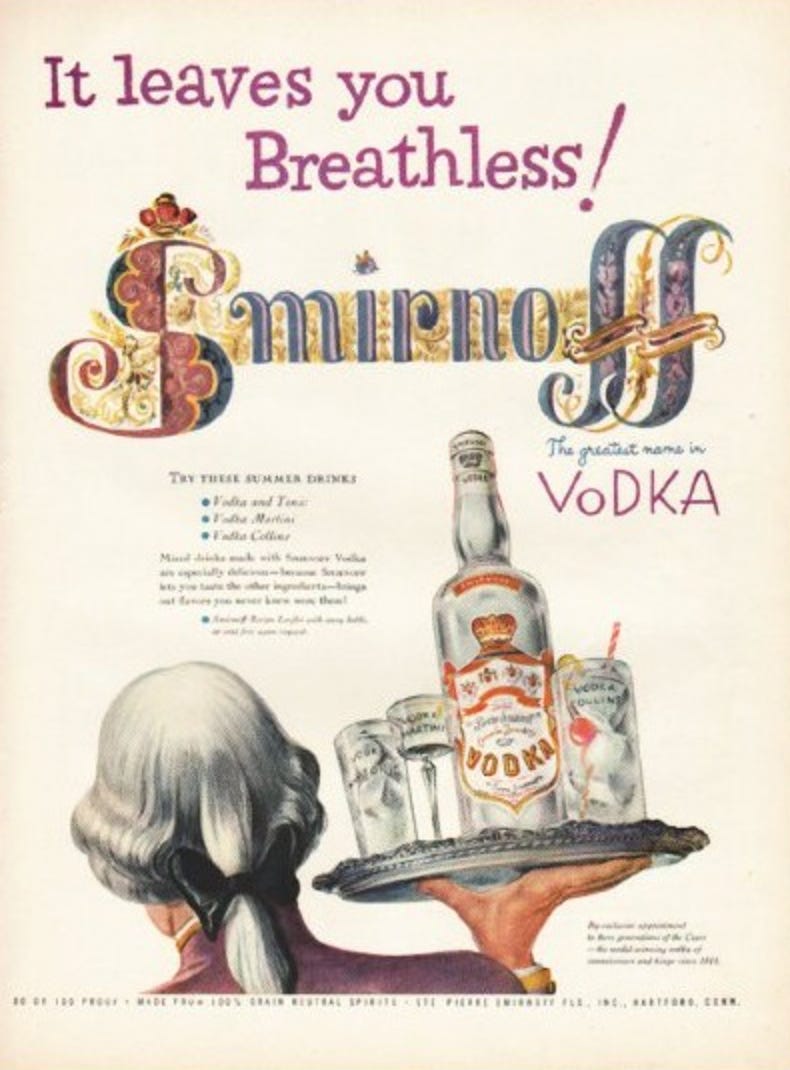
An interesting side note? Sanders was a renowned teetotaler. He probably wouldn’t even approve of this newsletter writing about vodka.
And yet, he sold out to Heublein, a booze brand.
The company is kind of wild. They survived prohibition by owning A.1. steak sauce, bought the rights to a corpse of a Russian brand known as Smirnoff for $14,000 despite nobody drinking vodka in America at the time.
They called this Martin’s Folly for Heublein president John Martin who ended up teaching bartenders drinks like the Moscow Mule in the copper mug to sell the stuff.
He used the new Polaroid camera to take photos and show the next bar how much fun everyone was having drinking vodka.
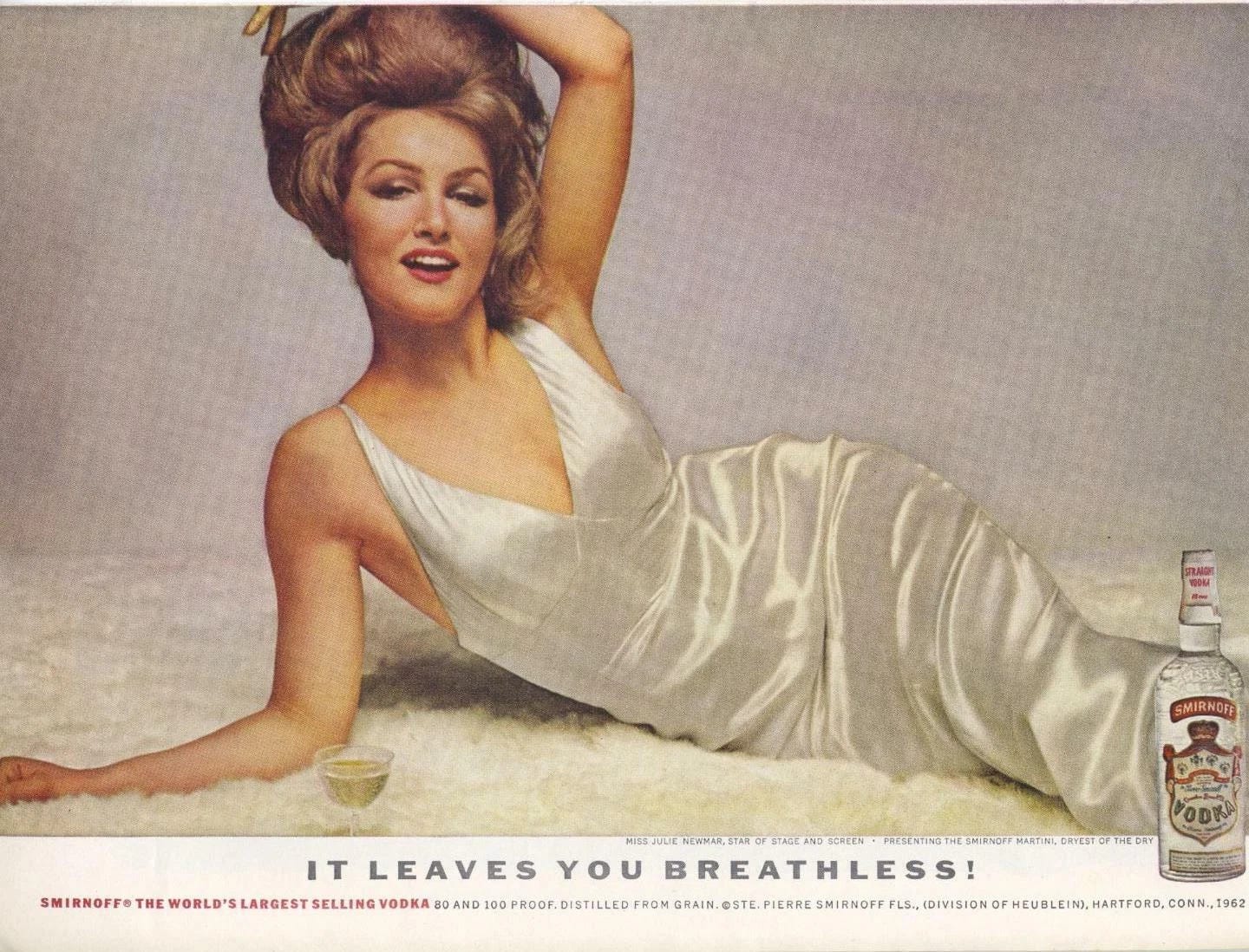
He also helped position vodka as white whiskey that “leaves you breathless.”
It had no taste or smell and you could drink it at lunch and no one would be the wiser. People still believe that vodka doesn’t show on your breath.
That’s what years of advertising will do for you.
THE ROGUE KFC OFFSHOOT IN MISSISSAUGA
In 1965 Sanders moved into a home at 1337 Melton Drive to run the Canadian fried chicken empire in the north. The house went on the market this June. $1,499,999. Four bedrooms.
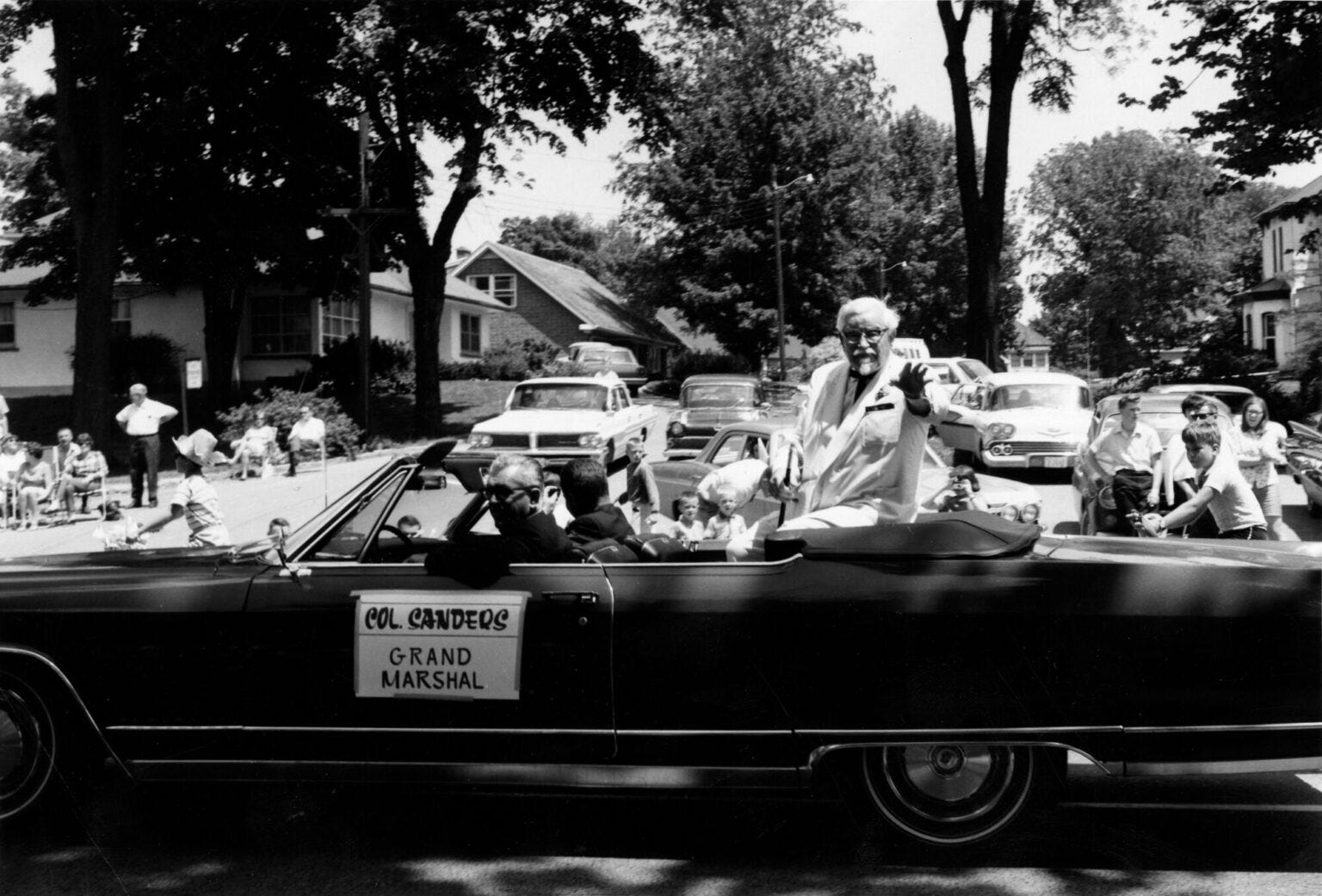
They ran as Scott’s Chicken Villa. Sanders would ride around in local parades and was referred to as the year-round Santa. He filmed commercials, tried to learn French and reportedly even looked into becoming a citizen.
All the Canadian money went into a charity that still exists. Hell, there’s a wing of Mississauga Hospital with his name on it, and Trillium named its women’s and children’s centre after him in 2000.
THE MASCOT TURNS ON THE BRAND
What happened next? Heublein cheapened the food. Most egregious was the powdered gravy where the colonel’s famous cracklin’ used to be.
Sanders was still the spokesman and in 1973 sued them for $122 million for slapping his face on food he never made. He’d settle for $1 million and promised to stop trashing the brand.
He does not stop.
In 1978, he told Louisville Courier-Journal: “My God, that gravy is horrible. They buy tap water for 15 to 20 cents a thousand gallons and then they mix it with flour and starch and end up with pure wallpaper paste.”
When they launched Extra Crispy? “A damn fried doughball stuck on some chicken.”
A single franchisee sues him for libel. But here’s the funniest part. The Kentucky Supreme Court threw it out since he actually insulted all 5,000 stores. Nobody was defamed.
The mascot was legally cleared to call his own product garbage.
DEATH DID NOT END THE CONTRACT
Then on December 16, 1980 the chicken finally caught up with Sanders. He died of leukemia at 90.
So famous he lay in state in the Kentucky Capitol rotunda.
As the brand was bought and sold by R.J. Reynolds, PepsiCo and Yum, the brand slowly put the colonel out to the big deep fryer in the sky.
By the late 1990s he was simply an animated Colonel voiced by Randy Quaid.
Research said that young customers didn’t know he’d been a real person.
Wieden+Kennedy brings him back in 2015 for the 75th anniversary casting Darrell Hammond, with a chuckle the real man never had. Three months later they swap in Norm Macdonald, who opens by calling Hammond an imposter.
“They can’t just grab some super funny Hollywood actor, throw a white suit on him and try to pass him off as the real Colonel Sanders.”
Then Jim Gaffigan. George Hamilton as the Extra Crispy Colonel. Rob Riggle. Billy Zane. Rob Lowe. Ray Liotta. Reba McEntire. Jason Alexander. Sixteen-plus actors in the white suit.
People said they hated it but same-store sales went up 3% after a 15% drop two years earlier, and the CMO pointed to the wave of Colonel Halloween costumes as proof.
MASCOT LEFTOVERS: FINGER LICKIN’ LORE
In 1976 a survey ranked Colonel Sanders the second most recognizable celebrity on earth. First place was Muhammad Ali. Not surprisingly. also a Kentucky Colonel.
Truthfully, and I feel bad about this, the KFC bucket deserves its own newsletter.
This iconic brand asset was first served up in 1957 at Pete Harman’s Salt Lake City store (aka franchise number one) and ended up becoming a mascot in its own right.
The striped drum, the Colonel’s face rotating on a pole above the parking lot. Stuffed with chicken for the whole family. It’s arguably done more brand work than any slogan they ever wrote, and you can still buy vintage ones on eBay right now, grease ghosts from Christmas in the 1970s and all.
There are bucket people who collect them. An empty cardboard bucket with a dead man’s face on it, trading as memorabilia. How do you fall into that niche? Imagine the rush of writing, ”1 ORIGINAL 1960s KENTUCKY FRIED CHICKEN BUCKET LID MINT 1969 COLONEL SANDERS KFC” and then typing in $129 after sitting on a trove of 7 of them. There’s still 3 left.
And then there’s Japan. There is always Japan. This is where the Colonel became a vengeful spirit.
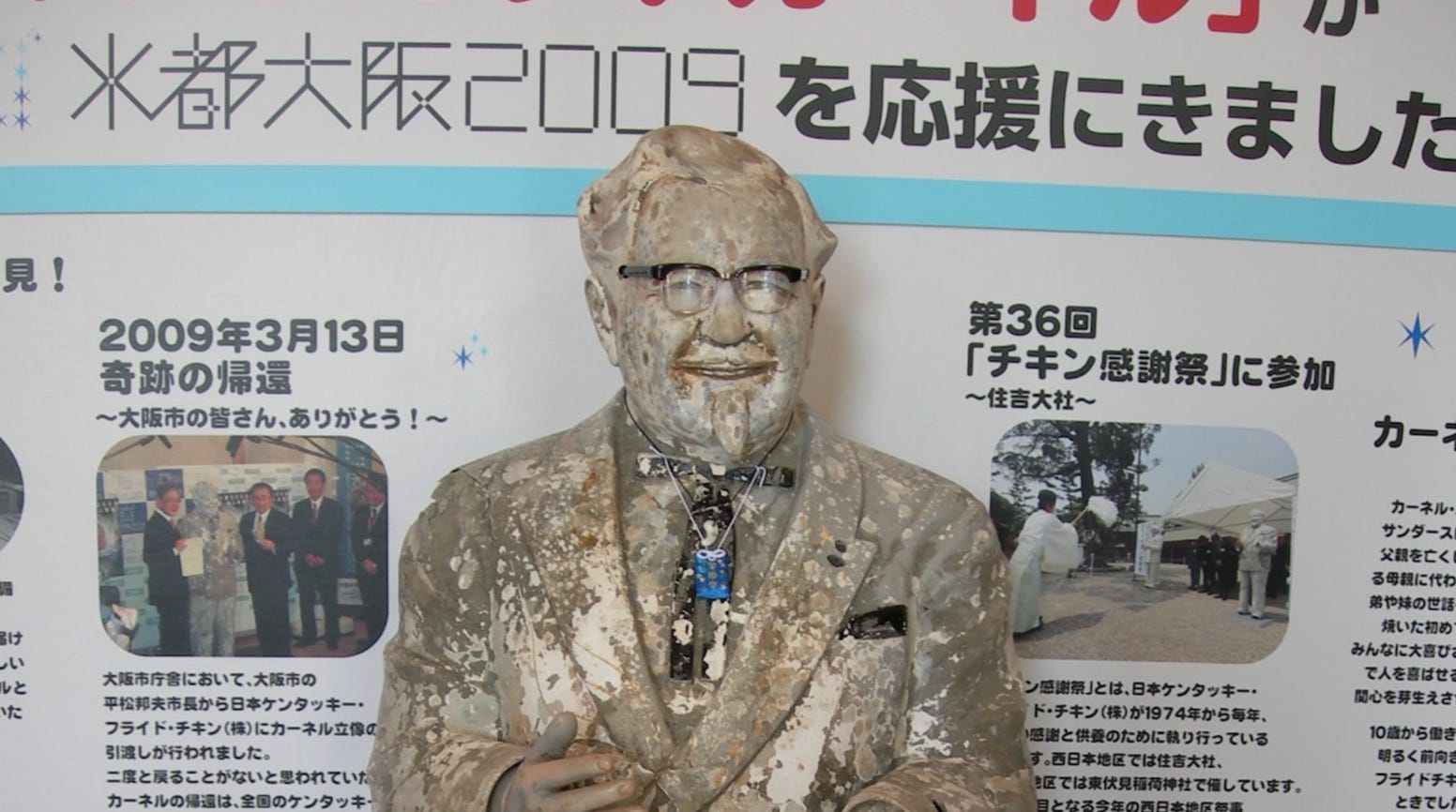
In 1985 the Hanshin Tigers won the pennant and celebrating fans in Osaka threw a Colonel statue off a bridge into the Dōtonbori canal. The reason? He apparently looked liked their bearded American slugger.
The Tigers then didn’t win it all again for decades. Many blamed the Curse of the Colonel.
Divers finally pulled him out of the canal in 2009, missing his glasses and his left hand. The team laid the curse to rest with a championship in 2023.
For a mascot to be so magically transformed into such a symbol that his statue could haunt a baseball team from the bottom of a river.
PENCILS DOWN
Build a brand on a real person and eventually you have to choose between them.
KFC chose the suit.
It’s the right call, if we’re being cold about it. The person ages, sues you and tells reporters your gravy is wallpaper paste.
The costume does none of that. The costume takes direction. The costume can be Norm Macdonald one quarter and Reba the next.
The man got to keep the salary, the lawsuits and the ranting.
They got the goatee, forever.
Harland Sanders has been dead for nearly 46 years and he’s still their hardest-working employee. Never complains anymore, either.
COCKTAIL OF THE WEEK: THE KENTUCKY COLONEL
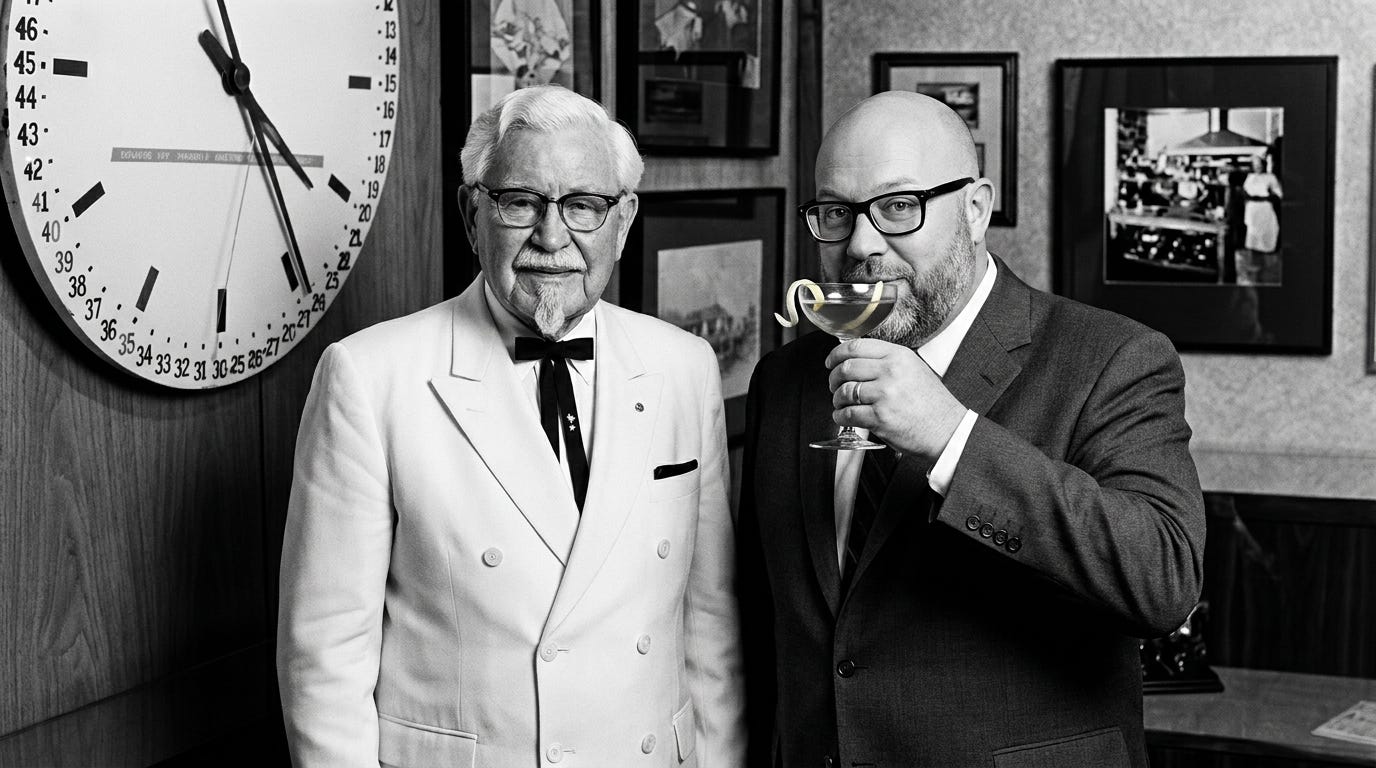
This is simply a Bourbon and Bénédictine, first noted in 1914’s Jacques Straub’s book Drinks. Straub ran the bar at Louisville’s Pendennis Club, so it’s a Kentucky recipe by a Swiss bartender which later became the house drink at the Hotel Bel-Air.
Three things make it the only possible choice for this week.
It’s named for the title that turned a man into a mascot.
The Colonel was a lifelong teetotaler, so he’d never have touched the stuff.
And it’s just sweetened with Bénédictine — the liqueur whose whole “1510 monastery” origin was invented in 1863 by a wine merchant named Alexandre Le Grand.
A drink named for a fake colonel sweetened with a manufactured heritage, for a man who manufactured himself to sell chicken.
Bénédictine has 27 secret herbs and spices. The Colonel had 11. Sometimes things just work out.
The Kentucky Colonel
2 oz bourbon
1/2 oz Bénédictine
2 dashes Angostura bitters
Lemon peel
Stir it with ice, strain over a big ice cube, drop it in the lemon peel. It’s an Old Fashioned with the sugar swapped for some honeyed herbs to give you a warm long dry finish.
The Drink Cart is the newsletter version of sitting at a really good bar with someone who thinks too much about advertising and won’t shut up about it. Subscribe to get it on Wednesdays and Fridays.
Wow, what a story! Guns, treachery, hot chicken and more. Never knew half the story. Well written, Jackson, well done. Also, Reba as the colonel? Cray cray.
The fact that you can buy the KFC house for $1.5M sounds like a pretty good deal to me.