

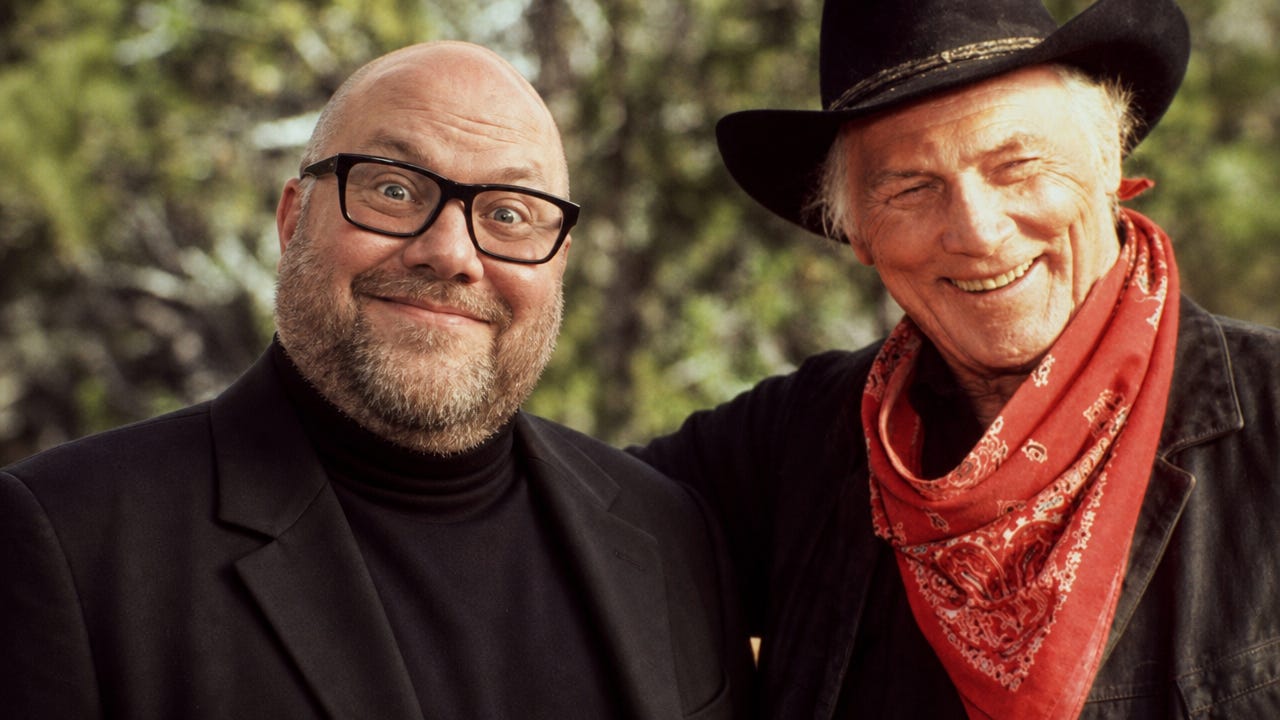
Marlboro was a woman’s cigarette. Not in some loose, forgotten way. Nope, it was deliberately, head to toe, selling to women for thirty years.
Philip Morris launched it in 1924 as “America’s luxury cigarette.” Sold it in fine hotels and resorts. Called it “The Cigarette of Distinction” and charged twenty cents a pack back when twenty cents meant something.
By 1927 the company was reportedly the first to advertise a cigarette directly to women, running spreads in fashion magazines with lines like “Favorites on Fifth Avenue, famous wherever Fashion gathers.”
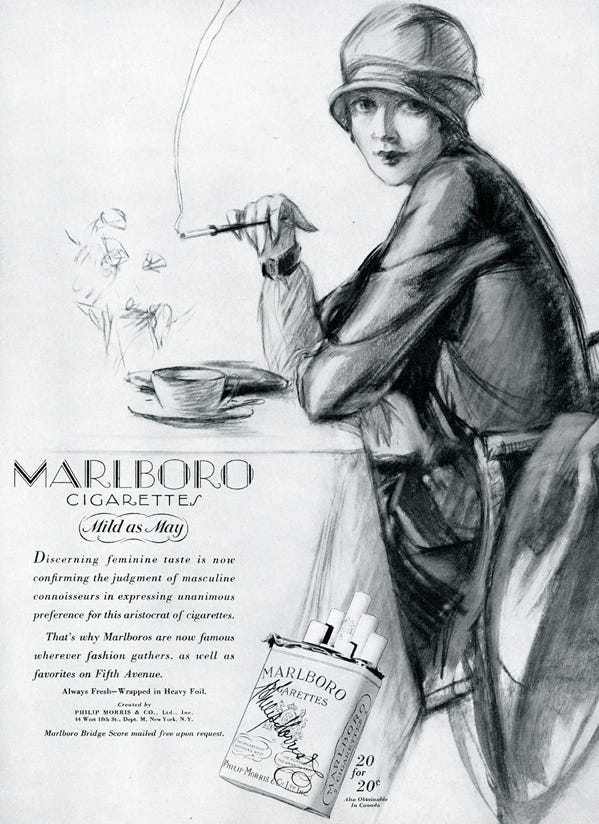
The whole pitch was beauty counter. And because a lit cigarette left lipstick on the paper, Philip Morris dyed the tip red and sold the flaw as a feature: “Red Tips to Match Your Pretty Lips.” Later they switched to an ivory tip and ran “Ivory Tips Protect the Lips.” The entire brand was organized around not smudging your makeup.
It flopped. By the late 1930s Marlboro was stuck under 1% of US cigarette sales, and Philip Morris pulled it off the market for a stretch.
So the most aggressively masculine brand in the history of advertising started life as a fashion-magazine cigarette for women who didn’t want to ruin their lipstick. A brand that failed so badly it briefly stopped existing.
Then it got handed to a short bald man in Chicago.
THE GUY THEY SAID WOULD BE SELLING APPLES
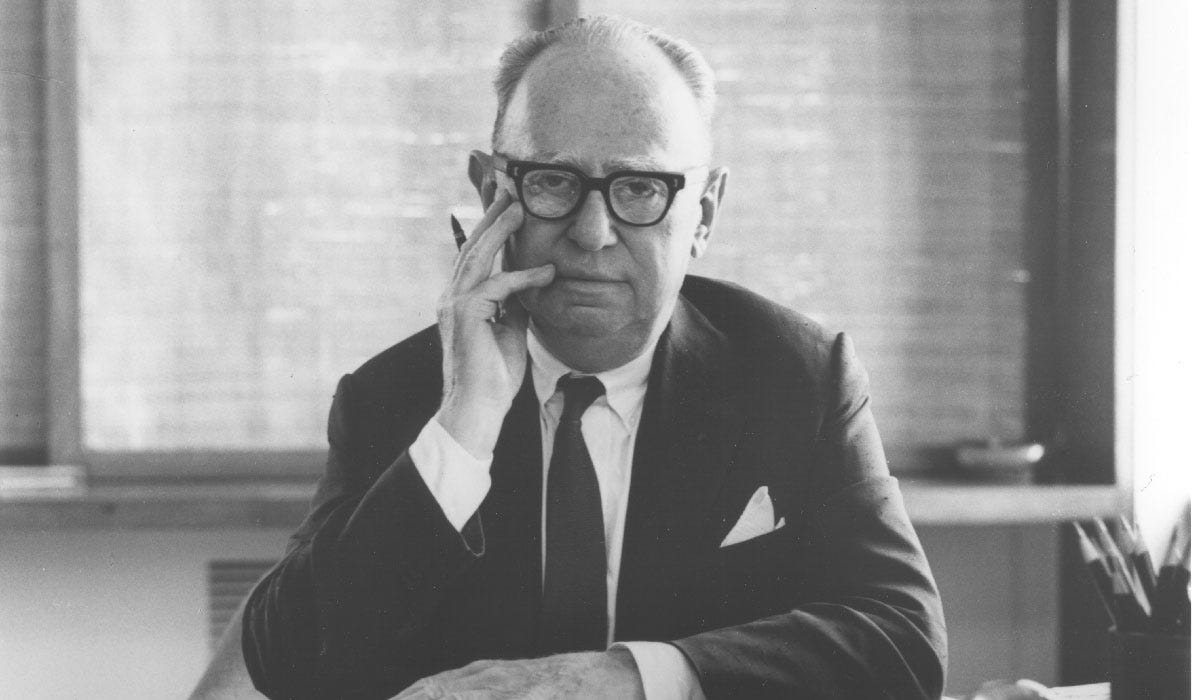
Leo Burnett opened his agency on August 5, 1935, in the deepest part of the Great Depression. He was 44. He’d borrowed against his life insurance and mortgaged his house to do it.
A Chicago columnist took one look and predicted Burnett would be broke and selling apples on a street corner inside a year.
So Burnett put a bowl of apples at the front desk. The message being: I’m not selling them, I’m giving them away. Ninety years later there are still bowls of apples in Leo Burnett lobbies around the world. The man held a grudge with style.
He believed every product had what he called its “inherent drama” — some true, human thing buried inside it — and the job was to dig that out and put it on display. He kept a folder in his desk labeled “Corny Language” where he wrote down honest, plainspoken phrases he overheard, the kind that sounded like a real person talking.
In 1999 Ad Age ranked the most important advertising people of the century and put Burnett third. Then it named the ten greatest advertising icons of the century. Four of them came out of his shop — the Marlboro Man, the Jolly Green Giant, the Pillsbury Doughboy and Tony the Tiger. No other agency had more than one. Toucan Sam, Charlie the Tuna, Morris the Cat, the Keebler Elves, the Maytag Repairman — also his. The man basically invented the entire genre this series has been picking through.
In 1954 Philip Morris brought him the failing brand. Like Michael Jordan, Burnett took the account personally.
THE COWBOY WAS A CASTING CALL THE PUBLIC WON
He didn’t bet the brand on a cowboy. Here’s the part that gets flattened in every retelling. Burnett pitched a whole lineup of manly men. Sea captains, drill sergeants, war correspondents, construction workers, weightlifters. The cowboy was just the first one out of the gate. Early ads even ran a “Tattooed Man,” a clean-cut guy with a tattoo on his wrist hinting at some rugged past he wasn’t going to tell you about.
Then they watched what landed. The cowboy won.
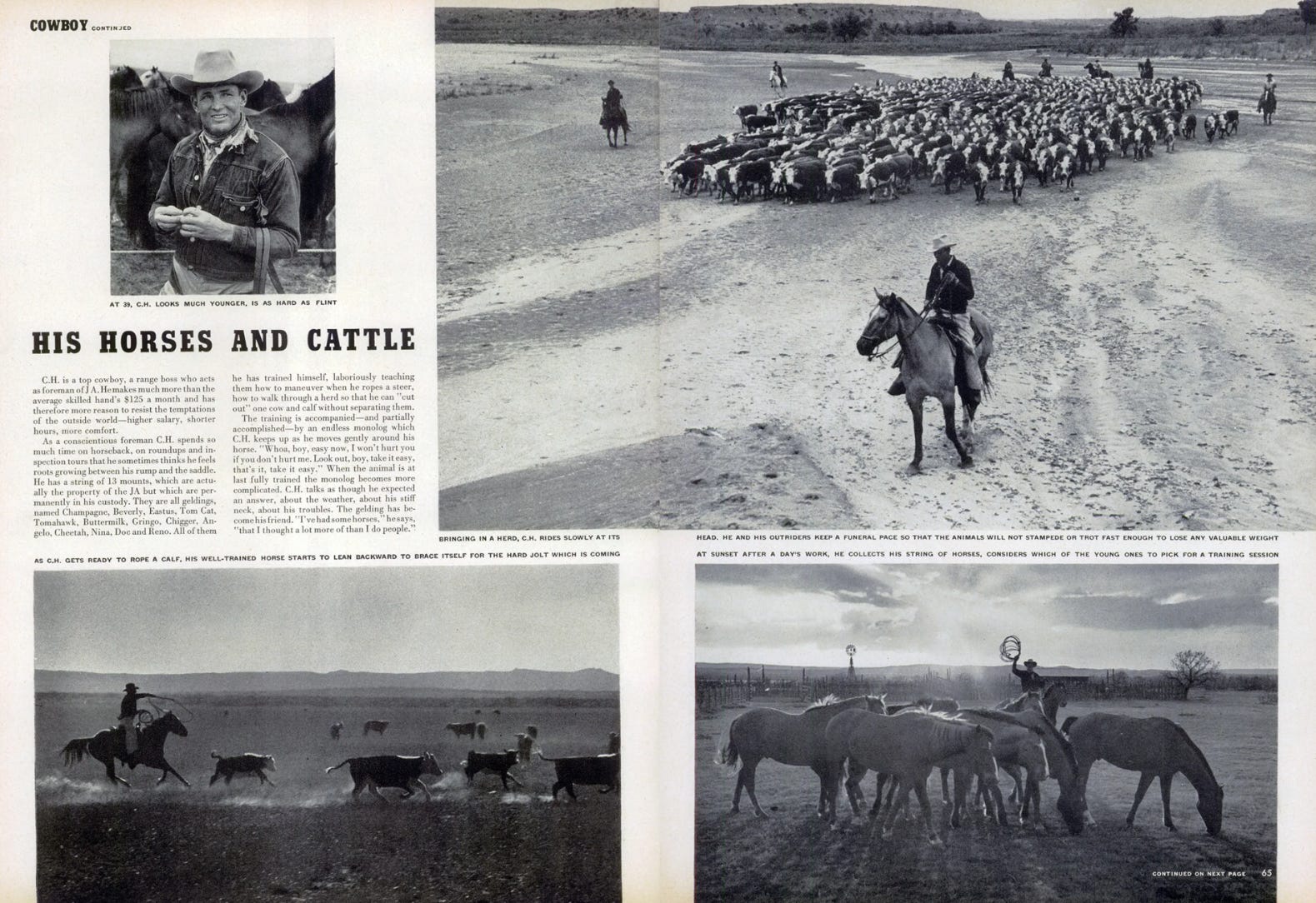
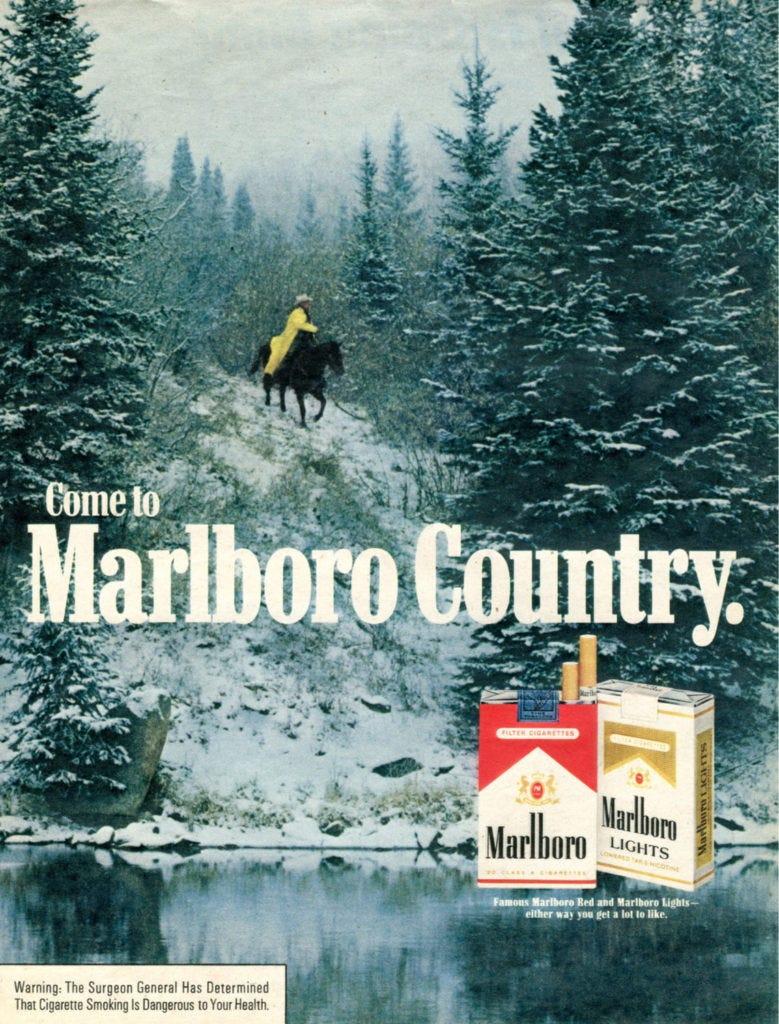
His inspiration was a single photograph. A 1949 issue of Life, a Texas cowboy named Clarence Hailey Long, foreman of the JA Ranch. Sun-creased face, cigarette already in hand like it had always been there. Burnett saw it and never let it go.
He told Philip Morris to skip the filter conversation entirely. No health claims. No technical language about what the filter did or didn’t do. Every competitor was busy reassuring smokers that filters made cigarettes safer. Burnett figured that talking about safety just reminded everyone cigarettes weren’t. So he said nothing. Just a man in a landscape.
Philip Morris thought it might kill the brand.
IT WORKED FASTER THAN ANYTHING SHOULD
Within four weeks of launch, Marlboro was the number one cigarette in the greater New York area. Within a year, the fourth best-selling brand in America — up from less than 1% of the market. Sales jumped roughly 300% in two years.
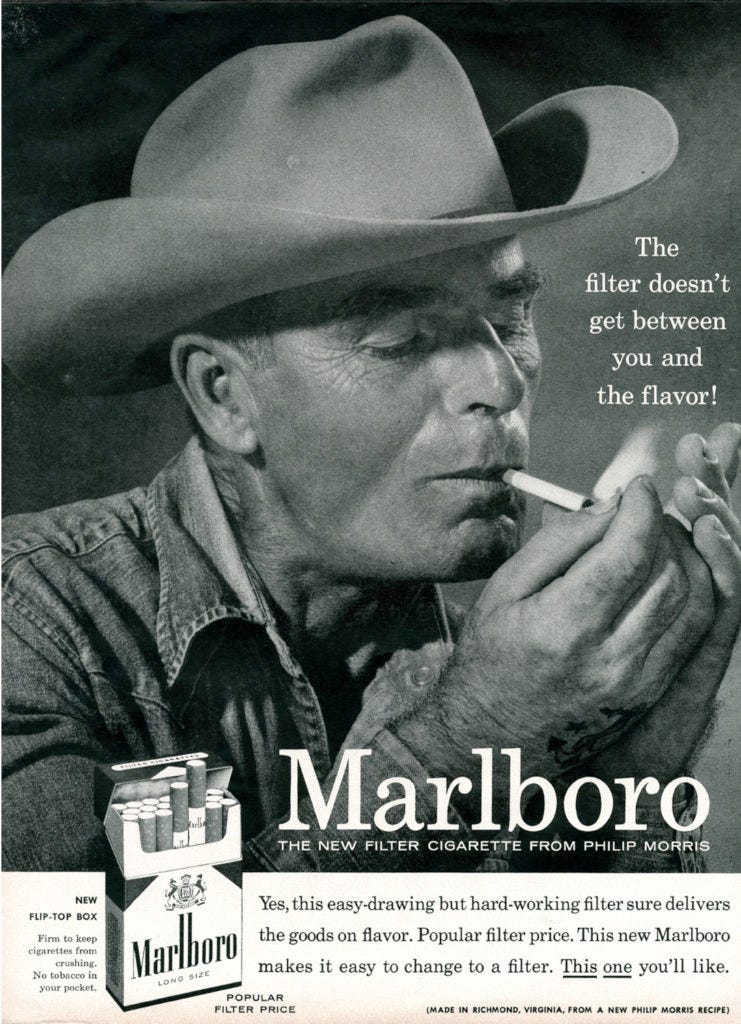
The cowboy the client thought was too regional, too masculine, too narrow turned out to appeal to everyone. Men bought the cigarette. The image pulled in everyone else.
The Marlboro Man was never one man. Over 45 years the role went to actors, models, agency employees and a handful of actual ranchers. The first ones were fakes. Paid models pretending to rope cattle, plus Burnett’s own art supervisor posing in a uniform. You could tell they’d never sat a horse.

So he started casting real cowboys at rodeos.
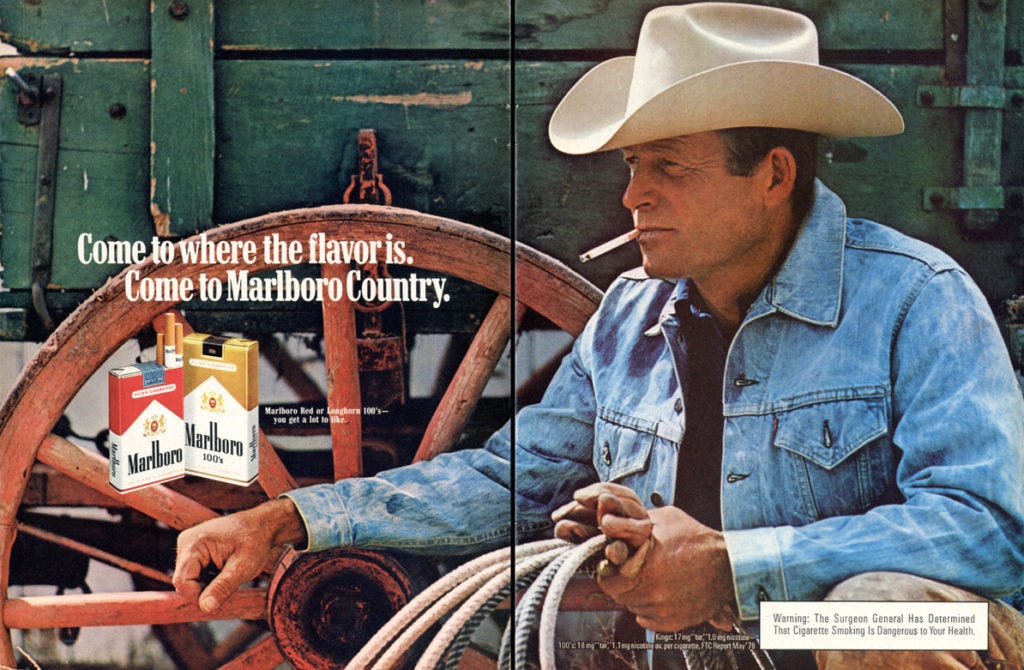
The definitive one was Darrell Winfield. A ranch hand on the Quarter Circle 5 in Wyoming, discovered by the agency in 1968. He wore his own clothes to the shoots.
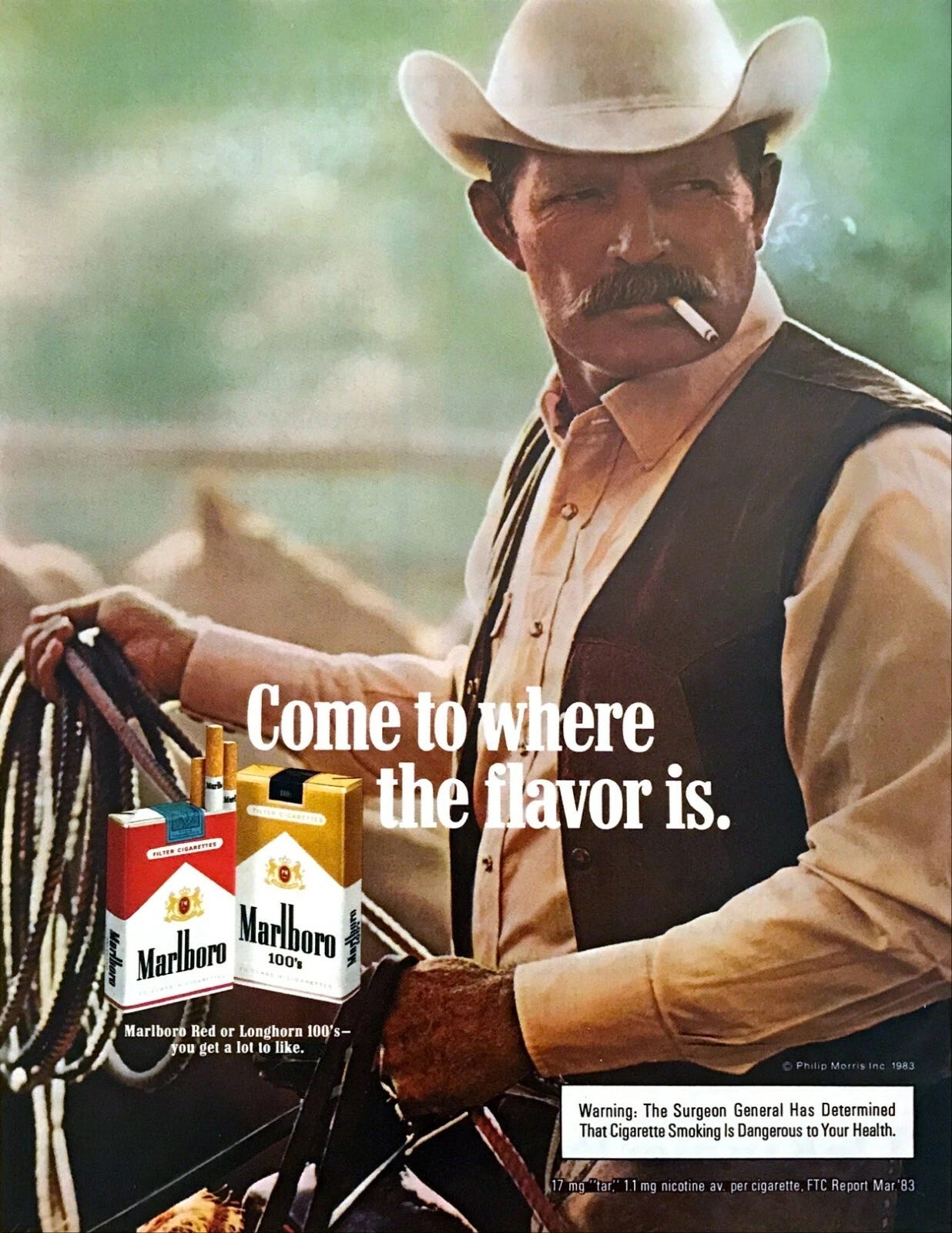
At his peak he was in eight of every ten Marlboro ads on earth, and he held the role for two decades. He once said Burnett didn’t do “phoney baloney stuff” and that Marlboro Country was about as close to authentic as they could make it.
WHAT THE COWBOYS FOUND OUT
Marlboro Reds picked up a street name Philip Morris never printed.
Cowboy Killers.
The men who played the part are why it stuck.
The ones who never smoked walked away. Bob Norris was the real thing — a Colorado rancher the agency found because he knew John Wayne. Twelve years as the Marlboro Man, never touched a cigarette, quit because he didn’t like what it might teach his kids. Died in 2019 at 90.
The ones who believed the ad didn’t. Wayne McLaren modeled in the mid-70s, got lung cancer at 49, and spent his last years testifying for anti-smoking laws and pushing Philip Morris at shareholder meetings to pull back. The company answered by denying he’d ever been a Marlboro Man — then walked it back to say the real one was Darrell Winfield. The authentic cowboy they’d built became the thing they used to disown a dying one. McLaren died in 1992. His last words, per his mother — tobacco will kill you, and I’m living proof.
The rest went the same way. David McLean, sued Philip Morris claiming he was handed five packs a take to get the shot, lung cancer, 1995. Eric Lawson, COPD, 2014. Dick Hammer and Tobin Jackson, both lung cancer.
The product kept its promise. Just not the one on the billboard.
The Master Settlement Agreement didn’t ban the Marlboro Man. An earlier failed deal would have wiped human figures out of cigarette ads forever — the settlement that actually passed in 1998 let him live.
It just took away every place he could appear.
Cigarettes had been off TV and radio since 1971. The 1998 settlement — $206 billion, 46 states — banned the billboards. And the billboard was the Marlboro Man’s whole world.
The lone rider, fifty feet tall, against a desert sky. In 1999 they came down across the country and the most recognizable cowboy in America had nowhere left to ride.
THE AD LESSON
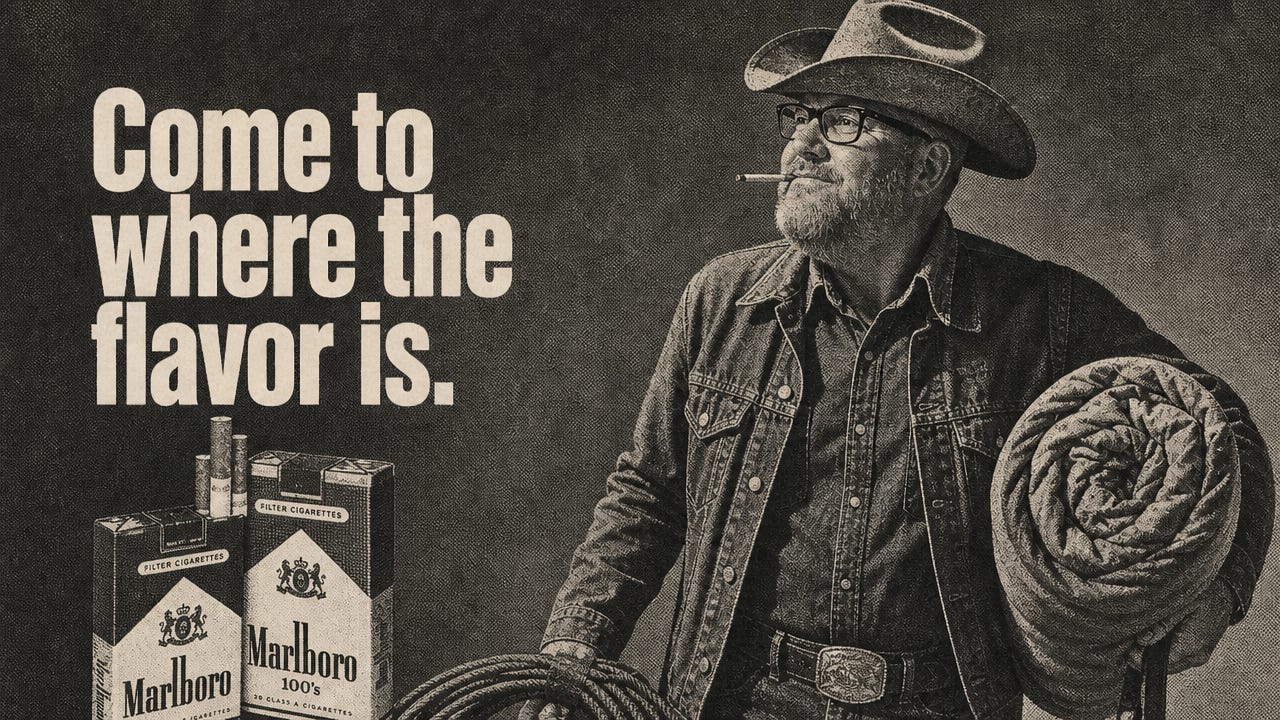
Burnett preached “inherent drama” — every product hides something true and human, and your job is to dig it out. Marlboro broke his own rule. There was nothing true or human buried in a filtered cigarette that used to ship with lipstick-matching tips. So Burnett didn’t uncover the drama. He imported it — bolted a cowboy who had nothing to do with the product onto the front of the brand and let it ride.
His second move mattered just as much. He refused to argue. Every competitor was explaining their filter, the science, the safety, the technology. Burnett understood the explanation was the problem. Defend the product and you remind people the product needs defending. So he said nothing about cigarettes at all and let the cowboy carry the whole thing. Nobody buying Marlboros in 1960 was thinking about filtration. They were thinking about the man.
Here’s the darker half. The most “authentic” campaign in advertising history was almost entirely manufactured. The cowboys were mostly models and actors. The most famous real one was a Wyoming ranch hand the agency used to prove their fantasy was true — and later used to disown a dying one.
Authenticity wasn’t the truth of the campaign. Authenticity was the product. That’s exactly how dark this gets — emotional identity beats factual information almost every time, and the people selling the identity always know it before the people buying it do.
Burnett knew. Philip Morris knew. The cowboys found out last.
COCKTAIL OF THE WEEK: THE GIN RICKEY

Gin, fresh lime, soda, no sugar. Bone dry and all fizz with nothing sweet to get in the way.
Born in 1880s Washington DC at a lobbyist hangout called Shoomaker’s, named for Colonel Joe Rickey, who took his drinks dry and his politics Democratic. It started as a whiskey drink. Gin showed up a decade later and stole the name.
Fitzgerald put it in The Great Gatsby — the gin rickeys land on the hottest afternoon of the book, right before everything comes apart. Same chapter where Daisy looks at Gatsby and tells him he resembles “the advertisement of the man.” A drink, a heat wave and an ad reference, all in one scene. We didn’t plan that.
The cowboy got retired by a Washington courtroom. So this week we drink like a Washington lobbyist.
Gin Rickey
2 oz gin
1/2 oz fresh lime juice
Soda water
Build over ice in a highball, top with soda. Lime shell dropped in. You’re welcome.
The Drink Cart is the newsletter version of sitting at a really good bar with someone who thinks too much about advertising and won’t shut up about it. Subscribe to get it on Wednesdays and Fridays.
A Gin Rickey sounds kind of perfect.