

Dr. Evil came back this week.
Not for a movie. Twenty-four years after Goldmember, after a decade of will-he-won’t-he about a fourth Austin Powers, Mike Myers finally put the bald cap back on and reanimated the most quotable comedy villain of his generation, to sell Verizon.
He brought the whole band. Seth Green as Scott. Rob Lowe as Number 2. Mindy Sterling as Frau Farbissina. The lair outside Las Vegas. All of it dusted off and fully operational, so Dr. Evil could pitch a world-domination scheme called Menace Mobile and have his own henchmen tell him they’d rather have Verizon’s no-hidden-fees plan.
That’s the joke. The supervillain’s evil phone plan loses to a cleaner telco plan.
This is not even the first time Myers has rented Dr. Evil out for ads. There was a Super Bowl spot back in 2022 too. The character too precious to revive for 24 years. Available, apparently, for a teleco. Turns out, he claims a sequel is coming. God help us all.
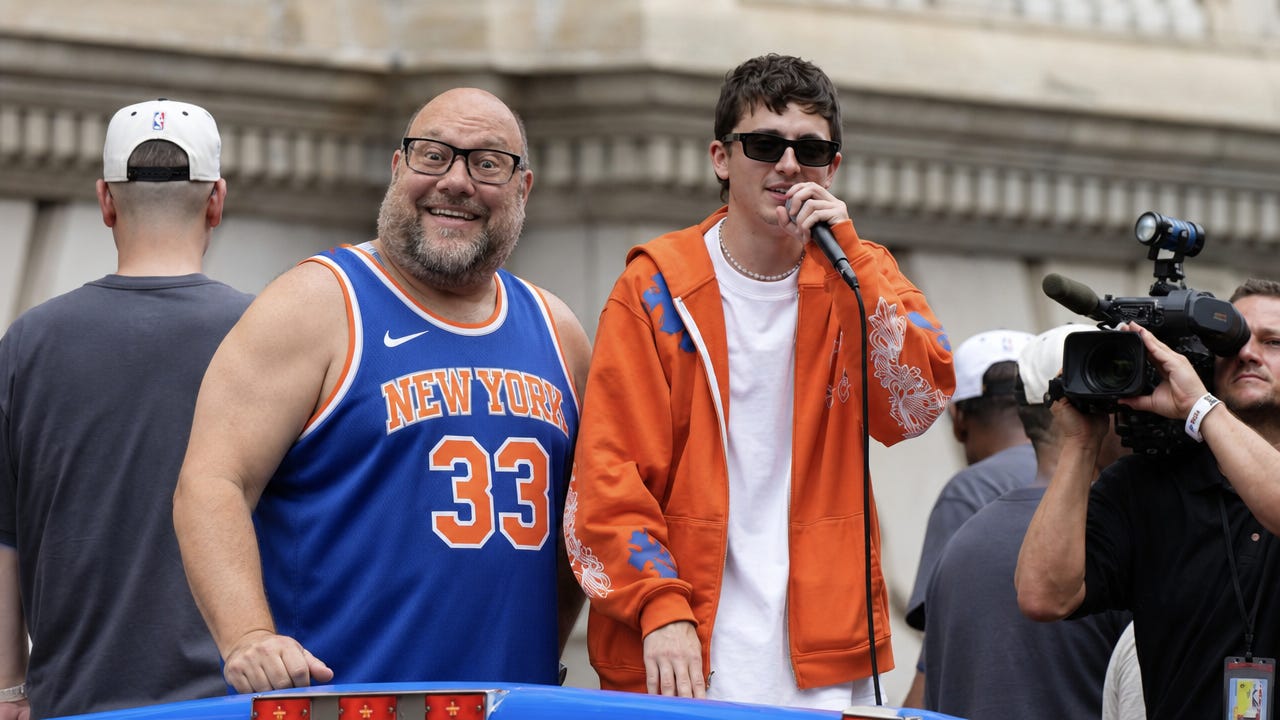
This week, another icon, Timothée Chalamet, was being torn apart asking if he had sold his soul. Next to Myers, Timmy C looks like a Trappist monk. But his sellout is the more interesting one.
A man watched his team win its first championship since ‘73 from courtside seats and the internet decided the real story was that he had to sell his soul to do it.
The Knicks closed out the Spurs in San Antonio on Saturday, ending a drought that started when Richard Nixon was president. Funny side bar, but there is an article this week about how Nixon is suddenly cool on social media. But little Lisan al Gaib from Hell’s Kitchen got his ring-adjacent moment.
And the same week, he dropped a Kalshi ad. So the comments went: “had to pay for those courtside seats somehow.” “Bro sold his soul.” “Dune funds couldn’t have dried up that fast.”
The roast is missing the actual story.
HE’S THE MOST INTERESTING AD GUY IN HOLLYWOOD
Here’s the ad résumé people forgot while they were dunking.
Cartier, since 2021. The luxury Muad'Dib on-ramp.
Then Bleu de Chanel in 2023 — and this is where it gets good. Chanel didn’t hand him a 30-second spot. They handed him a Martin Scorsese short film. Ninety seconds, mostly black and white, scored to Herbie Hancock’s “Rockit,” riffing on a Fellini short about an actor losing himself to fame. A fragrance ad built as an art film about hating fragrance ads.
Last year, Timmy cashed in with Cash App in a spot that ran as an ambient short before blockbusters instead of a hard sell.
And the adidas film, which was barely a shoe commercial. A whole soccer-obsessed universe, Messi and Bad Bunny and Jude Bellingham floating through it, and somehow Chalamet was the gravity. It played like an installation, not a 15-second pre-roll.
See the pattern? Chalamet has never once done a normal ad.
Every partnership is a weird little movie that refuses to behave like marketing. The Marty Supreme rollout was the same instinct — bro climbed the Sphere and pitched his own campaign over a viral Zoom call.
So when this Kalshi ad turned out strange, that wasn’t a betrayal of the brand.
That was the brand.
There’s a reason Chalamet has appeared in The Drink Cart not once, or twice, not three times, or even four times, but five times. At this rate we might need to think about some branded Six Time Drink Cart Jackets.
SO DID HE SELL HIS SOUL OR NOT
The ad itself is committed to the bit. One minute, directed by Linus Sandgren — who has an Oscar for shooting “La La Land,” because of course Chalamet got an Oscar winner to point the camera.
Timmy says “Kalshi” to his dentist mid-procedure. He bangs his head on the ceiling to shut up his upstairs neighbors. He tests keyboards in a Guitar Center. The word flashes. The ad never tells you what Kalshi actually is.
As a piece of craft? It’s exactly his lane. Deadpan, surreal, allergic to explaining itself. If this were for Squarespace nobody blinks.
The problem isn’t the film. The problem is the client.
Kalshi is a prediction market — bet on outcomes, including stuff that got close enough to death markets to draw legal heat. The CEO has since said they don’t list markets tied directly to death. This is not Cartier. This is a casino wearing a fintech blazer.
And that’s the whole tension. Chalamet’s whole appeal is that he chooses. The Scorsese short, the art-film shoe spot — they work because we believe he’s curating, not cashing checks. The second the choosing starts to look like chasing the bag, the spell cracks. An Oscar-winning cinematographer doesn’t launder a predatory product. He just makes it look expensive and cool.
Bro didn’t sell his soul. He rented it to a betting app and hired a fancy director to shoot it.
THE CHALAMET AD RULE
The rule was never don’t sell out. Everybody sells out. The rule is how.
Chalamet wrote the modern version of it. If you’re going to take the check, make it cool. Make it art. Hire the best director you can get in a room. Score it like a film. Stay in control of every frame.
Because here’s the part nobody at the agency says out loud — when the talent is this big, the talent runs the set. The agency is sniffing off his vapor. They’ll settle for a few approving nods in a boardroom and the slim chance the client gets flown out to grab a photo on set with Tim.
So the work bends to him, not the other way around. The Scorsese short exists because Chalamet can summon Scorsese. The shoe film looks like an installation because the star had the leverage to demand it. He’s not a logo’s hostage. Chalemet is the captain now. And he just took Tom Hanks hostage on a boat.
Warhol called this 50 years ago. He would know, he was a commercial illustrator before he was Warhol. Making money is art, he said, and good business is the best art. He stopped pretending the wall between commerce and craft was real and started charging for it.
That’s the rule. You don’t avoid the sellout. You out-class it. You make the ad so good that “he sold out” curdles into “wait, did you see what he did with it.”
Kalshi is the one place the rule strains — not because the film is bad, but because no amount of control makes the client cool.
Make the art. Keep the control. End of lesson.
THE COCKTAIL: THE GALLIANO SOUR
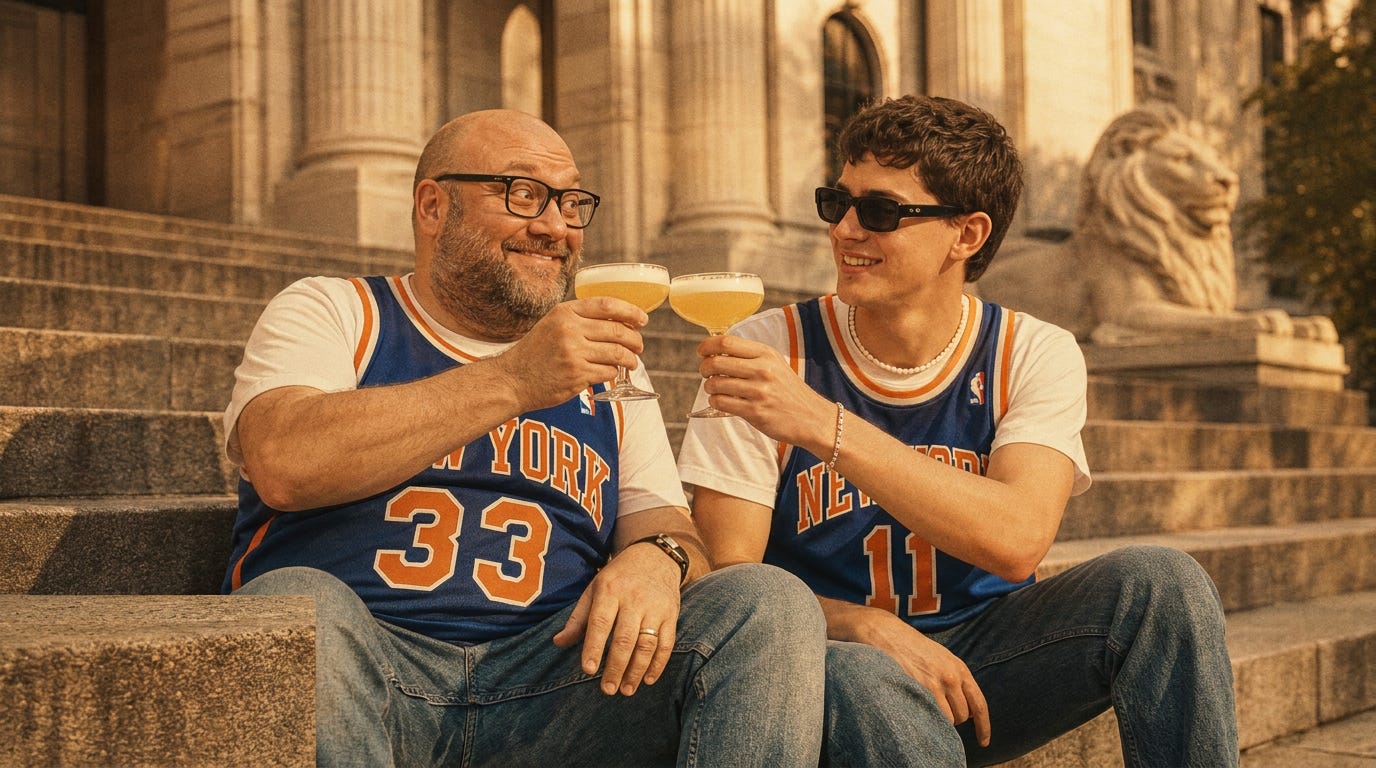
This week’s drink comes with its own vintage ad, and the ad is the whole point. It’s 1972. McKesson is selling Galliano with a candlelit shot of two beautiful people about to either kiss or duel, and a headline that toasts itself: “May all your sours be Galliano sours.”
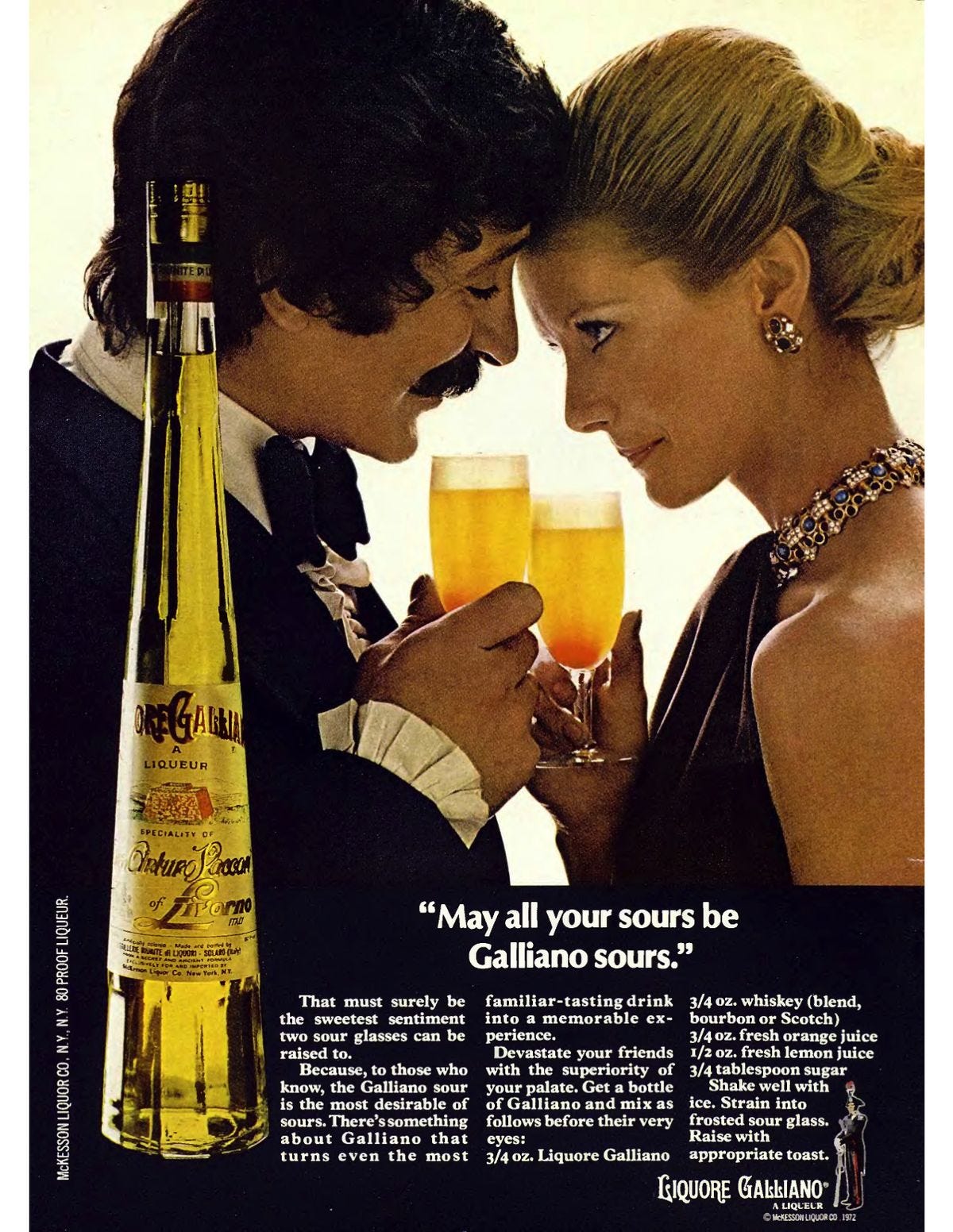
The body copy doesn’t sell taste. It sells superiority. Make this, it says, and you will devastate your friends with the superiority of your palate.
That’s a Chalamet move if I’ve ever seen one. Take the most ordinary format in the world — a whiskey sour, an endorsement deal — and dress it up until it’s insufferable in the best way.
And Galliano itself is the original prestige veneer. The bottle calls it a secret and ancient formula. It was invented in 1896 by a Livorno distiller named Arturo Vaccari, who named it after Giuseppe Galliano — an Italian war hero who’d died at the Battle of Adwa months before the liqueur hit shelves.
So the “ancient” golden elixir was Victorian, and the legend got bolted on after the fact. Tall Roman-column bottle, gold-rush yellow, a dead hero’s name. Pure manufactured heritage. By the 70s it was the best-selling liqueur in America.
Kalshi hired Chalamet and an Oscar winner to look this expensive. Galliano just did it with a bottle shape and a good story.
So raise with appropriate toast — the ad’s words, not mine. This week the appropriate toast is to the Knicks.
The Galliano Sour
3/4 oz Galliano
3/4 oz whiskey (blend, bourbon or Scotch)
3/4 oz fresh orange juice
1/2 oz fresh lemon juice
3/4 tablespoon sugar
Shake hard with ice and strain into a frosted sour glass. The original calls for sugar straight — if you’d rather not gamble on it dissolving, swap in 1/2 oz simple syrup. Bourbon makes it rounder, Scotch makes it smokier and more interesting.
Vanilla, anise and citrus over whiskey. Devastate and sell out accordingly.
The Drink Cart is the newsletter version of sitting at a really good bar with someone who thinks too much about advertising and won’t shut up about it. Subscribe to get it on Wednesdays and Fridays.
Whatever else he is, he’s not boring.