

Try explaining to a kid today what it meant to run out of batteries in 1983.
Not your phone. You charge that overnight, full by morning, the whole transaction invisible. Batteries didn’t work like that. Batteries were a finite resource you hoarded in a kitchen drawer.
A crisis when the remote died. You went through drawers like a hungry raccoon cracking open the back of every other device in the house to see who had a fresher pair worth stealing.
The Walkman ate them. Game Boys ate them even faster. The smoke detector that started chirping at 3am for reasons known only to God. The flashlight you needed exactly once every five years during a blackout, when you discovered the batteries in it had died during the last blackout.
Your entire life ran on AAs and you never had enough of 'em.
And here’s the part that sounds genuinely insane now. You couldn’t tell how much was left.
No percentage. No little icon. You used the thing until it slowed down or quit, and then you guessed. Dead battery or broken toy? Nobody knew. So you’d toss a maybe-battery back in the drawer and find it six months later with no way on earth to know if it had anything in it.
Then in 1996 they put the tester right on the battery. Press two dots, watch a strip change color, mystery solved. It felt like the future.
It was also a tiny lie. The strip ran current through heat-sensitive ink, which means every time you checked how much life the battery had, you spent a little of it. Checking the charge cost you charge. Duracell’s strip gave you a percentage. Energizer’s just said “good” and went blank when it wasn’t.
Both companies announced the technology on the same day in December 1995, then spent years in court over who owned it.
These two had been at war for a decade. And the whole thing started with a rabbit nobody was supposed to keep.
THE BUNNY WAS A ONE-OFF PARODY
In 1973, Duracell launched a campaign in Europe. A set of pink toy rabbits, all drumming at once. Batteries dying one by one. Only the Duracell rabbit keeping going. Simple. Memorable. They ran it for fifteen years, made their point and stopped. They also let the US trademark lapse in 1988.
DDB Needham noticed.
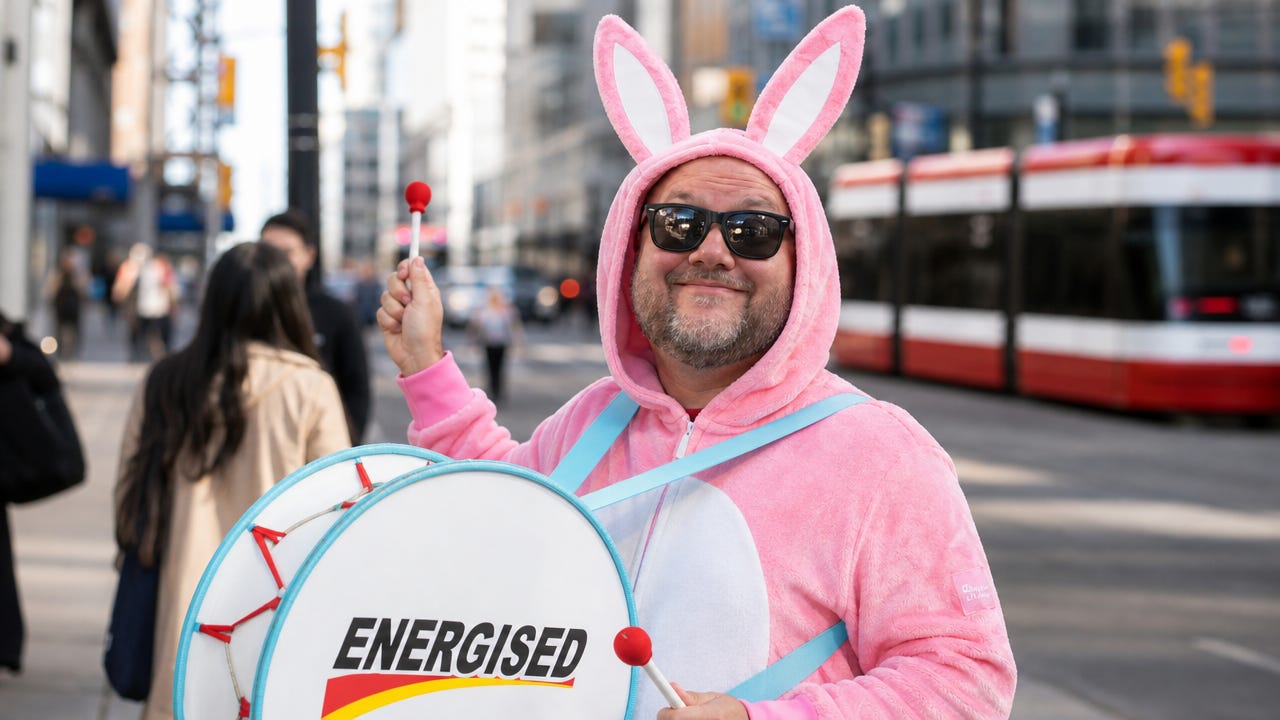
They made a commercial that opened exactly like a Duracell ad. Multiple pink bunnies drumming, batteries fading out one by one. And then a different pink bunny marched onto the screen. Sunglasses. A massive bass drum with the Energizer logo on the head. He kept going while every other bunny stopped cold. They filed the trademark immediately.
The first commercial aired October 30, 1988.
And it didn’t really work. The first spot was fine. Competent. Forgettable. The Bunny everyone actually remembers showed up only after Energizer handed the campaign to Chiat/Day, who found the thing that made it click.
The Bunny isn’t selling at you. He’s rescuing you. He interrupts bad commercials, which puts him on the viewer’s side. Jay Chiat went for the throat, and a competent competitive battery ad became one of the great sustained campaign structures in advertising history.
The actual Bunny was built by Eric Allard’s company, All Effects. Allard was the robotics guy who built Johnny 5 for Short Circuit. Same shop did the creature for the 1988 Blob remake and worked on Teenage Mutant Ninja Turtles III. He went from movie monsters to a corporate rabbit on a drum, and he’s on record saying the Bunny is probably his most recognized work. Sit with that.
Here’s how the campaign ran. The Bunny would interrupt fake commercials for fake products, marching through mid-pitch, still drumming. And the fake products had real names. Sitagin Hemorrhoid Remedy. Nasotine Sinus Relief. TresCafe Coffee. Somebody wrote those. Somebody got paid to name a fictional hemorrhoid cream so a rabbit could ruin its commercial. That’s the job.
AND THEN THEY INVENTED A VILLAIN
This is the part that gets left out. The famous crossovers — Darth Vader, King Kong, the Wicked Witch of the West, Wile E. Coyote, Boris and Natasha — weren’t random celebrity cameos. Energizer built an entire fictional rival battery company to hire them. It was called Supervolt. It had its own mascot. It was a deliberate Duracell lookalike. And its CEO was played by Rip Torn.
The bit was always the same. Supervolt hires a famous villain to destroy the Bunny. The villain corners him. And then the villain’s weapon dies, because it was running on Supervolt batteries. Vader’s lightsaber goes dark. Coyote’s gadget quits. King Kong gets tricked off the Empire State Building. The product demo was the plot. Even the Grim Reaper showed up and got out-waited.
Now the good part. Duracell built the exact same thing in reverse.
Their counterpunch was the Puttermans, a family of plastic robots powered by Duracell who ran from 1994 to 1996. Their enemy was a generic Brand X drawn to look like Energizer.
So at the same moment, both companies were producing elaborate expensive commercials starring a cartoon-villain version of the other guy. Two brands. Each one the bad guy in the other’s universe. The whole battery aisle was a cinematic universe nobody asked for.
THE CAMPAIGN WORKED. THE SALES DIDN’T
During the peak Bunny years when Energizer was most culturally embedded, the brand stayed stuck behind Duracell.
Duracell claimed 40% of customers thought the Energizer campaign was actually for Duracell. The pink bunny was so completely associated with battery advertising that consumers couldn’t reliably remember which company owned him. The campaign designed to destroy Duracell’s brand was accidentally reinforcing it.
Energizer kept running it for 35 years anyway.
Even the tagline ended up in a courtroom. Nothing outlasts the Energizer had to be softened after Duracell sued over the claim. With these two, everything was a battlefield. The mascot. The trademark. The tester strip. A single adverb.
In 1992, Duracell filed for a new US trademark on their own bunny citing prior use. Energizer filed suit. The settlement split the world in two. Energizer keeps the trademark in the US and Canada. Duracell keeps it everywhere else. This is why if you grew up in Europe or Australia you remember the Duracell Bunny, and if you grew up in North America you remember Energizer. One world. Two pink drumming rabbits. Divided by trademark law.
Energizer Bunny entered the language as a synonym for unstoppable endurance. George H.W. Bush compared himself to the Bunny during the 1992 campaign. Howard Dean did the same in 2004. Two presidential candidates, twelve years apart, reaching for the same mascot to describe their own resilience. When politicians use your character as a metaphor for staying in a fight, the character has done something beyond advertising.
THE AD LESSON
The Energizer Bunny is proof that cultural penetration and sales effectiveness are not the same thing, and sometimes one matters more.
The numbers didn’t support the campaign. Brand confusion was documented. Duracell still was #1. And yet the Bunny became a phrase people use in sentences that have nothing to do with batteries. That kind of embedding is almost impossible to engineer directly.
Energizer kept going because going was the whole point. The product benefit and the campaign mechanism were the same thing, and once you’ve found that, you don’t stop even when the quarterly numbers are telling you to. The lesson is also in the accident.
They built the whole campaign on a competitor’s lapsed trademark. And the two of them spent so many years obsessed with each other that they each wrote the other into their own commercials as the villain.
Sometimes the best idea in the room is the one nobody protected. Sometimes the whole category is just two companies who can’t stop thinking about each other.
COCKTAIL OF THE WEEK: THE NORDIC NEGRONI
Here’s a confession. I did a bar cart clear-out a few weeks ago and found a mini bottle of aquavit I got for Christmas - I’m not even sure when. It had just been sitting there behind the good gin, doing nothing. The bar cart equivalent of that battery in the junk drawer you can’t bring yourself to toss.
So I did what a responsible adult does now. I fed the contents of my bar cart into a robot and asked what I could make.
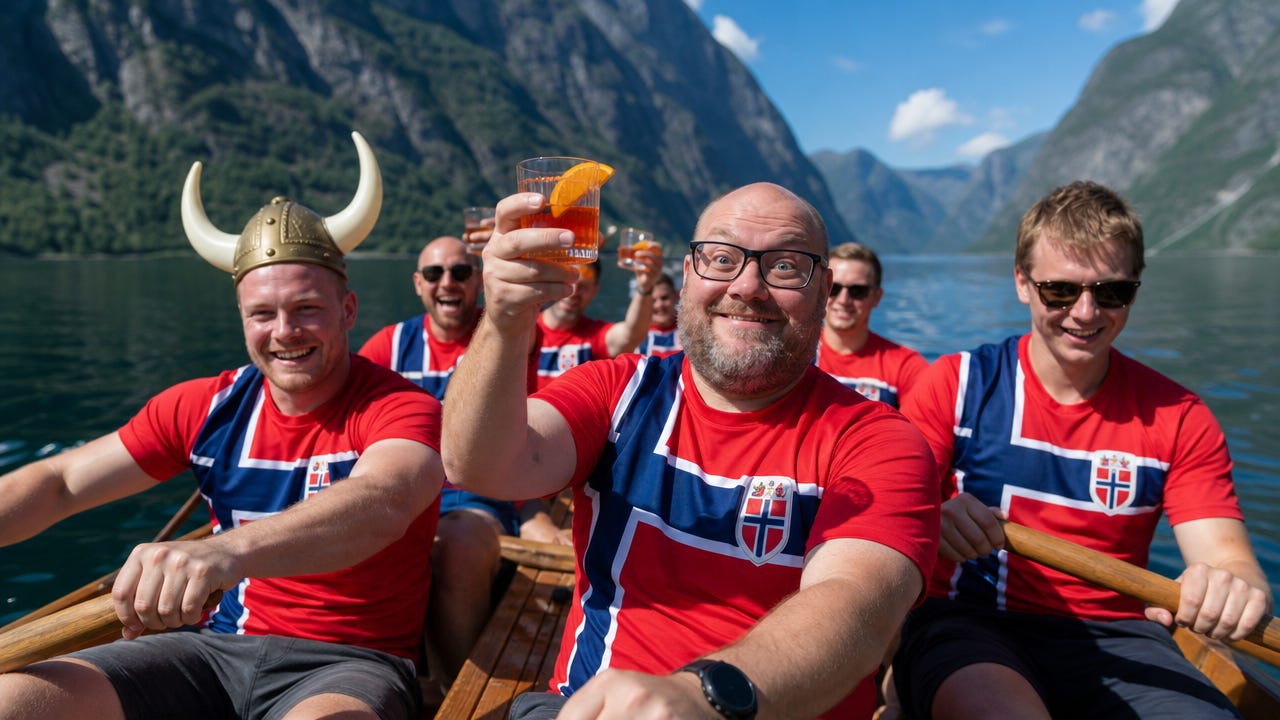
It came back with a Negroni. Aquavit swapped in for the gin. And it’s a nice taste. Genuinely good. The caraway leans into the Campari instead of fighting it. Earthier than a regular Negroni. A little bread-y. Like a Negroni that spent a winter in Oslo at $47 a cocktail.
Then I went looking into the thing I’d been ignoring all this time, and it turned out the aquavit had a better travel history than I do.
Aquavit is the Scandinavian water of life. Aqua vitae, same root as whisky’s uisce beatha. Distilled from potato or grain, flavored with caraway and sometimes dill, kicking around since the 1500s. But the best story in the whole category belongs to one bottle in particular.
In 1805 a Norwegian shipowner named Catharina Lysholm loaded five casks of potato aquavit onto her brig and sent them to the East Indies, betting she could crack a new market. Nobody out there wanted Norwegian caraway hooch. The casks came home unsold two years later. But when the Lysholms cracked them open, the spirit was transformed. Rounder. Smoother. Better. Months at sea, the constant rolling, the swing from tropical heat to North Atlantic cold, had aged it in a way no cellar ever could.
So they made the voyage the entire point. The brand became Linie, Norwegian for the line. As in the equator. Every cask still sails the world for four months in old Oloroso sherry barrels lashed up as deck cargo, crossing the equator twice and stopping in dozens of ports before it ever gets bottled. Every back label tells you the ship’s name and the dates it sailed. It’s the only thing on the boat that gets picked up and dropped off at the same harbor.
The casks ride up top, out in the weather, on purpose. Temperatures swing from the high 40s to below freezing. And in the old days sailors used to drill holes in the barrels, drink the aquavit on the sly and plug the holes back up with wooden pegs — so a few casks came home, in one blender’s words, like porcupines on the inside.
A spirit that crosses the equator twice and keeps going. For an issue about a rabbit that won’t quit, I couldn’t have planned that better. That little mini bottle hiding on my bar cart had probably seen more of the world last year than I did.
It just kept going. Same as the Bunny. Same as the drink.
The Nordic Negroni
1 oz aquavit
1 oz Campari
1 oz sweet vermouth
Stir with ice until cold. Strain into a rocks glass over a big cube. Express an orange peel over the top and drop it in.
If you’ve got a bottle of Linie, use that and read the back label first. It earned it more than the rabbit ever did.
The Drink Cart is the newsletter version of sitting at a really good bar with someone who thinks too much about advertising and won’t shut up about it. Subscribe to get it on Wednesdays and Fridays.
Two brands that couldn't stop thinking about each other long enough to notice they were running the same ad. Classic! 🐰🥁
The interesting thing about some of those energizer bunny “fake” ad commercials is that the Energizer bunny doesn’t come in until 3/4 of the way through the commercial. Would be hard to sell that in these days…