

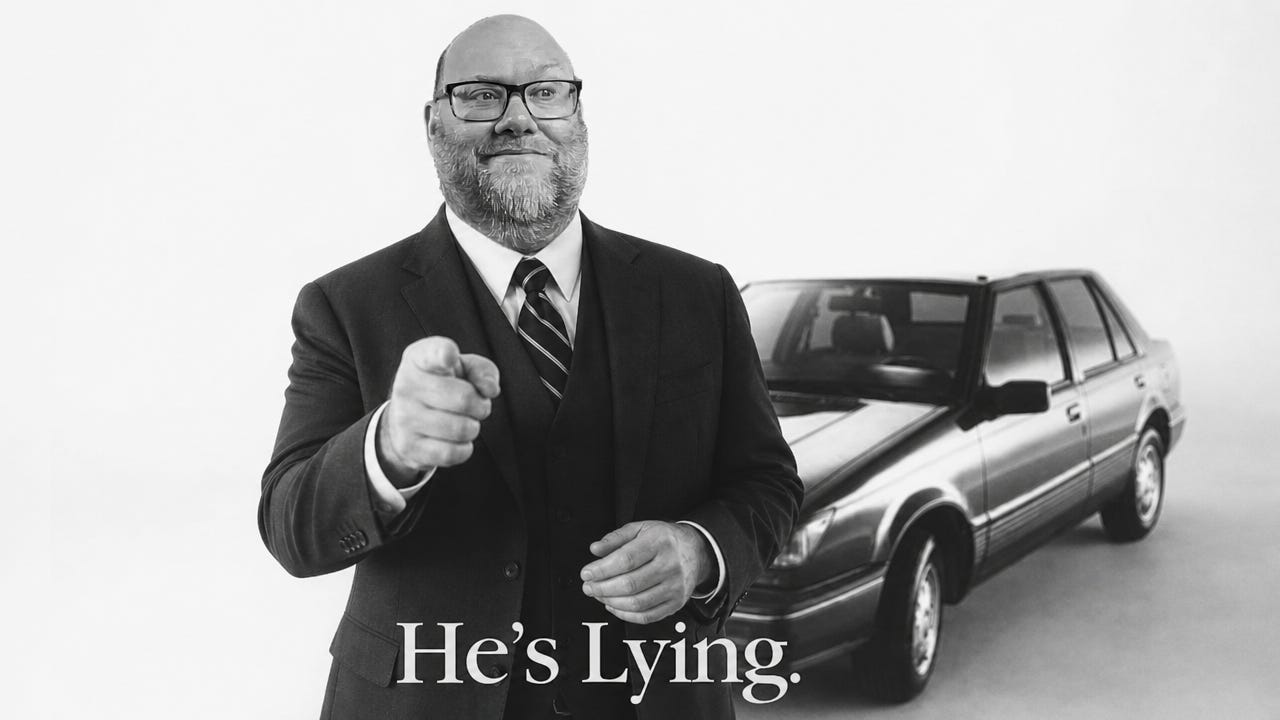
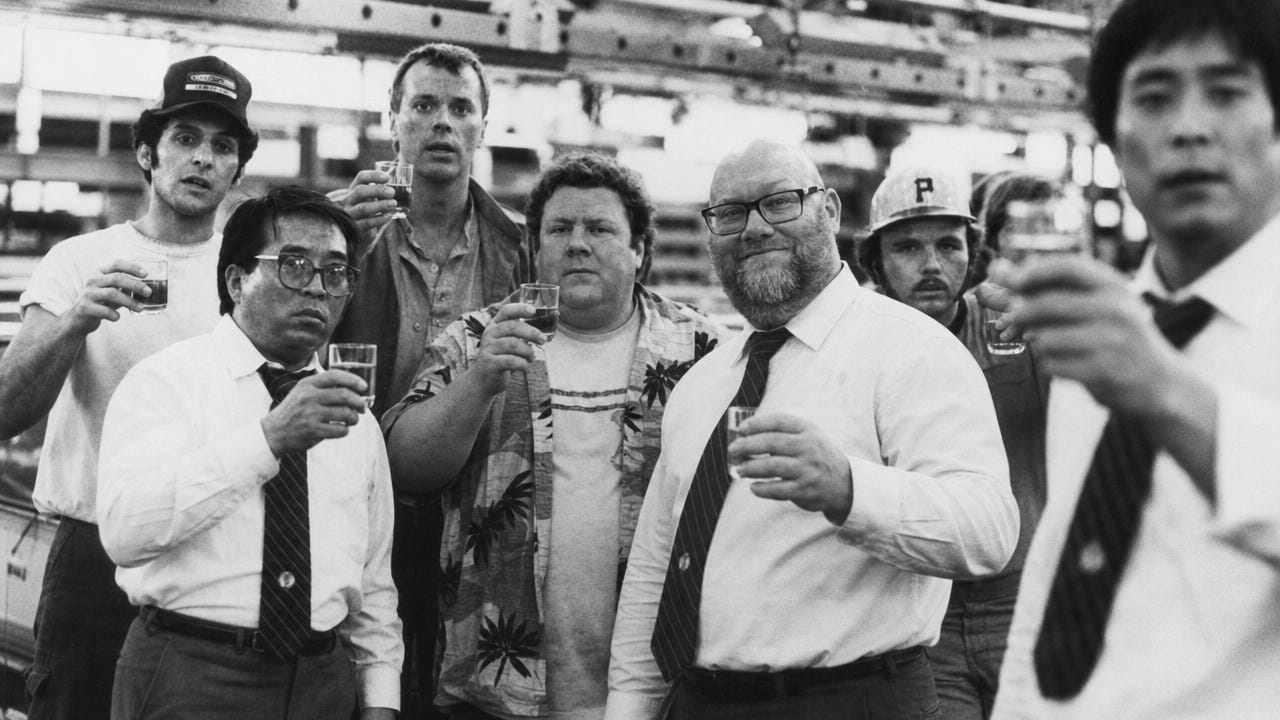
I saw a post about Gung Ho, the short lived TV series about a Pennsylvania auto plant taken over by a Japanese car maker, based on the 1986 film directed by Ron Howard and starring Michael Keaton.
Keaton was a bit of a generational run, playing his second car manufacturing character. The movie is very 1986. The trailer is even more 1980s. That voice.
Of course I had to watch it. Incredible 40 year old artifact.
But that’s not really the story. The story is about panic.
The US-Japan trade deficit climbed from $10 billion in 1981 to $50 billion by 1985.
It got so bad that by 1987 US politicians were taking sledgehammers to Toshiba radios on the Capitol lawn. Not about cars per se, but more about sticking it to companies selling tech to the commies.
By 1989 Americans rated Japan a bigger threat than the USSR.
This seems like a parable for AI coming for us. And maybe the scrappy steel town (aka humans) can actually fight back against the robots.
THE WORST CAR BRAND IN AMERICA
So Japan’s taking over and at the same time a completely unpronounceable brand enters the market.
It was so completely unpronounceable that their first campaign was just getting consumers to learn how to say it.
To make matters worse the car was everything that America hated in the early eighties.
Embarrassingly small. Foreign. Low budget. Some things never change.
They entered the market with 0.26% share in 1981. Only to squeak to 0.68% by 1985.
This is the story of Isuzu. (100% True)
SO THEY CAST A LIAR
In 1986 Della Femina Travisano & Partners landed the account.
Ron Travisano went to the heart of the matter. Every car brags, so why not make the most brag worthy mascot or spokesperson ever.
So the pitch was devilishly anti-advertising and self aware. And that’s where they could let the lies rip.
$10.80 cars. 300 miles per hour. More seats than the Astrodome.
All paired with subtitles and lines like “He’s lying,” “If I’m lying, may lightning hit my mother” and “You have my word on it.”
They apparently wanted Jon Lovitz, fresh from his SNL pathological liar skits.
They found David Leisure instead. A struggling actor who was living in a Volkswagen.
He became Joe Isuzu.
GUESS WHAT? IT WORKED. KIND OF.
The campaign worked. They didn’t defend Japanese cars or even mention Japan. But they changed the subject to the real villain. The car salesman. The most distrusted archetype in the world.
The subtitles let viewers in on the joke and sales jumped. By the time they aired during Super Bowl XXI in 1987, they were well on their way to the top ten of consumer recall by 1989.
The campaign became part of culture too. In 1988 Michael Dukakis tried to paint George Bush as the liar. He said in a nationally televised debate, “If Bush keeps it up, he’s going to be the Joe Isuzu of American politics.”
It’s perfect. A fake liar becoming code for real liars while selling cars America hated.
WHAT GOES UP, MUST COME DOWN
Joe Isuzu got so big, people forgot about the car completely.
As he got more famous, they tried to make him more likable. The more likable he got, the less he tried to hammer the car salesman jokes.
By 1991 they fired Della Femina Travisano & Partners and ended the first run of Joe Isuzu..
They tried to bring him back in 1999 - 2001 but that didn’t work. By 2009 Isuzu stopped even making US passenger vehicles.
Leisure didn’t get the memo. He hawked A&W Cream Soda in 1992. Mocked Mitt Romney in 2012. He even made spots for the Isuzu Trooper a decade after the brand left America.
PENCILS DOWN
Here’s where things get interesting. 1986 and 2026 feel very similar. A different panic, a different problem.
But 82% of ad execs think Gen Z and millennials feel positive about AI ads, but only 45% do. And that gap is widening.
Half of US consumers prefer brands that don’t use generative AI in brand content. You only have to see the reaction to Coca-Cola’s holiday spots getting pegged with “Soulless” to realize it.
Nobody has built the AI-era Joe Isuzu yet. Will someone build the first AI mascot that lies beautifully and we’re all in on the joke because the villain isn’t AI at all?
COCKTAIL OF THE WEEK: THE JAPANESE COCKTAIL
Let’s go back even further than 1986. Further than 40 years, you’re crazy Jackson. Yes, let’s go all the way to 1862.
In Jerry Thomas’s How to Mix Drinks, a very early bartender’s guide, the author penned two cocktails himself, including The Japanese Cocktail.
The story goes that in 1860, the first Japanese delegation to the US finished their tour in New York and basically drank their way through America. When they stayed at the Metropolitan Hotel near Thomas’s bar, they were basically drinking cocktails “from breakfast to supper.”
There seems to be no evidence that the delegation hit Thomas’s bar or had any interaction. He never explained the name either.
The Minneapolis Tribune called the cocktail years later, “The Japanese Cocktail is a liquid attack of spinal meningitis. It is loaded with knock-kneed mental ceramics, and is apt to make a man throw stones at his grandfather.”
Yikes.
The Japanese Cocktail
2 oz cognac
½ oz orgeat
2 dashes Angostura bitters
Lemon peel.
Stir this up with ice. It’s kind of an Old Fashioned, but with the orgeat, it’s like a dessert too. That is the trap. A sneaky cocktail that will leave you gutted and features absolutely nothing Japanese about it. (I’m not lying.)
The Drink Cart is the newsletter version of sitting at a really good bar with someone who thinks too much about advertising and won’t shut up about it. Subscribe to get it on Wednesdays and Fridays.