


I’m pretty sure that when Grand Theft Auto VI comes out tomorrow, nobody is going to discuss banning it.
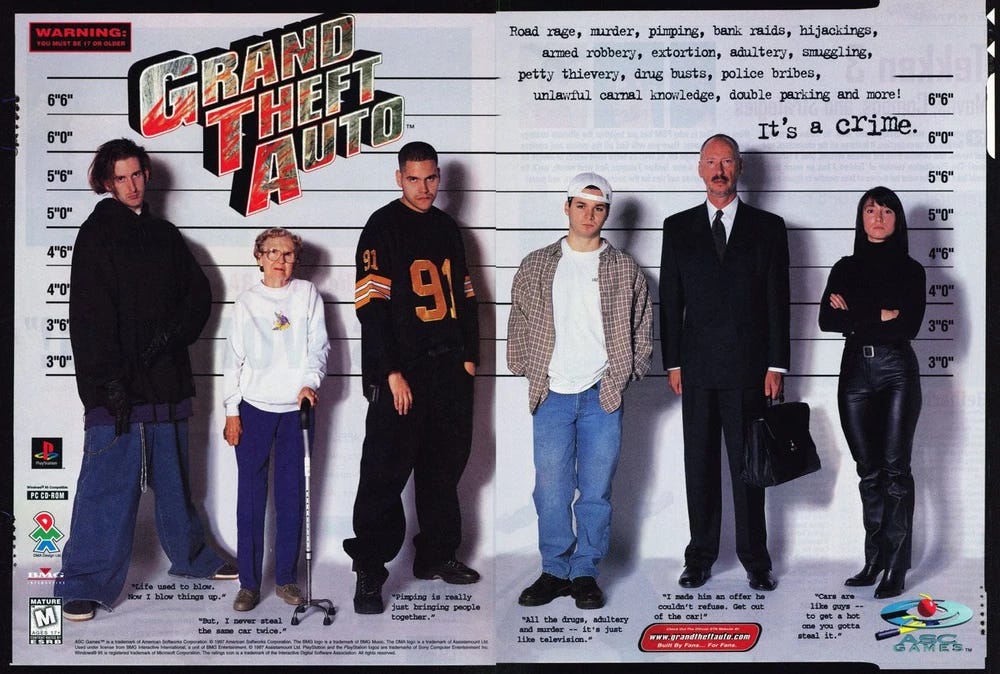
But in 1997, that very thing happened to the original Grand Theft Auto. The British House of Lords talked about banning.
Then a publicist named Max Clifford helped whip it up and turned it into the whole marketing campaign.
The controversy over the original game is shocking when you think about it now. The game was top down, the cars looked like Tic Tacs at best. But nobody in the House of Lords was playing it. But it made for a good fight. The latest version looks like a movie.
THE FIRST CONSOLE WAR WAS FOUGHT FROM AN ARMCHAIR
When Mattel launched Intellivision in 1980 they desperately needed people to buy it. Their marketing team figured a head-to-head battle with Atari would instantly jump awareness.
At the same time they hired the editor of the Paris Review, an unlikely and cerebral spokesperson in George Plimpton. He would intellectually compare the baseball games of both systems like he was in an Aaron Sorkin movie.
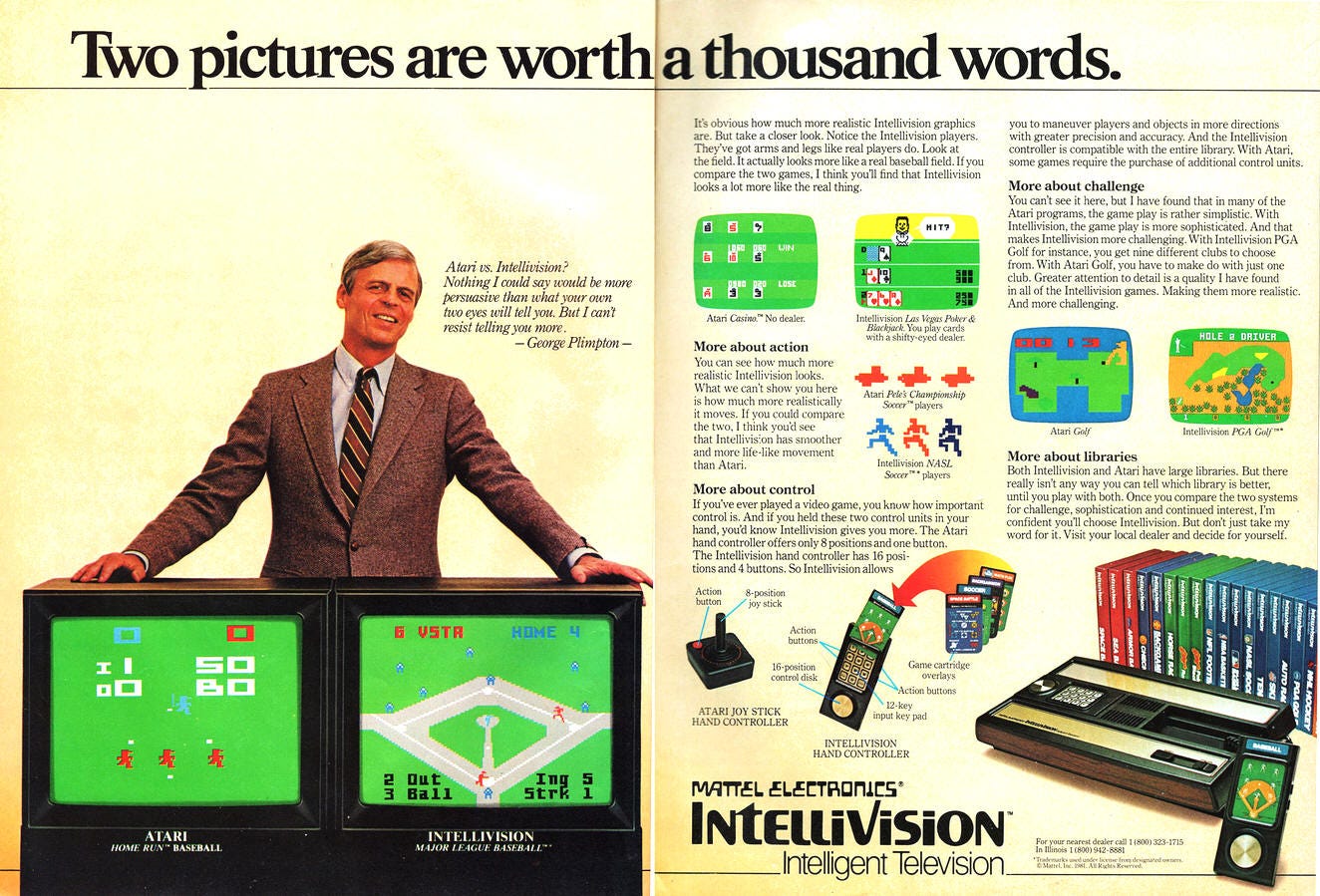
The pre-Christmas campaign cost more than $6 million. And frankly I only ever knew one family in our area that even had it. Now, to be fair, I like this campaign very much and the controller was a revelation.
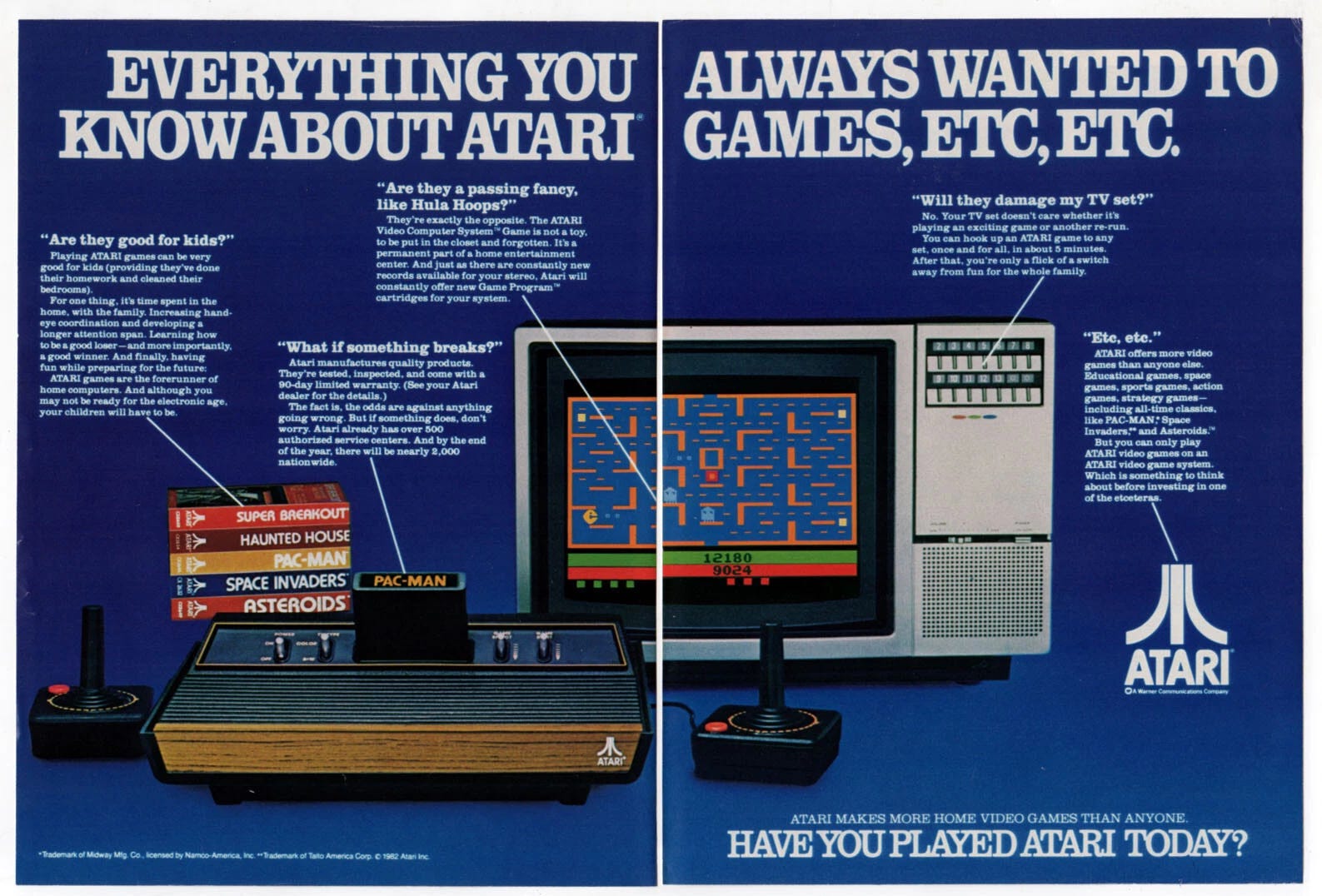
Atari answered with a jingle. “Have you played Atari today?”
This was almost unfair. Atari had Robert Wain Mackall from Doyle Dane Bernbach on the business and the power of the agency that dropped Think Small and sold the VW Beetle.
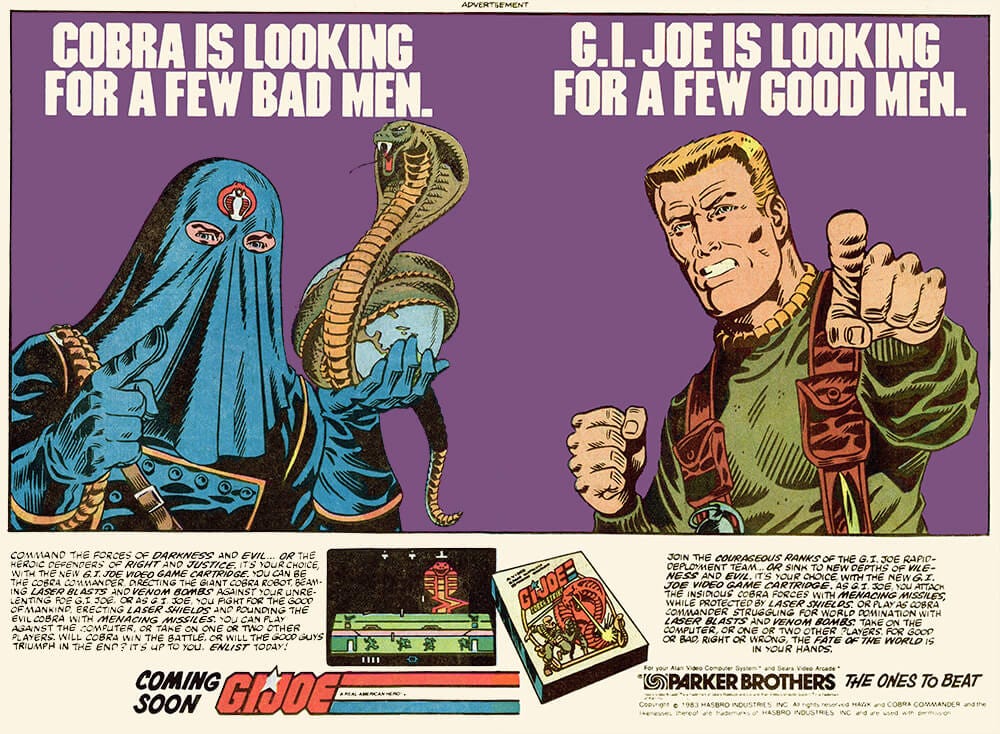
My favourite game ad remains the 1983 GI Joe ad from Parker Brothers. It’s perfect.
THE LEATHER COMPANY THAT BROUGHT THE ARCADE HOME
Coleco began in 1932 as The Connecticut Leather Company, supplying leather and shoe repair supplies to cobblers. Fifty years later it made the best video game console on the market.
ColecoVision’s ads promised “we bring the arcade experience home,” and for once the ad wasn’t lying.
Coleco bought the rights to Nintendo’s arcade hit Donkey Kong and threw the cartridge in the box for $199. Atari had its own version of Donkey Kong, and it was terrible. Coleco moved over 500,000 units by Christmas 1982, and more than a million by early 1983.
THEN VIDEO GAMES ALMOST DIED OUT
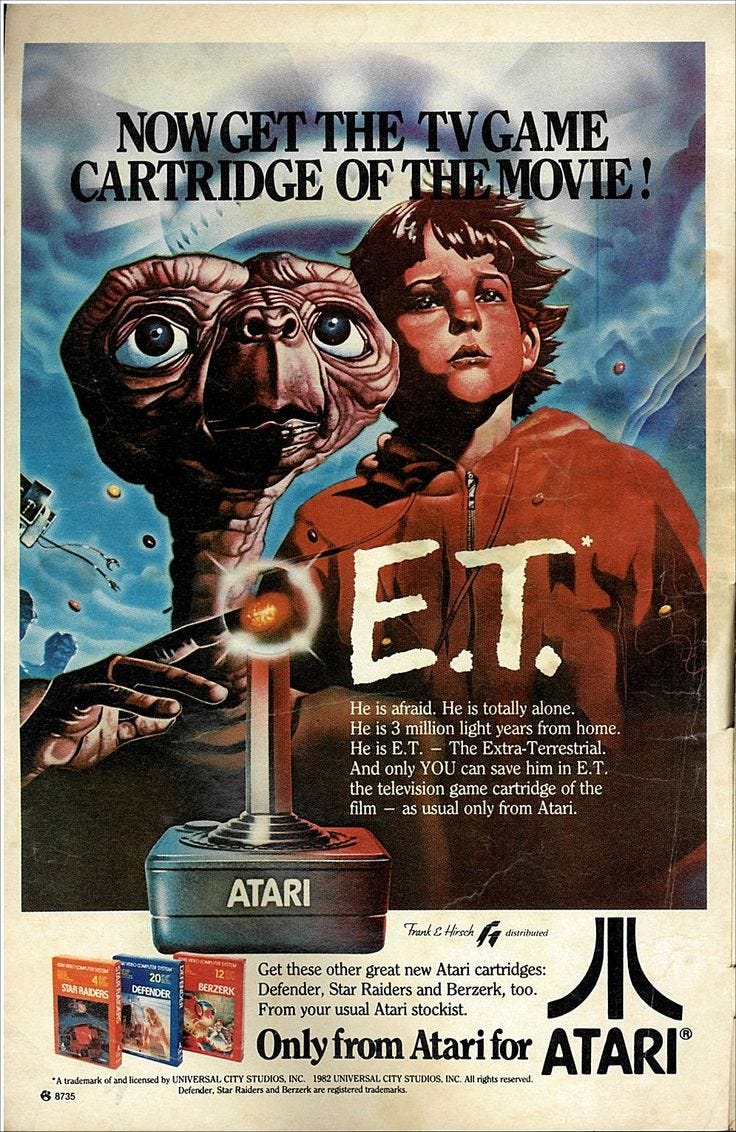
Living through it, you didn’t feel it happening. But every Tom, Dick and Harry was making a game, and most of them were bad. And some were expensive flops. Atari paid up to $25 million for the rights to Spielberg’s E.T. in July 1982.
They rushed the game for the holidays, shipped millions of copies and nobody wanted to phone home. In fact they quietly buried much of the excess stock in a landfill near Alamogordo, New Mexico. Isn’t it weird that people don’t really talk about E.T. that much?
The whole video game console industry went from a peak of $3.2 billion in 1983 to a paltry $100 million by 1985. A nearly 97 percent drop.
Kids like me skipped consoles completely and started playing on computers instead.
MY FIRST CONSOLE HAD A KEYBOARD
In April 1984 Apple launched the Apple IIc with a party at San Francisco’s Moscone Center. It was also the start of Apple’s first ad blitz aimed at kids, and one ad previewed at the event carried the line “How to talk your parents into parting with $1300.”
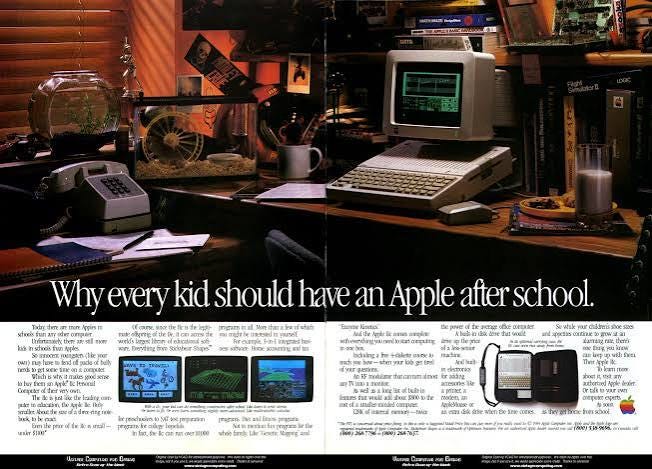
Even Alan Greenspan was enlisted in an ad for the Apple IIc.
Clearly it all worked on my parents. The IIc is where I played my first real games. Every one of those games had its own way of selling itself.
The games I remember most were pretty basic. But they are burned into my brain.
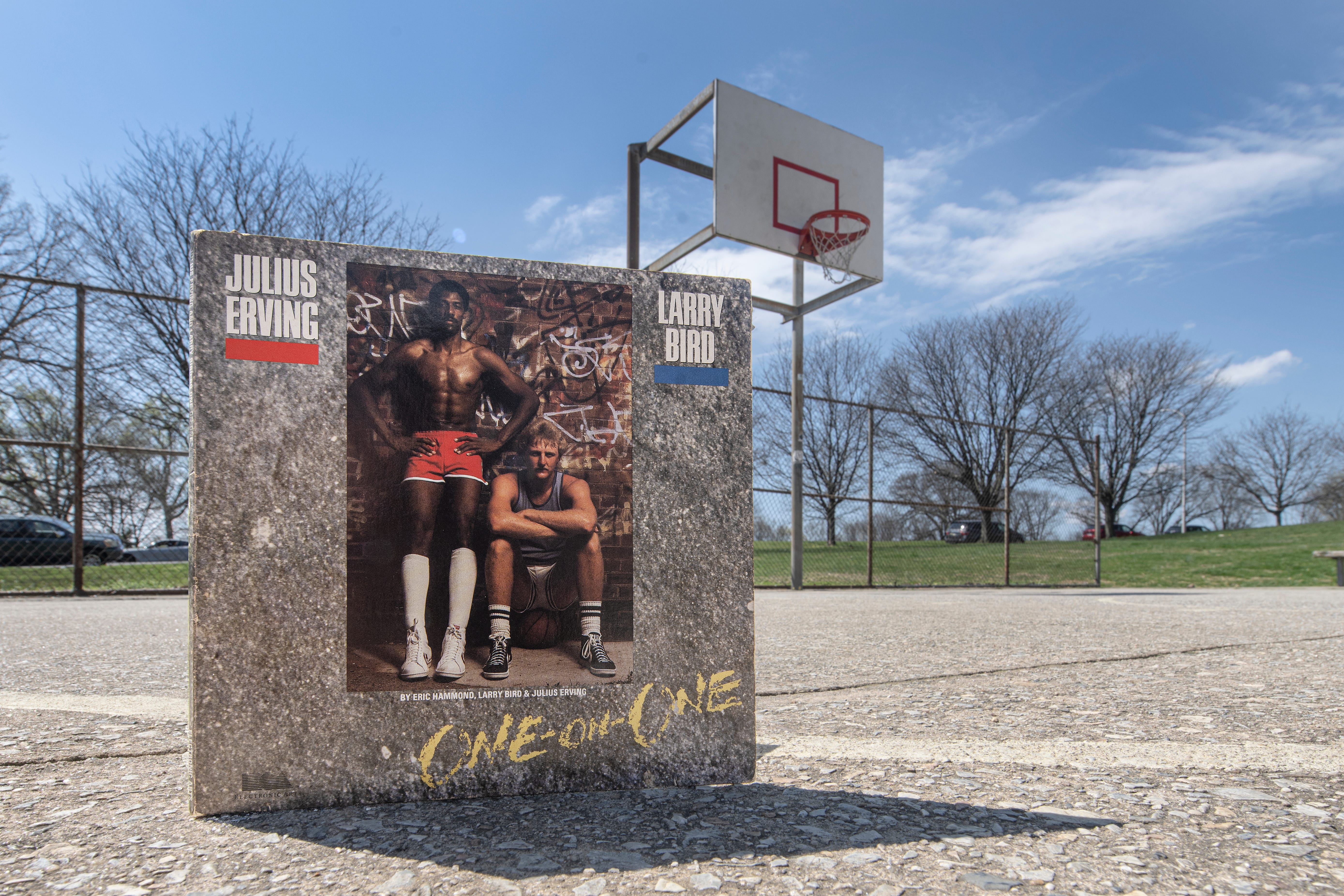
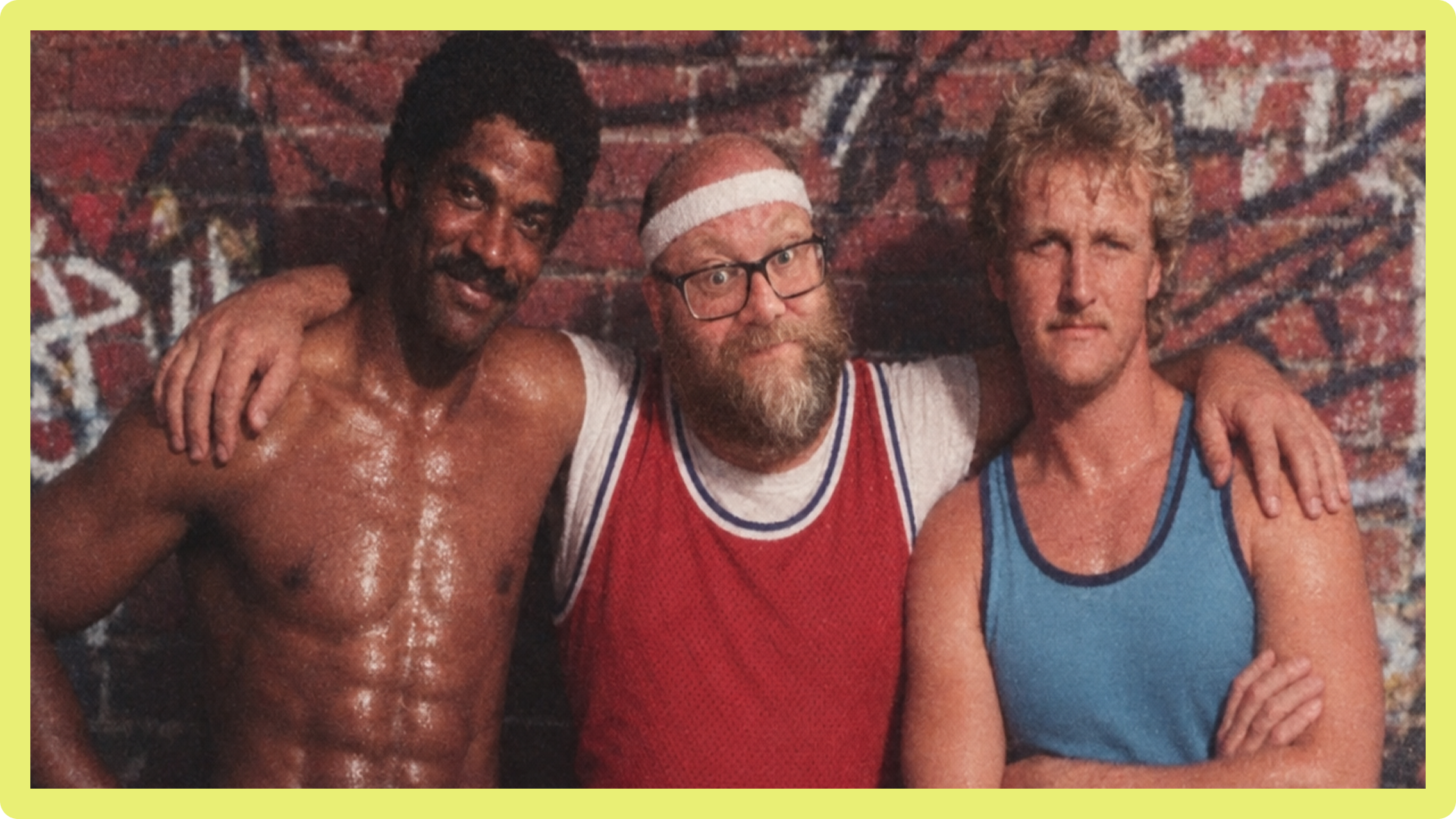
One-on-One sold you the star power of Larry Bird and Julius Erving in a street ball showdown. Instead of traditional ads, EA founder Trip Hawkins borrowed from the music industry and commissioned album-cover packaging with custom art for every title.
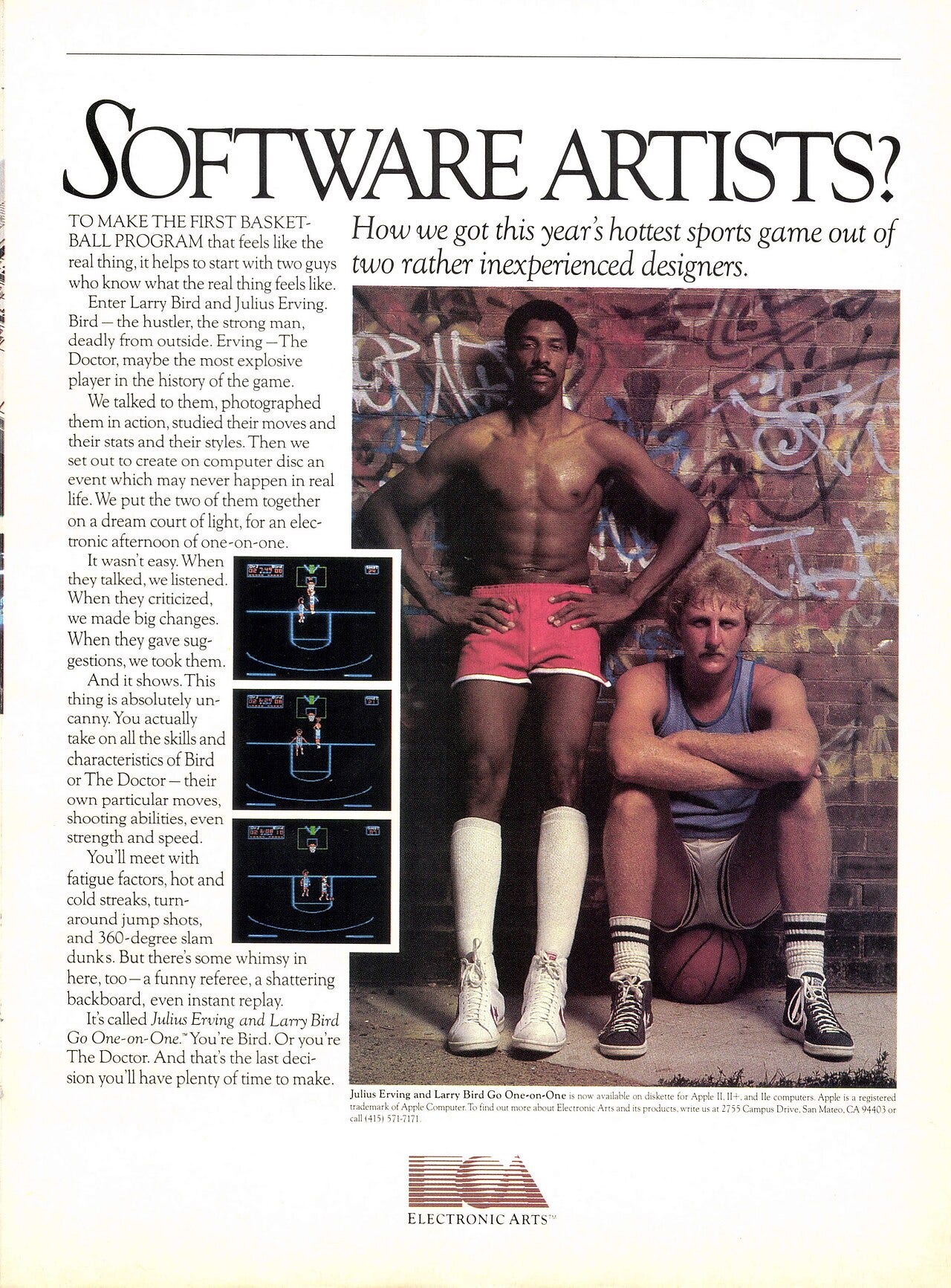
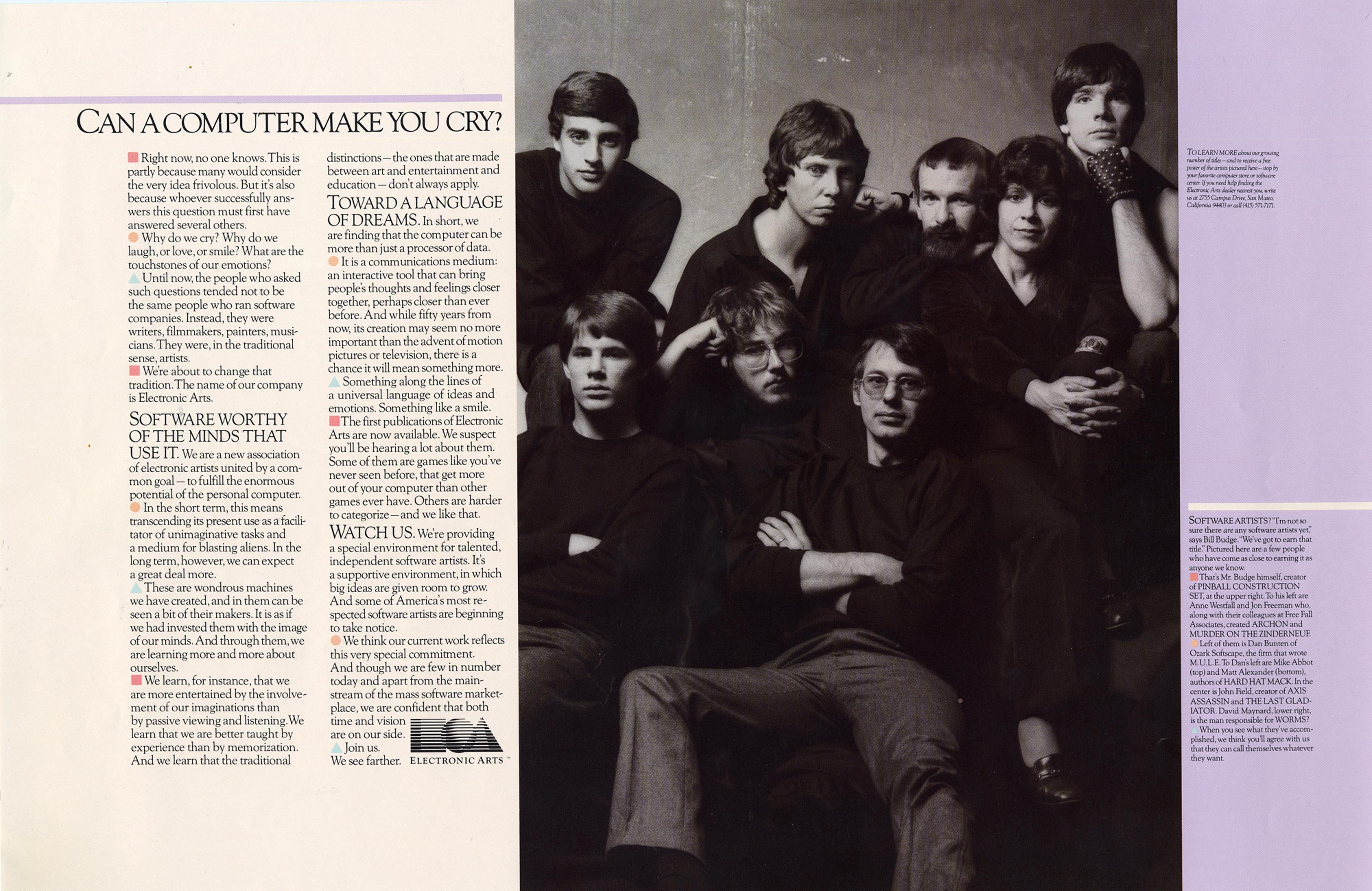
For their names, Erving and Bird were each paid $25,000 plus a 2.5% royalty. Erving apparently got some EA stock too. In addition to the rad cover art, the brand asked more thought-provoking questions in places like Scientific American about whether a computer could make you cry. I can tell you that at the time, Larry Bird blocking my shot may well have done the trick.
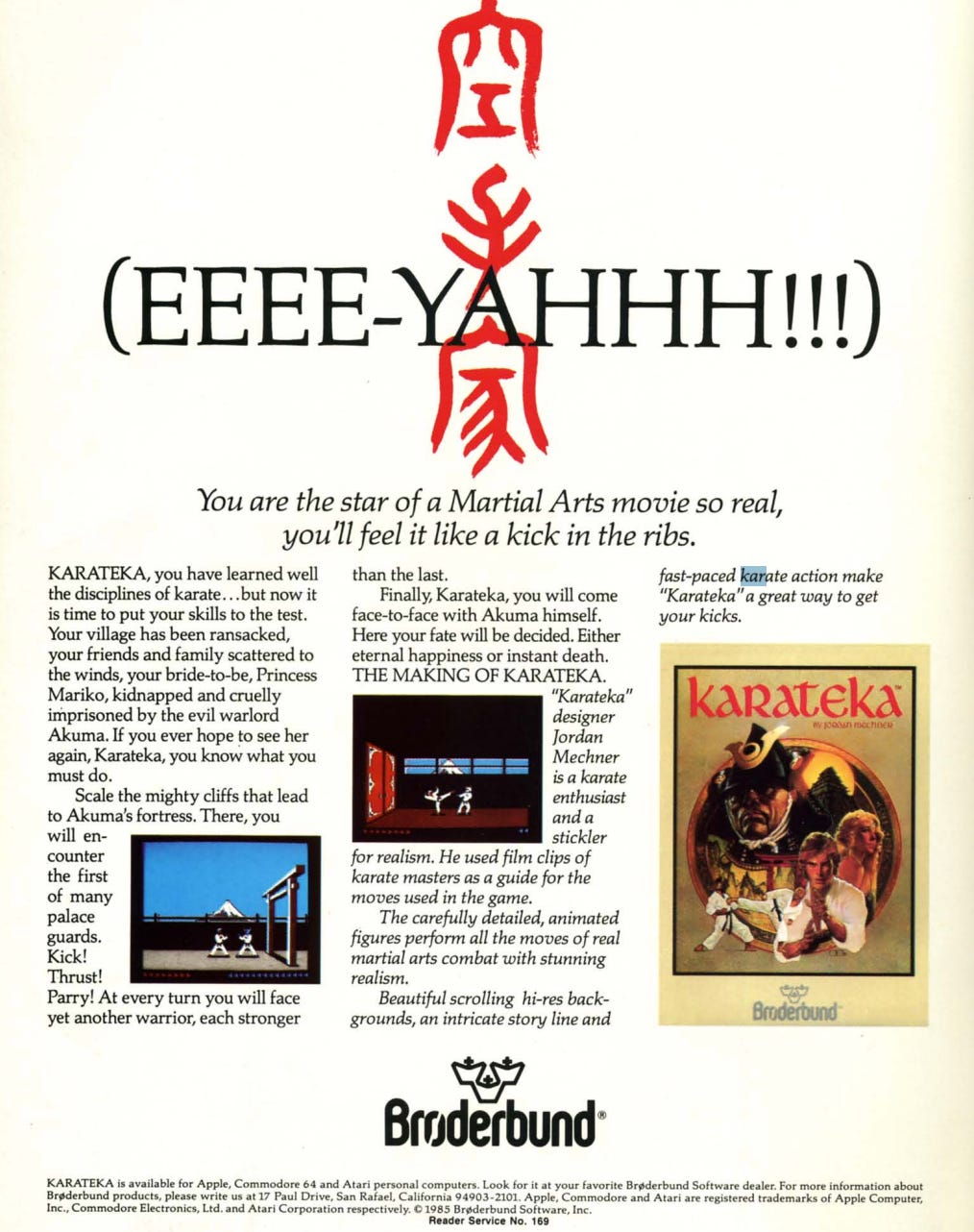
I also tried to play Karateka. But honestly I think I just liked the scrolling story intro and the funky theme. The game wasn’t really advertised, but became the #1 best-selling game in the US by April of 1985 via word of mouth. It wasn’t that great.
When Broderbund finally did run an ad, it closed with the iconic, “a great way to get your kicks.” Never enough Karate jokes in ads I always say. There was one additional fun fact about this game. Legend has it that if you put the disk in upside down the whole game is played upside down. 100% true.
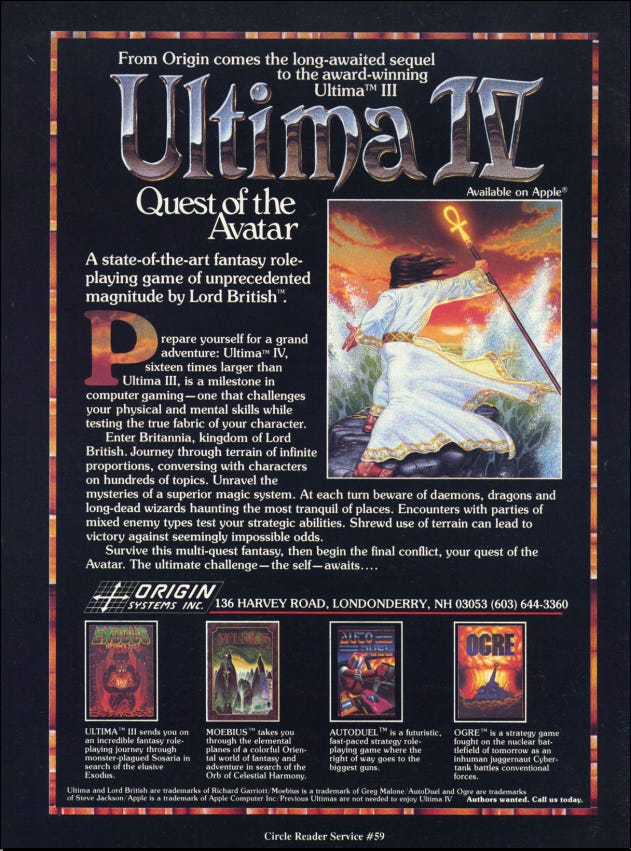
The games I spent the most time on were Ultima III and IV, and they sold you via the the incredible box. These were frustrating long format role playing games that nerdily came with hand-drawn cloth maps, metal ankhs and books of lore. This checks out since the man behind it called himself Lord British. Who were we to argue?
SEGA!
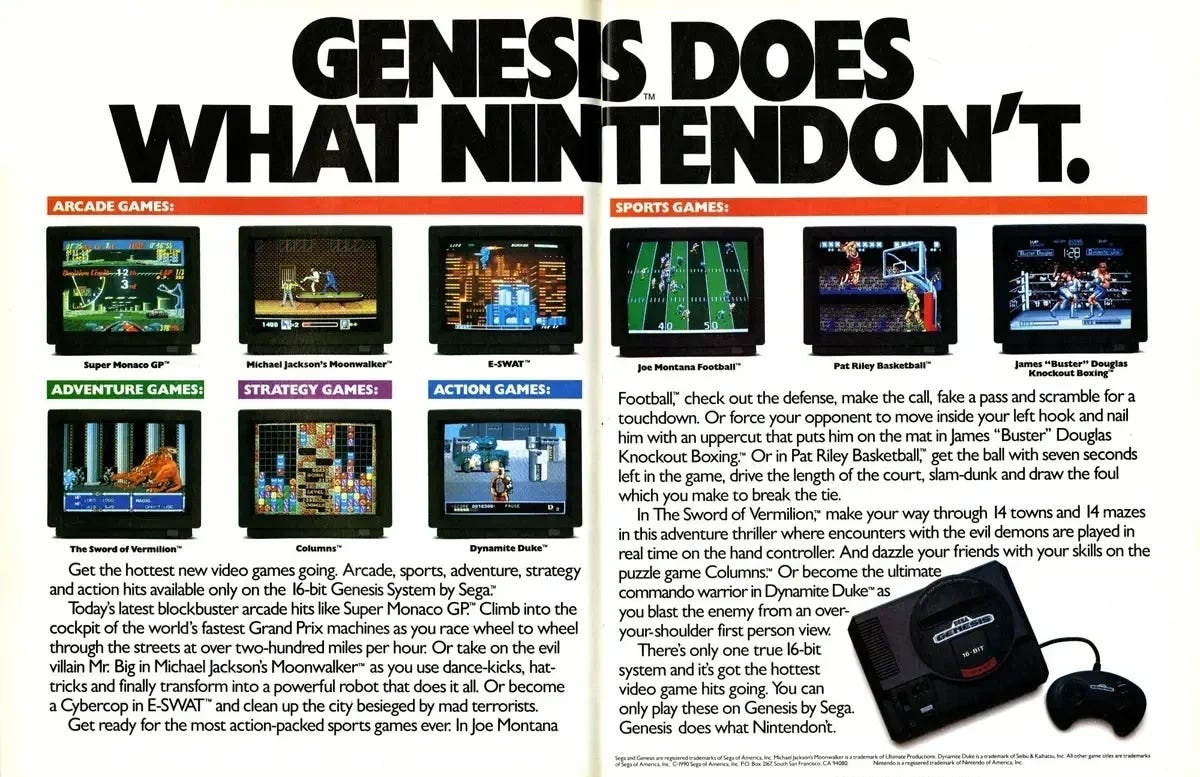
Sega was always outspent. Its marketing director Al Nilsen said that for every marketing dollar he had, Nintendo had 10. So Sega went after the name: “Genesis does what Nintendon’t.”
By October 1992 Nintendo had 70 percent of the market, and Sega hired Goodby, Berlin & Silverstein to create a national campaign, “Welcome to the Next Level.” The famous part was an accident. While shooting a commercial in 1992, someone on set suggested, “Hey, why don’t you guys have someone scream ‘Sega’ at the end?”
They screamed it at the end of every ad for years. Jeff Goodby says sometimes it came out of a person and sometimes out of a dog. If you were around at the time you can still hear the Sega scream whenever you still see something from the brand.
WII WOULD LIKE TO PLAY
I can still hear this ad too. In 2006 Leo Burnett’s campaign sent two Japanese gentlemen across America in a Smart car, ringing doorbells and politely inviting everyone to join them: “Wii would like to play.”
The awards jury put it simply: Wii ignored the prized teenage male gamer and went after his mom, dad and grandmother.
Nintendo spent US$200 million on the launch. It won the Grand Effie in 2008 as the most effective marketing of the year. Somebody’s grandma probably bowled a 220. I am still in trouble with my now-wife for being somewhat good at Wii Tennis. It ranks just below the dreaded “Garbage Wars” of 2009 as things we don’t speak about any more.
COCKTAIL OF THE WEEK: THE MIAMI VICE
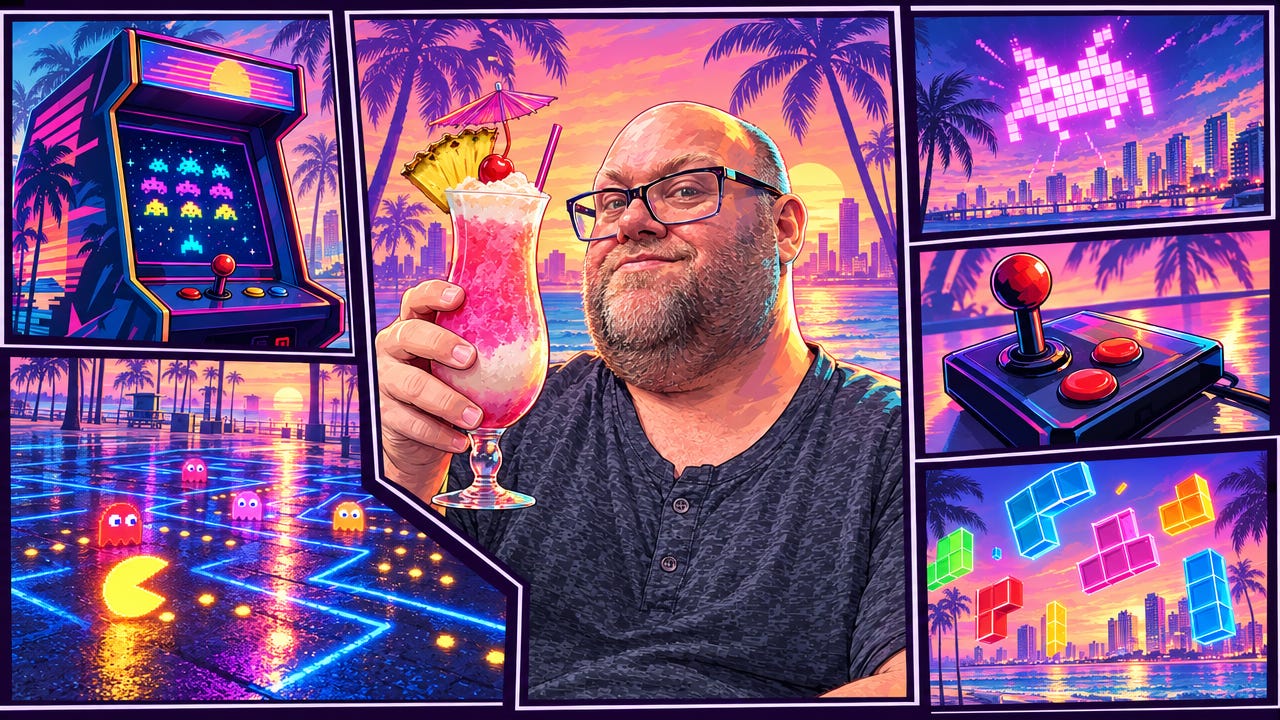
Since Grand Theft Auto is going to Vice City, which is essentially Miami, and I had to wear my gloves for the first time this fall, I figured we should take this week’s drink to the swim-up bar.
The Miami Vice is an amazing creation. Half piña colada and half strawberry daiquiri, layered in one insane glass. Scientifically superior if you are in fact sitting in a Mexican all-inclusive pool.
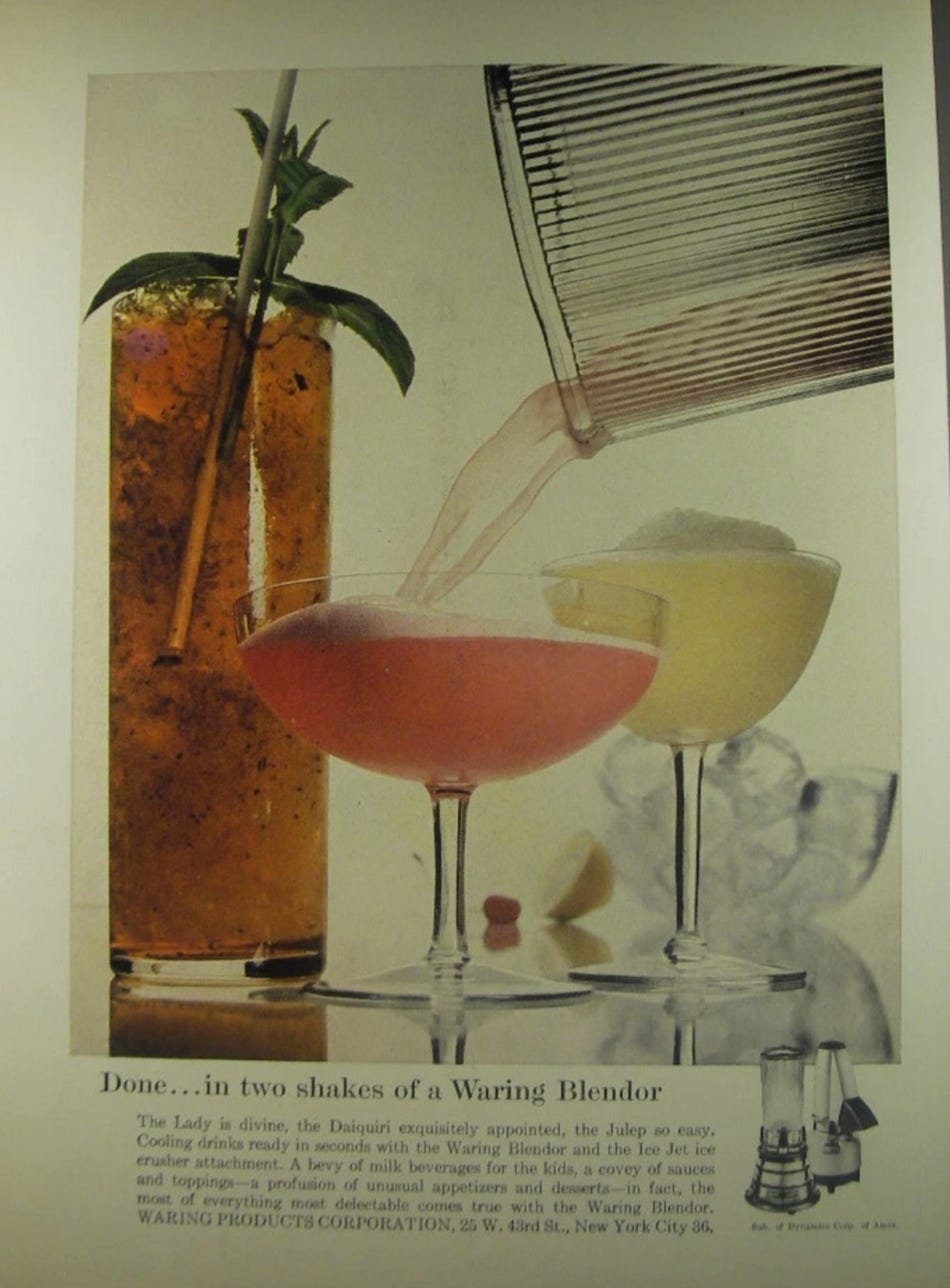
Nobody knows who poured it first. It feels like it was almost certainly named after the show that made pastel blazers with no socks look like a good idea. Except rumours suggest it was around before that.
What’s likely more true is decades of advertising blenders probably gave bartenders across the country ideas like this. And writers with headlines like this, “Done…in two shakes of a Waring Blender.”
Two blender drinks, one glass, full price.
Strawberry half:
1 oz white rum
1 cup frozen strawberries
1/2 oz lime juice
1/2 oz simple syrup
Colada half:
1 oz white rum
1 1/2 oz pineapple juice
1 oz cream of coconut
Blend each half separately with ice. Pour the strawberry into a hurricane glass, then pour the colada down the other side. Garnish with pineapple and a cherry. Don’t stir. Pretend you’re at the swim-up bar and remember to scream when you see the word SEGA!