

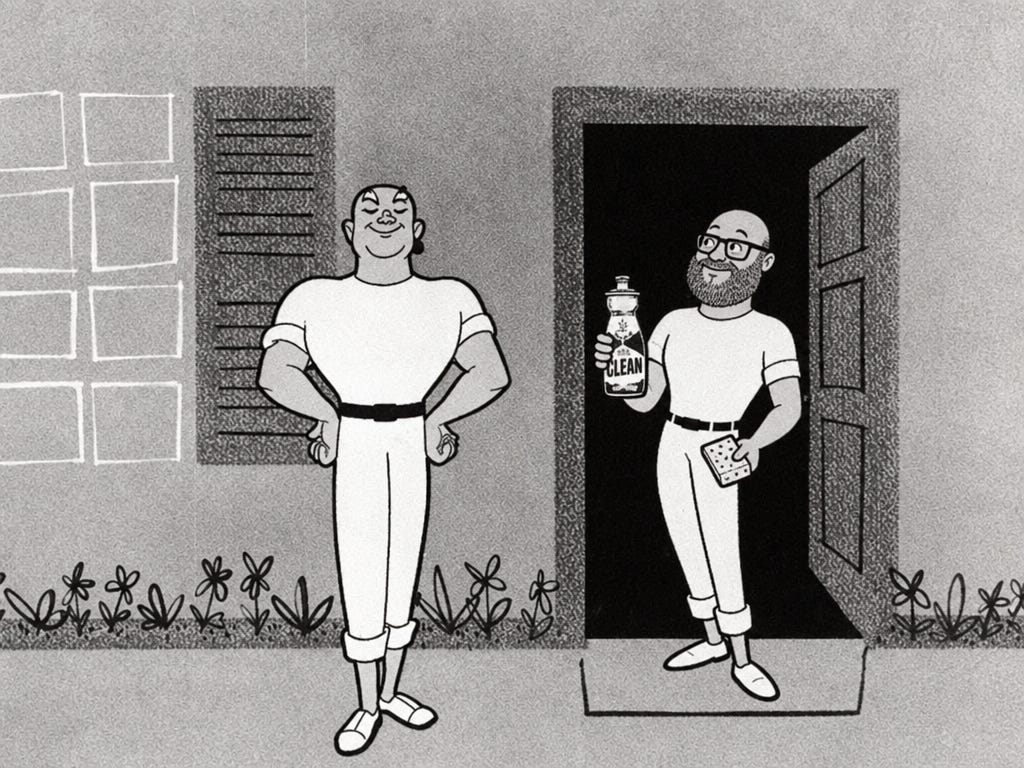
Back in 1962 Procter & Gamble offered up a fully furnished house to anyone who could give Mr. Clean a first name.
The winning entry was Veritably.
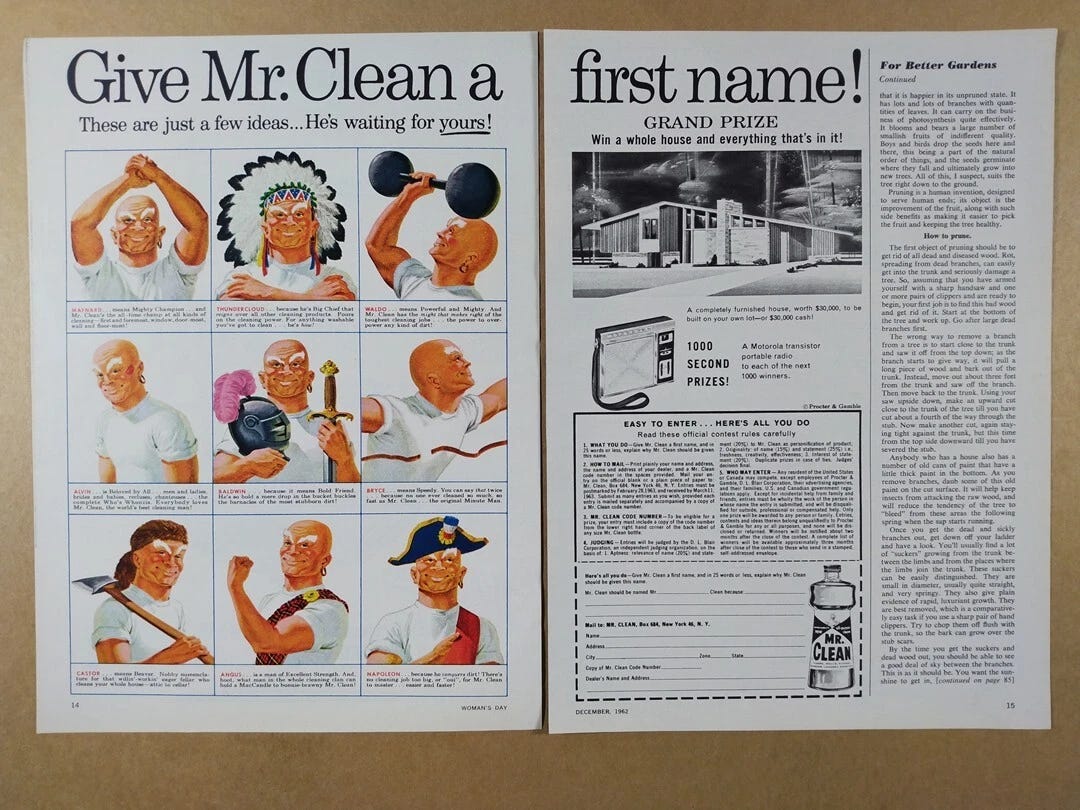
Huh? What in the world?
No wonder not a single person had used that in 64 years. But earlier this year Mr. Clean announced his retirement and said that’s what he wanted to be called.
Two weeks later he was back at work.
THE CLEANER CAME FROM THE DOCKS
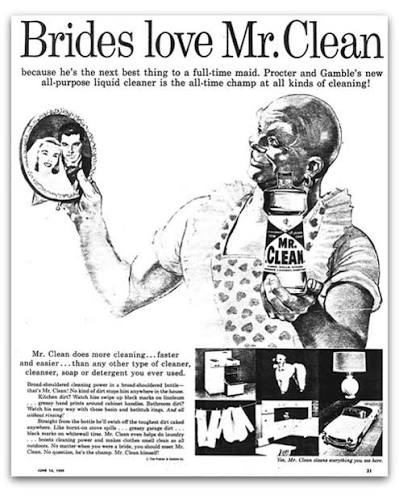
I love that this product’s origin story was basically that a ship-cleaning business was making their staff so sick and costing him liability because of the cleaning solvents used. So they mixed up something gentler that would still cut through the grease.
It worked so well that P&G bought it in 1958.
By August of that year the brand started dropping commercials in Pittsburgh and in six months it was one of the best-selling cleaners in America.
THREE MEN DREW HIM AND NOBODY AGREES ON WHAT HE IS
Mr. Clean started as an illustration. The character came from Harry Barnhart and Ernest Allen at Tatham-Laird & Kudner in Chicago.
But Fritz Siebel is credited with the first print illustration.
And just like pretty much every disputed cocktail origin in this newsletter, illustrator Richard Black’s 2014 New York Times obituary tells a third version. In that one he submitted two genies, one with a hoop earring and one with a nose ring. P&G chose the earring.
P&G’s official story says he was based on a Navy sailor from Pensacola. I honestly never got genie vibes, but the sailor makes sense. Seeing him in a suit in the 1950s is a wild take on Veritably Clean.
His own website now says some people think genie and some think sailor. It’s kind of amazing that everyone knows him, but almost 70 years in, even the brand hasn’t decided.
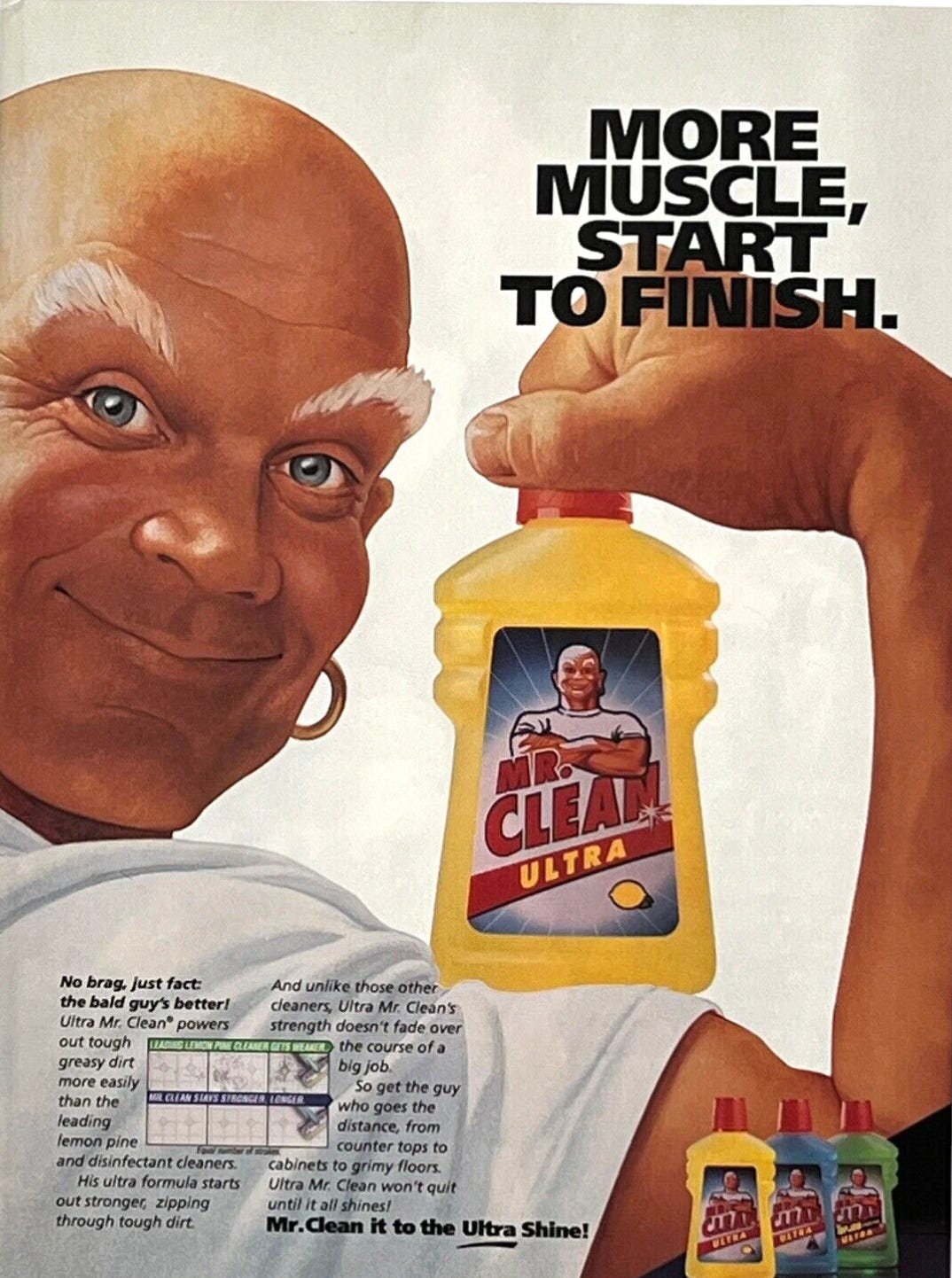
And just like Madge, Mr. Clean has a global cleaning force with their own names. In Germany he’s Meister Proper and in France he’s Monsieur Propre. Mexico calls him Maestro Limpio. In Quebec he’s M. Net. In the UK the Mr. Clean name was already taken by another brand, so he’s sold as Flash.
Thomas Scott Cadden wrote an incredible jingle in 1957 at his home in Skokie, Illinois, and recorded the demo on a home tape recorder.
I can only think of Verbal Kint, “I used to be in a barbershop quartet in Skokie, Illinois. The baritone was this guy named Kip Diskin, big fat guy, I mean, like, orca fat. He was so stressed in the morning…”
Anyway the finished version was a duet between Don Cherry and Betty Bryan.
That’s the American crooner Don Cherry, not the Coach’s Corner one in case you were wondering.
What’s interesting is that Mr. Clean’s first Super Bowl spot only ran in 2017. The ad was “Cleaner of Your Dreams” from Leo Burnett Toronto. A woman finds a spill on her stove, and an animated Mr. Clean in tight white pants appears and grinds his way through her house with a mop.
The fantasy ends when she sees it was her husband cleaning all along. The closing line was “You gotta love a man who cleans.”
Some critics called it creepy. That’s because it was.
Then on February 19, 2026, Mr. Clean’s Instagram posted an animated press conference where he announced he was retiring to pursue new hobbies. Over the next two weeks he DJed, cooked, played sports and toured a Maui mansion listed on Zillow as his retirement home.
On March 4 he came out of retirement to launch new Magic Erasers and a shower scrubber.
It got press twice, once for the exit and once for the comeback.
PENCILS DOWN
Mr. Clean has barely changed since Eisenhower. He has the same head, the same earring and the same folded arms, and he almost never speaks.
Planters already tried this whole when it killed Mr. Peanut in 2020. P&G’s version was gentler. They didn’t redesign the mascot or fire the agency. They took him away for two weeks, let people notice they missed him and then brought him back with a sponge to sell.
COCKTAIL OF THE WEEK: THE WHITE LADY
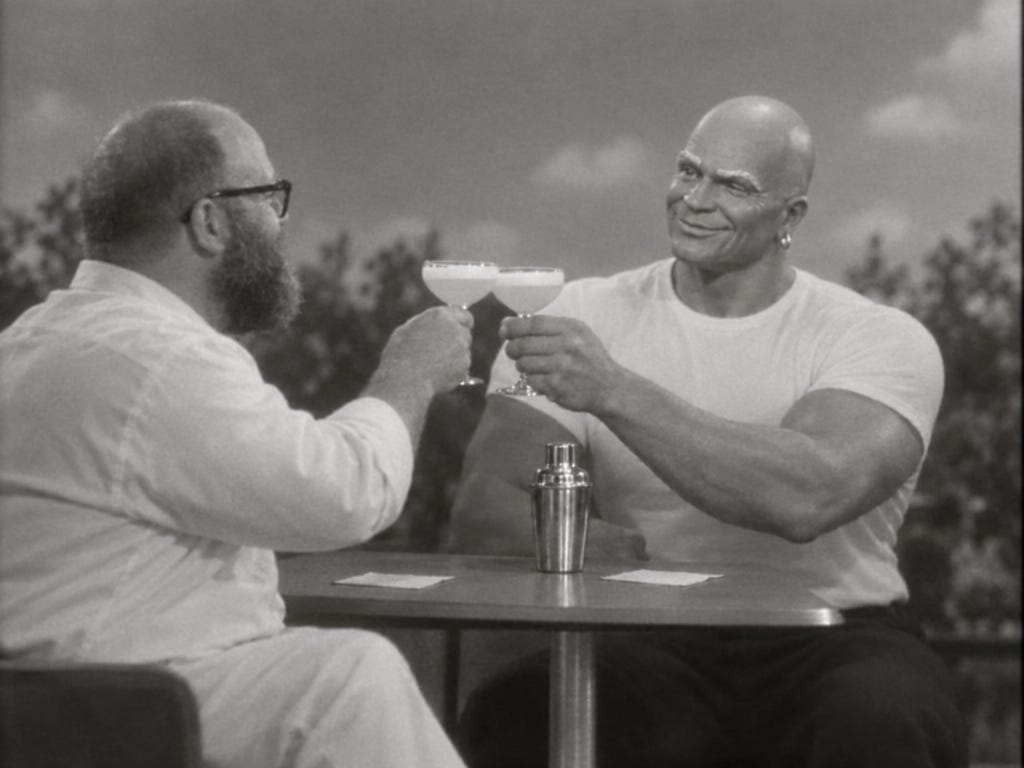
We obviously needed a white cocktail for the man who only wears white. Like Mr. Clean, it has more than one creation story.
Harry MacElhone made a White Lady in 1919 at Ciro’s Club in London, but his version used crème de menthe.
He reportedly switched to gin around 1929 at Harry’s New York Bar in Paris. Harry Craddock at the Savoy claimed the gin version as his own and printed it in his Savoy Cocktail Book in 1930.
According to Savoy lore, during a 1927 renovation Craddock sealed a shaker of White Ladies inside one of the hotel’s walls. Nobody has found it yet.
The egg white arrived decades later and is reportedly credited to Peter Dorelli, who ran the Savoy’s American Bar starting in 1984. The drink is bright and tart and looks spotless. The egg white also means the shaker will be a mess for Mr. Clean afterward.
The White Lady
2 oz gin
3/4 oz Cointreau
3/4 oz fresh lemon juice
1 egg white (optional)
If you’re using the egg white, dry shake first, then shake again with ice. Strain into a chilled coupe. Leave out the egg if you want the 1930 Savoy version. Call Mr. Clean for help.
The Drink Cart is the newsletter version of sitting at a really good bar with someone who thinks too much about advertising and won’t shut up about it. Subscribe to get it on Wednesdays and Fridays.