

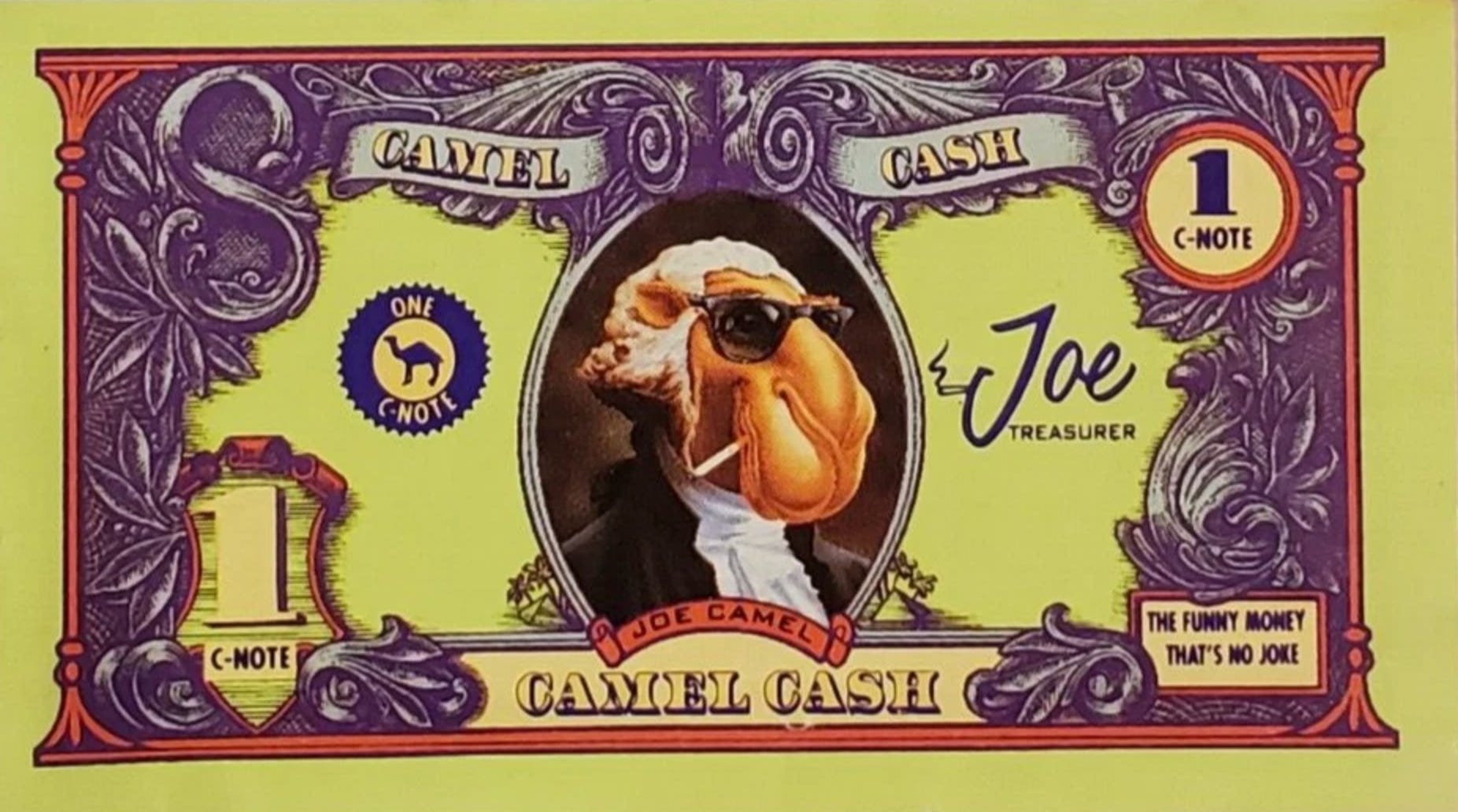
Somewhere in a basement is a bunch of dollar bills with a camel’s face where Washington should be.
Not instead of Washington. But a cartoon Camel wearing a powdered wig, colonial coat, sunglasses and cigarette.
The signature on the bill read “Joe, Treasurer.” And the tagline was, “The funny money that’s no joke.”
In 1991 Camel printed its own currency on pack flaps, redeemable through mail-order catalogs for an entire camel lifestyle. Hats, jackets, watches, lighters, tumblers, a “Sleepy Camel” silk kimono, tour merch for The Hard Pack, a band that did not even exist.
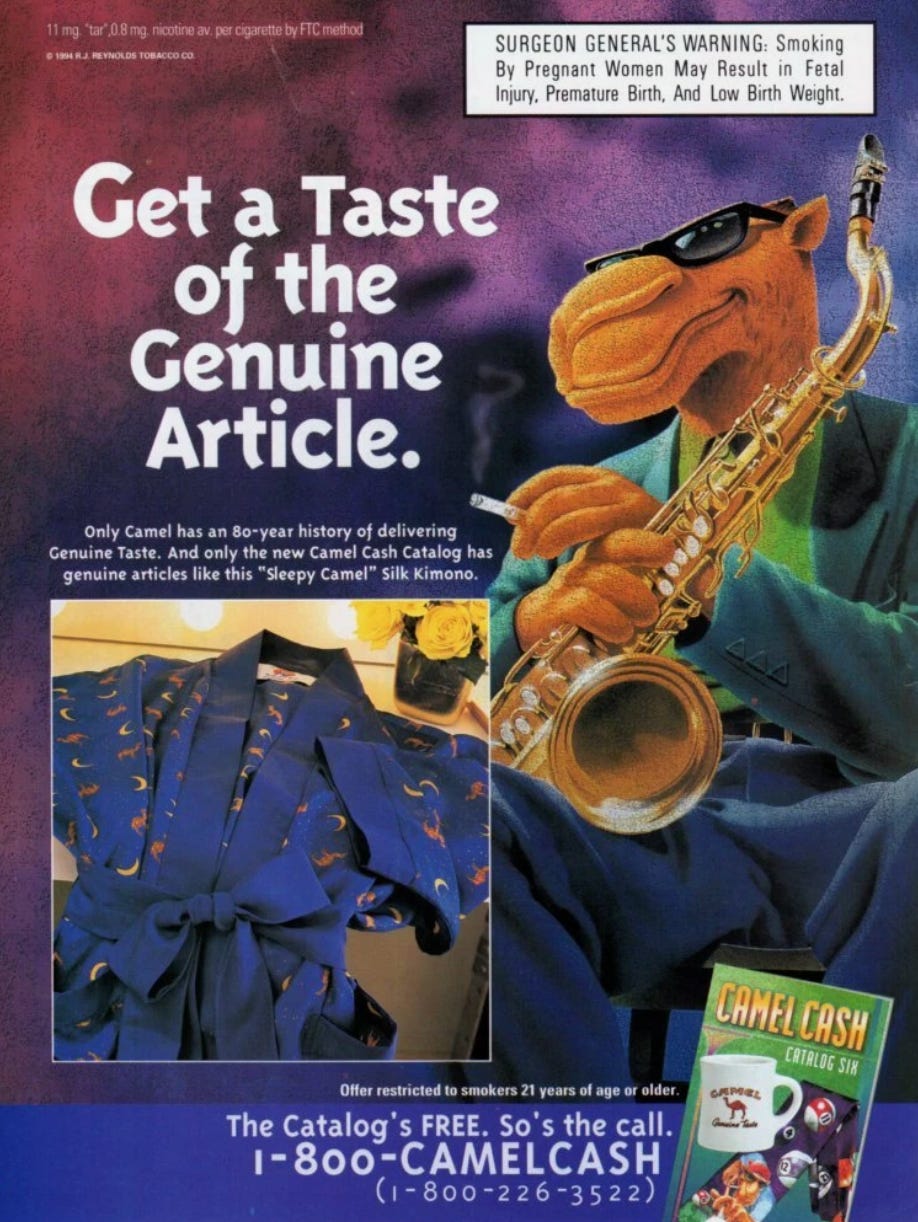
The Hard Pack was a band that toured nowhere, sold out nothing and still moved more merch than most real bands.
The ads did their own foreshadowing: “Get ‘em now, ‘cause this stuff is too smooth to last forever.”
Kids collected the Camel Cash whether they smoked or not.
Today the sealed stuff sells on eBay with the word BANNED in the listing title, because getting shut down by the federal government turned out to be the greatest thing that ever happened to the resale value of Camel brand merch.
But that’s getting ahead of ourselves. Camel’s first Joe was Joe DiMaggio.
BEFORE THE CARTOON, A CENTERFIELDER
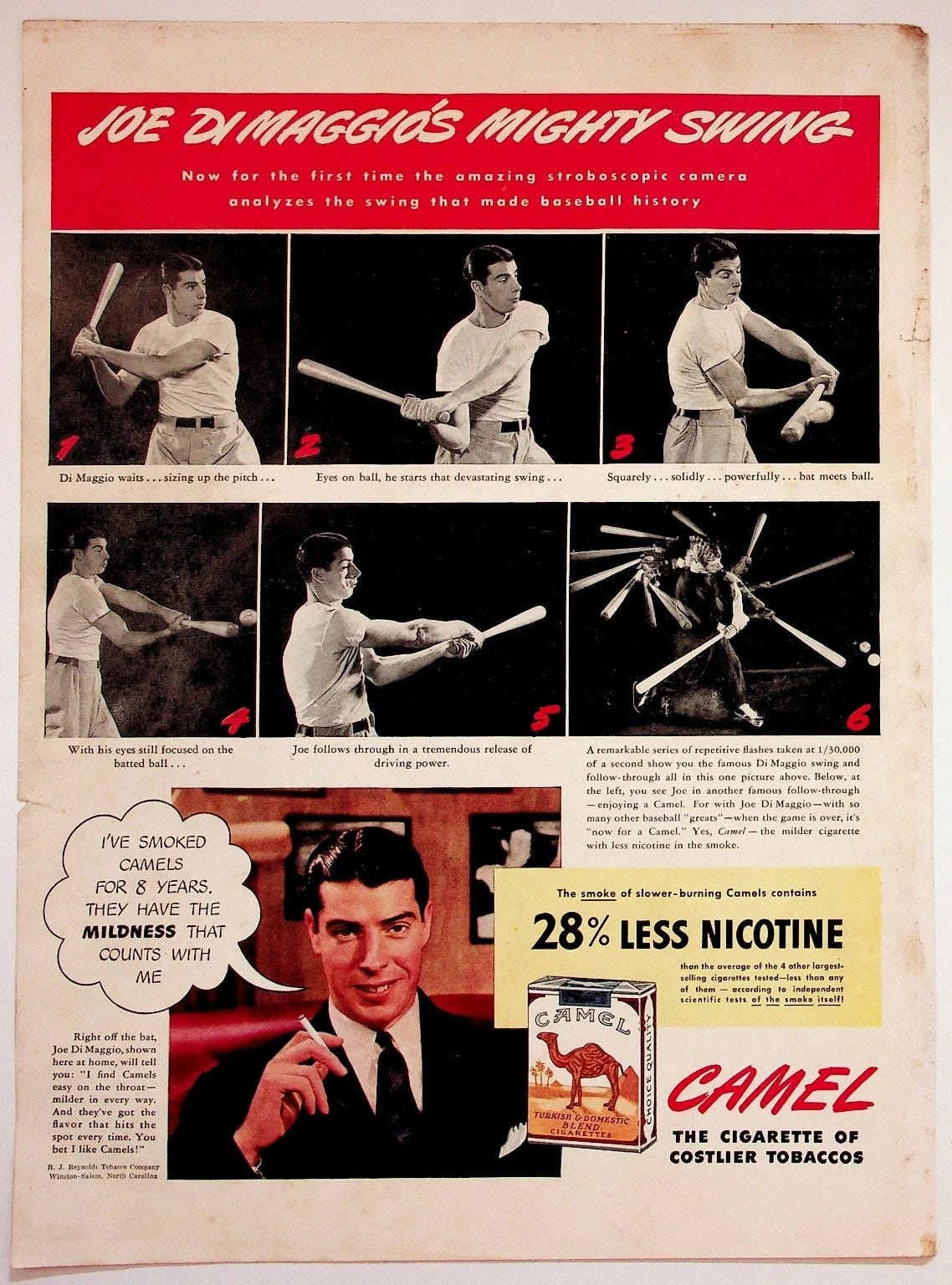
This classic Camel ad breaks down DiMaggio’s swing with stroboscopic photography. Six frames of one of the most famous swings in baseball (for a Yankee), and then Joe himself in a thought bubble: “I’ve smoked Camels for 8 years. They have the mildness that counts with me.”
The smoke of slower-burning Camels contains 28% less nicotine, says the yellow box, according to independent scientific tests of the smoke itself.
Fifty years later Camel would replace the most famous athlete in America with a drawing. Kept the first name though.
But between the two Joes, Camel tried being a man.
THE COWBOY HAD A JOB. THE CAMEL GUY HAD A MUSTACHE AND WAS LOST
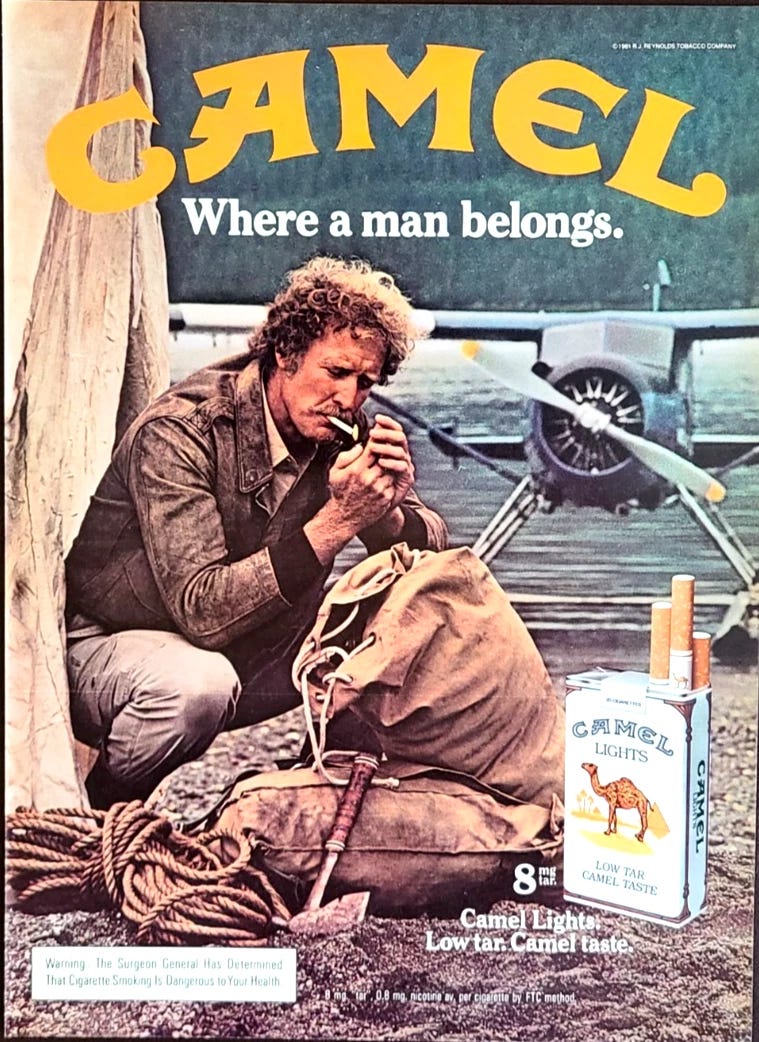
From 1979 into the mid-80s Camel ran a curly-haired, mustachioed adventurer under the slogan “Where a man belongs.”
This was the brand’s answer to the Marlboro Man. The rival who’d been selling rugged since Leo Burnett invented him in 1954.
The Marlboro Man had a job. He rode with other men, worked cattle, belonged to something.
The Camel Guy is alone next to a floatplane. Alone in a jungle river, pushing a bamboo raft loaded with gear toward absolutely nothing.
Where is this man going? What is his job?
By 1985 Marlboro had blown past Camel entirely. Worse, Camel had slid to sixth place among American cigarettes.
And in 1987 Camel finally blinked.
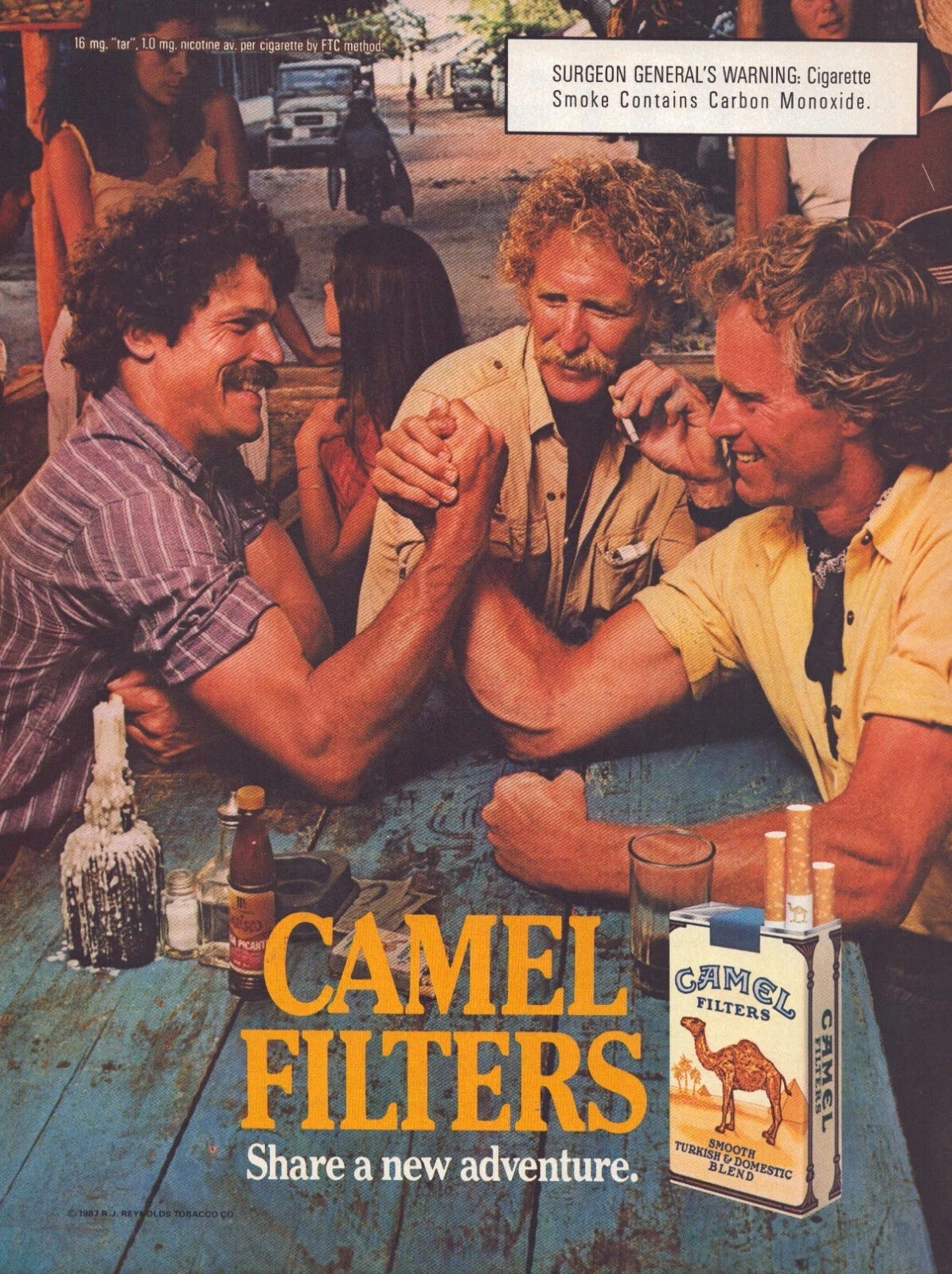
Suddenly the Mustached adventurer is seen with guys arm-wrestling at a beach bar, laughing, crowded table, “Share a new adventure.”
After eight years alone in the wilderness they’d finally learned Marlboro’s actual lesson, that the fantasy was belonging, not rugged solitude.
One year later they fired the humans too.
THE MUD WAS REAL, THOUGH
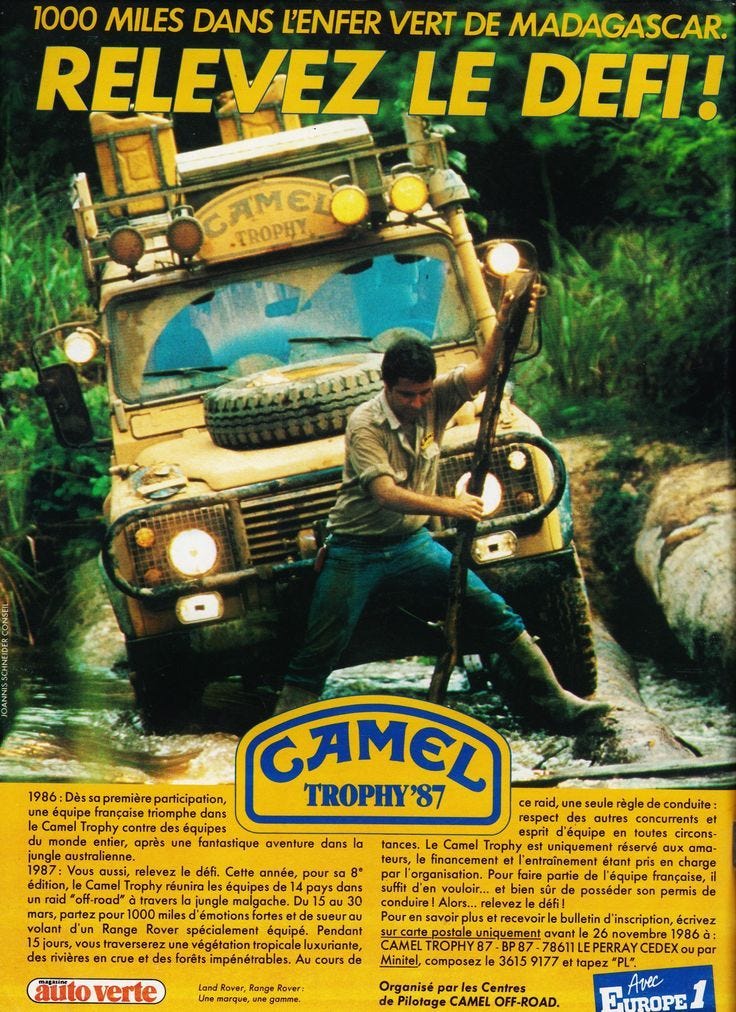
While the ads were faking ruggedness, Camel was quietly funding the genuine article.
The Camel Trophy started in 1980 when Camel’s West German office sent three teams across the half-finished Trans-Amazonian Highway in locally built Jeeps, reportedly rented from a Hertz in Belém.
That detail kinda smells like cocktail legend but I’m keeping it anyway. One of the Jeeps burned down too.
Land Rover came aboard in 1981 and for nineteen years the sandglow-yellow trucks slogged through Borneo and Siberia and everywhere without roads. It was the Olympics of 4x4.
Amateurs only, a million applicants some years, judged partly on a Team Spirit Award, which tells you it was never really a race. And tells you even more about what sponsorship looked like in the era of cigarette money. It was glorious.
It ended in 2000 but Land Rover still sells tribute vehicles. The cigarette brand bankrolled a legend and the truck company keeps that rolling along.
BORN IN A NAUGHTY FRENCH MAG
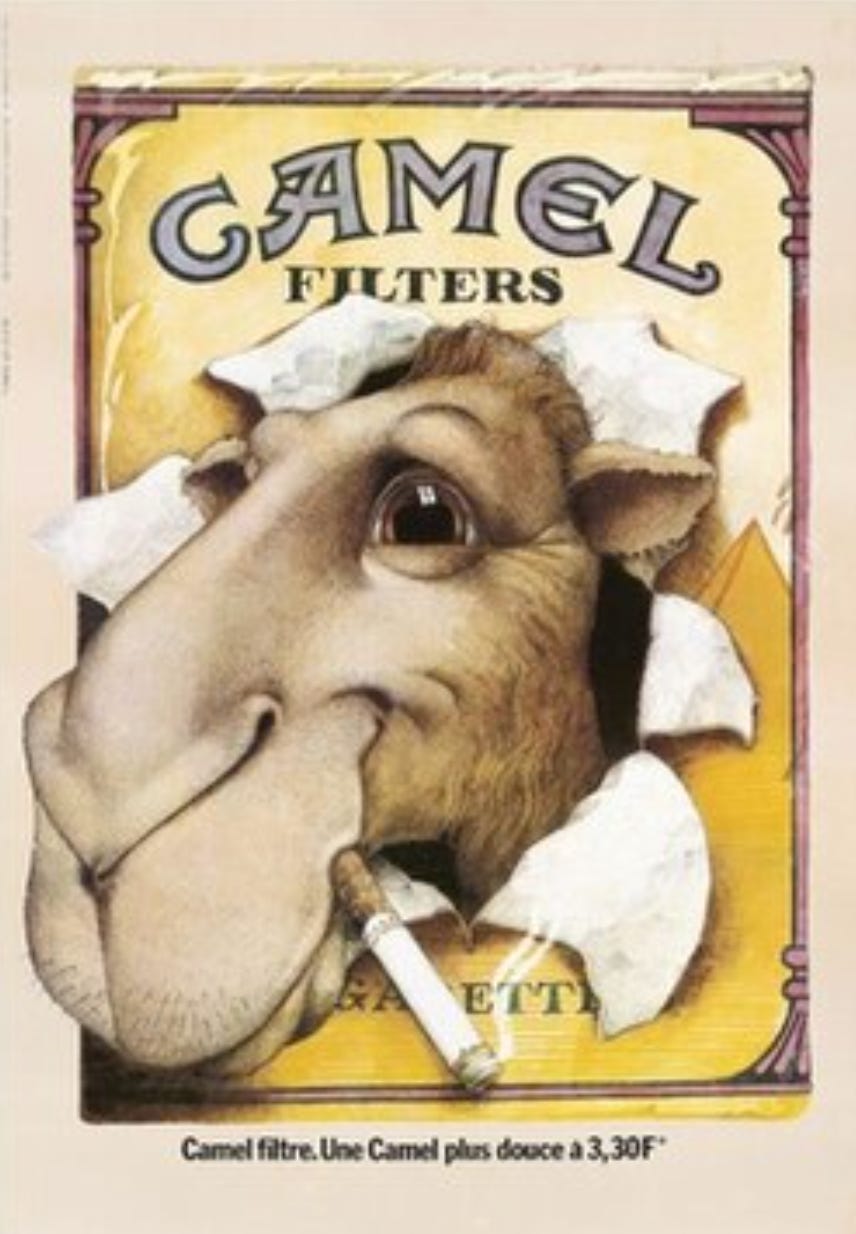
The cartoon they reached for wasn’t new.
British artist Nicholas Price drew him in 1974 for a French Camel campaign — a caricature of Old Joe, the camel on the pack since 1913 — and his first published appearance was in Lui, a French adult-entertainment magazine.
The cartoon camel knocked around Europe for a decade, at one point wearing a Foreign Legion cap.
America met him in 1988, dusted off for Camel’s 75th birthday by Trone Advertising out of Greensboro or possibly McCann-Erickson, depending on who’s telling it or how many martinis they’ve had.
Nobody fights over credit for a campaign until it works. Then everybody was in the room.
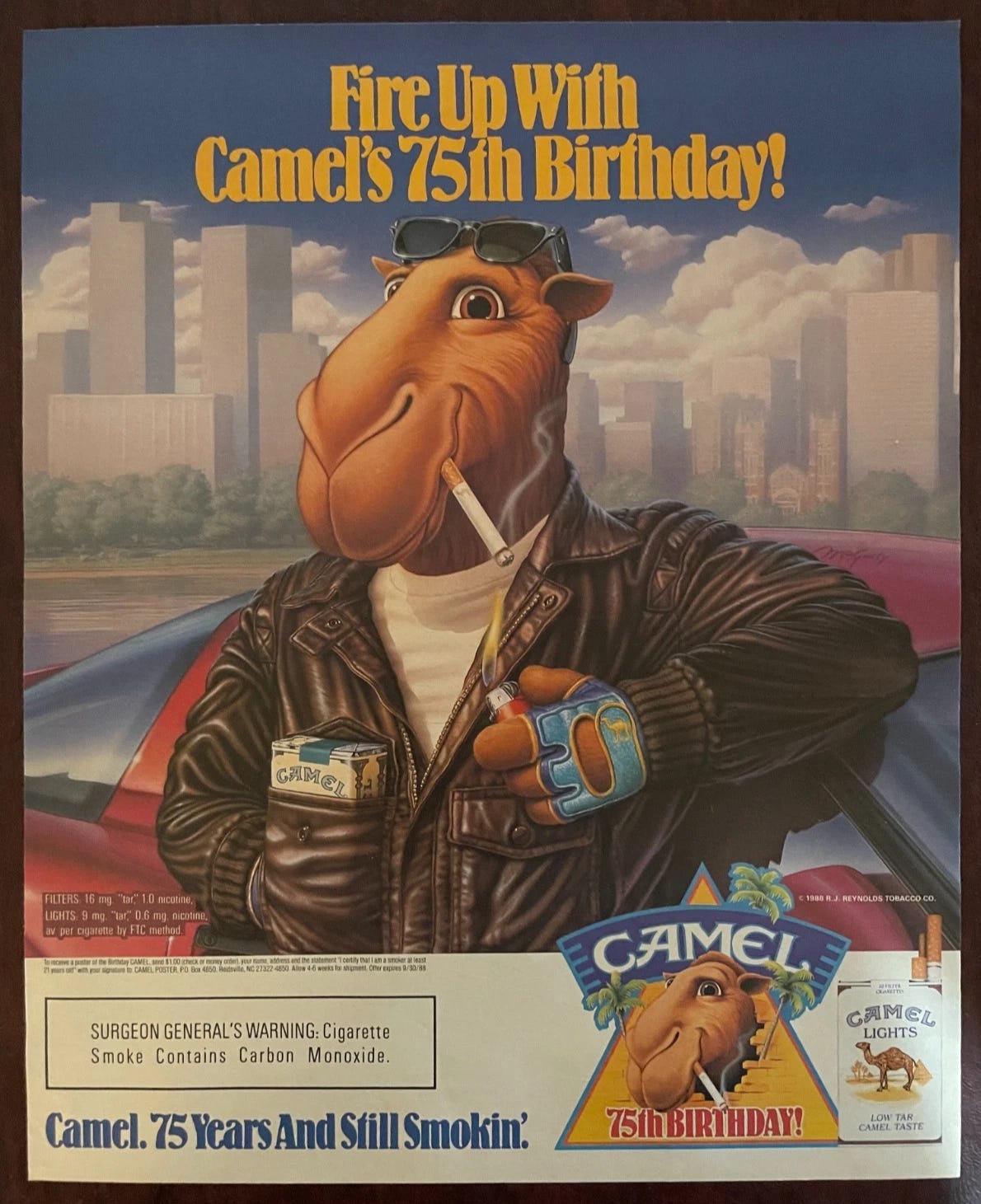
“Fire Up With Camel’s 75th Birthday!” Joe was leather jacket and white tee cool. He had a sports car, fingerless gloves and a lighter.
He only had nine birthdays left.
But he optimized and merchandised those like no one had ever seen.
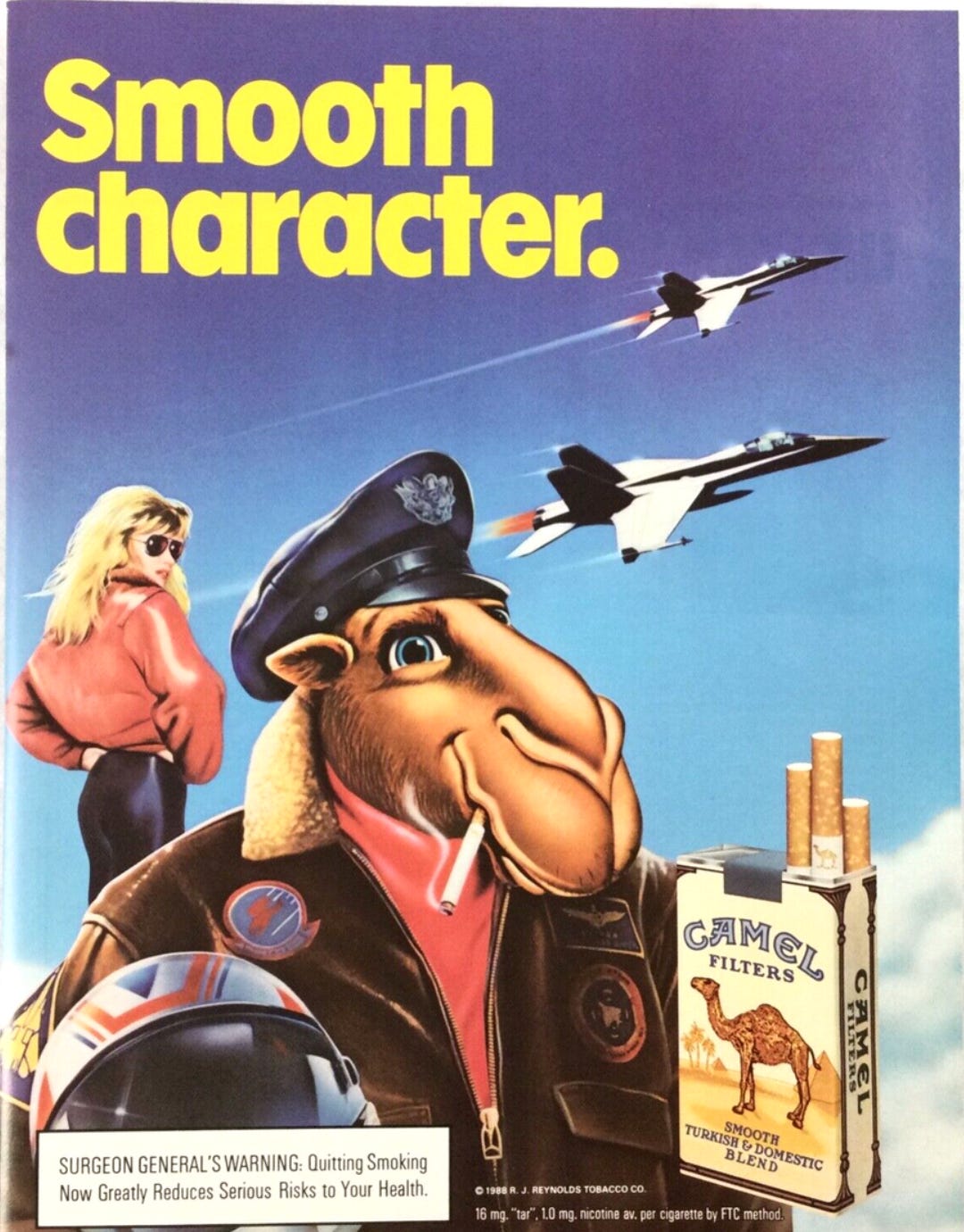
The “Smooth character.” ad from that same year puts Joe in an aviator cap and bomber jacket with fighter jets screaming overhead and a blonde in a red jacket looking back over her shoulder as an obvious tribute to Top Gun, which came out in ‘86.
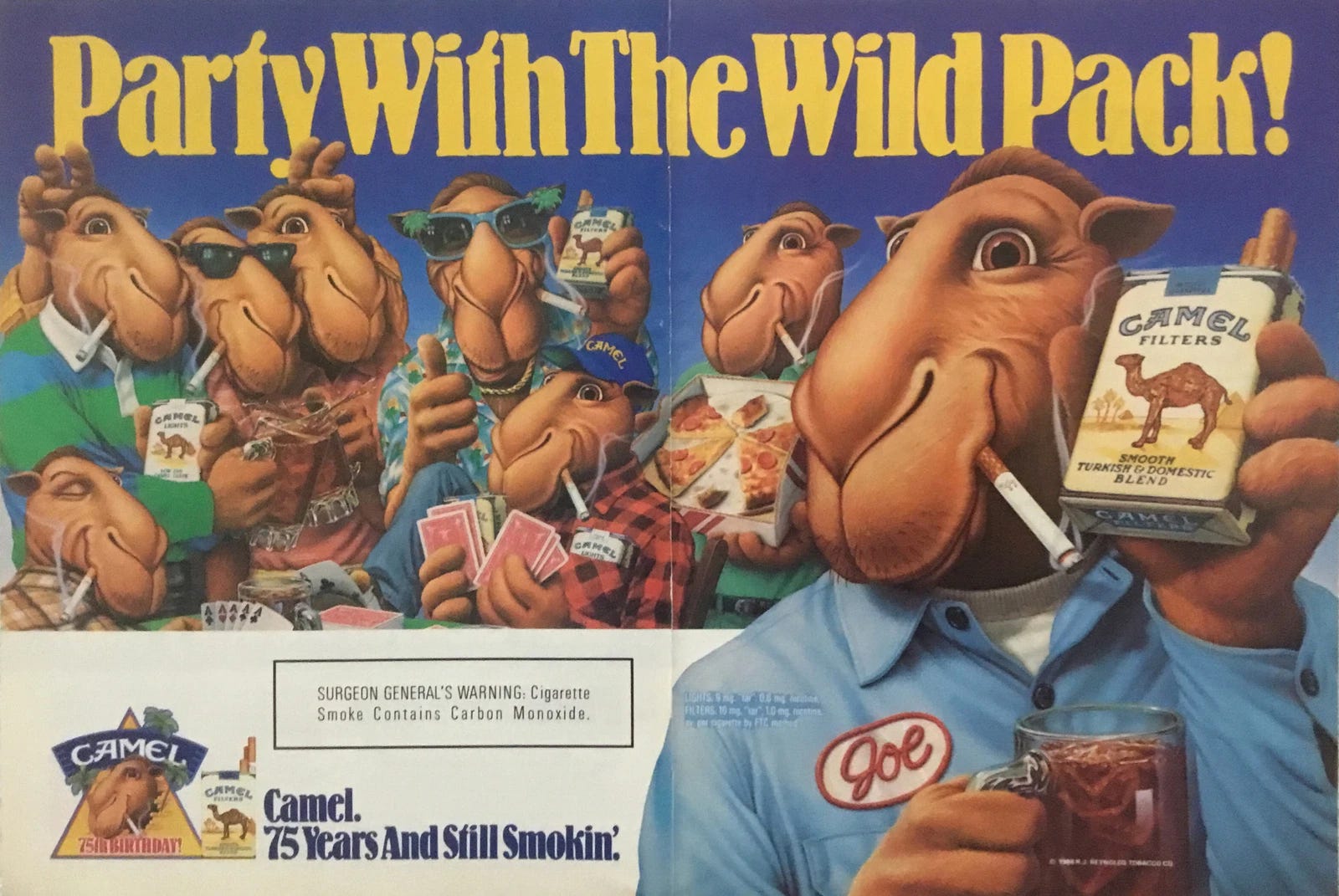
They gave him a whole crew of camels playing cards and eating pizza and then put his name on his shirt: a mechanic’s patch reading Joe.
The French drawing had been anonymous. America needed him to be a guy.
THE RESEARCH DEPARTMENT KILLED HIM
In December of 1991, the Journal of the American Medical Association (JAMA) published the study that ended everything: 91.3 percent of six-year-olds could match Joe Camel to a cigarette. An insane number that was statistically the same rate at which they matched the Disney Channel logo to Mickey Mouse.
A companion study said Camel’s share of underage smokers had gone from 0.5 percent to 32.8 percent since Joe arrived, a number Camel’s parent company fought bitterly.
A San Francisco family lawyer named Janet Mangini read the studies and sued. The FTC piled on in May 1997.
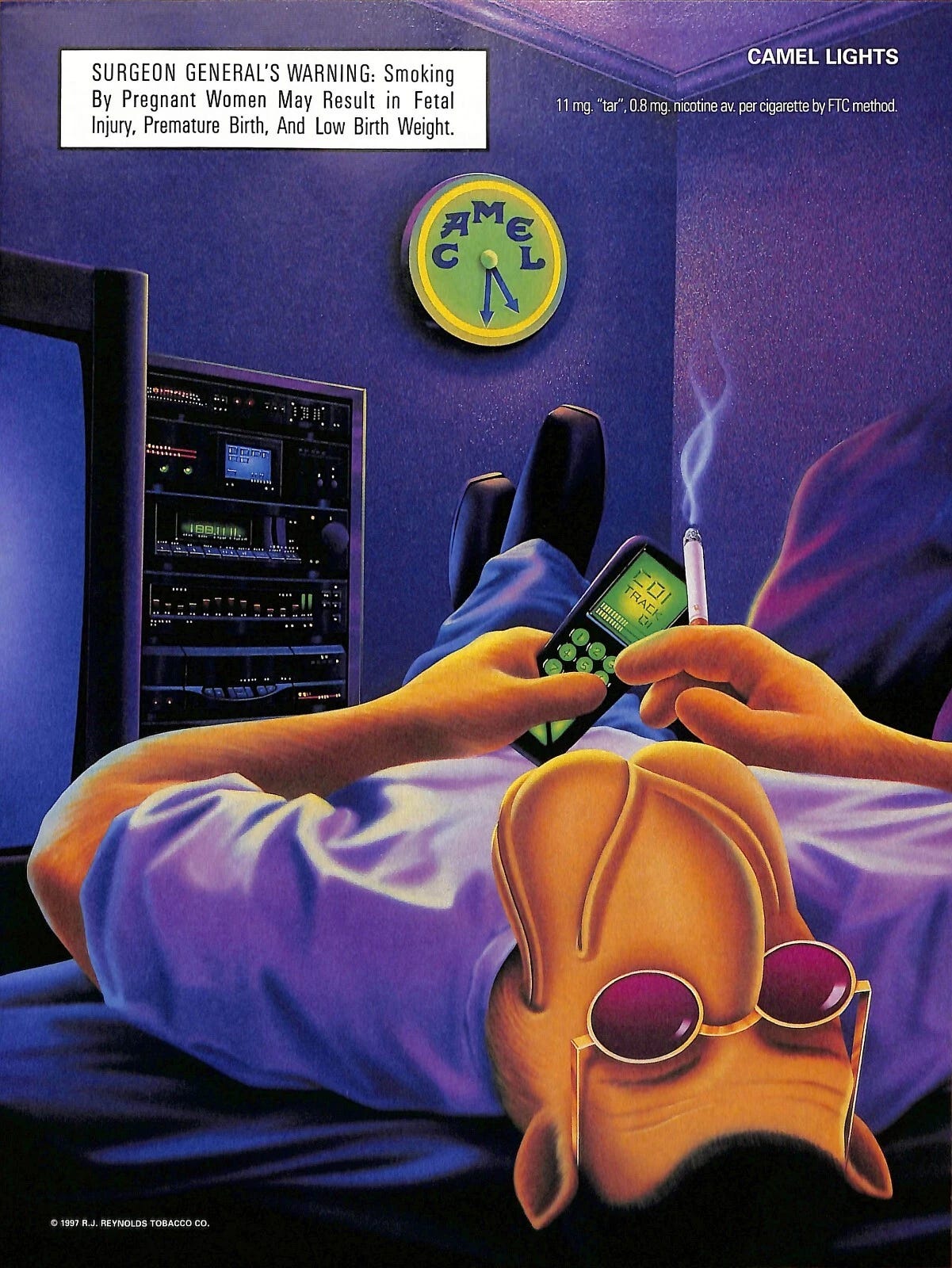
Joe’s last ads didn’t help the defense. A 1997 Camel Lights spot has him sprawled on a bed in a purple airbrushed room with what must be a pager in hand, stereo rack glowing, round tinted glasses.
It’s a teenager’s bedroom. No one questioned what a camel needed a pager for. In the campaign’s final year, with the FTC circling, that’s the room they drew.
On July 10, 1997, they pulled the plug, and a White House aide delivered the eulogy: “Joe Camel is dead. He had it coming.”
The kicker’s in the fine print of the JAMA study.
They tested Marlboro too. The kids didn’t know the cowboy.
Somewhere between the fighter jets and the subpoenas, Joe lost that lovin’ feelin’. It never came back.
Joe Camel: [Singing] You never close your eyes anymore when I kiss your lips...
PENCILS DOWN
The campaign worked exactly as designed. That was the verdict, not the defense. Camel lost the authenticity war to Marlboro fair and square, then won the awareness war with a cartoon. A cartoon so popular it wasn’t survivable.
Effectiveness and defensibility are different tests, and advertising only ever studies for the first one.
COCKTAIL OF THE WEEK: THE HENNY COLADA
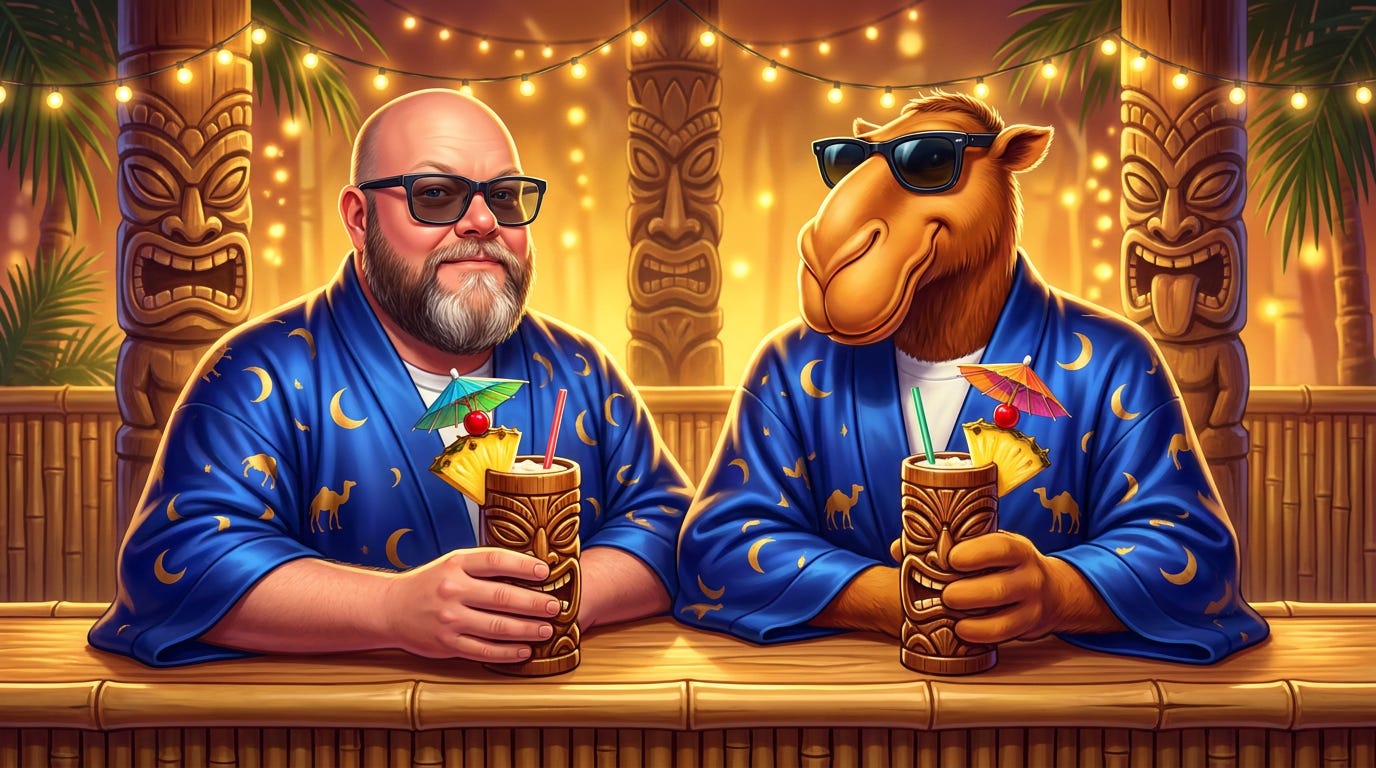
Joe Camel sold smooth. This week’s drink is what smooth actually tastes like.
A frozen piña colada made with Hennessy instead of rum. This has been the house drink of City Island in the Bronx for over two decades, served in tall plastic cups at seafood shacks.
The origin is disputed (when aren’t they), which is the good kind of story: Johnny’s Reef, sixty years on the island, swears they invented it. Others credit Seafood City.
Bronx-born bartender Giuseppe González put one on his Lower East Side menu as a tribute, with logic you can’t argue: the only way to improve a piña colada is aged rum, and aged rum is a lot like cognac.
Henny Colada
2 oz Hennessy VS
2 oz Coco López cream of coconut
2 oz pineapple juice
Blend with a scoop of ice until smooth. Serve it up in a hurricane glass or tall cup with a pineapple wedge and a cherry. Equal parts, so no measuring anxiety.
The Drink Cart is the newsletter version of sitting at a really good bar with someone who thinks too much about advertising and won’t shut up about it. Subscribe to get it on Wednesdays and Fridays.