

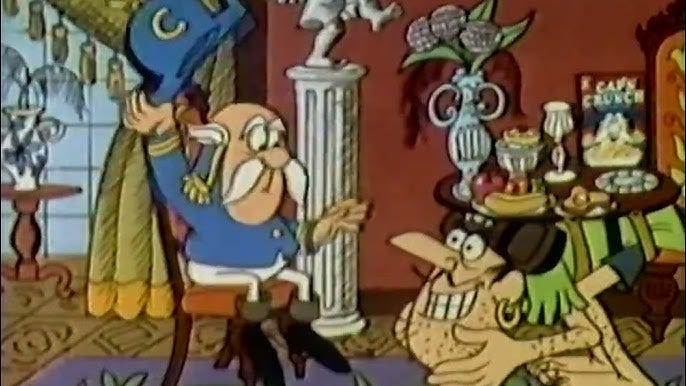
Advertising used to be so simple.
Imagine this happening so easily today.
Jay Ward, the creator of Rocky and Bullwinkle, gets contacted by Bruce Baker from Compton Advertising about a new cereal.
The brief? Just use the word crunch.
Ward was just about to let his whole studio go on vacation.
So his request was yes as long as there was no creative interference. (The dream)
A writer in the studio, Allan Burns, was inspired by Captain Horatio Hornblower.
But instead of Royal Navy officers as his crew. it was kids.
An early voice session had the girl playing Brunhilde call him Cap’n instead of Captain.
It stuck.
Cap’n Crunch’s origin story was, how shall we say, complicated and elaborate.
“Crunch’s father, Sven, was a navigator of a Viking vessel but was marooned in New England where he married a lovely Indian girl, Gidget Running Star.
They had a child, Horatio Magellan Crunch. Since American schools were limited in their curriculum at the time, Horatio was sent to England for schooling but on his voyage he was kidnapped by a band of pirates who taught him how to be a sailor.”
That seemed to be a bit much for breakfast cereal captain.
So it came down to basically, “he was born on Crunch Island located in a sea of milk.”
Much better.
Despite wild speculation that the captain’s, full name was Horatio Magellan Crunch, and he’s often been described as seafaring Napoleonic-ish egomaniac and that maybe he was French too.
There is also mounting evidence that the Capn’ didn’t seem to be a very good at his job of being the captain of a sailing ship.
Mon Dieu.
THE WHISTLE
One fun story is that some of those early 60’s boxes included a free toy whistle.
Legend says that the whistle emitted a tone at exactly 2600 Hz.
Why does that mean anything?
Apparently that is also the precise frequency AT&T used to signal a free long-distance trunk line.
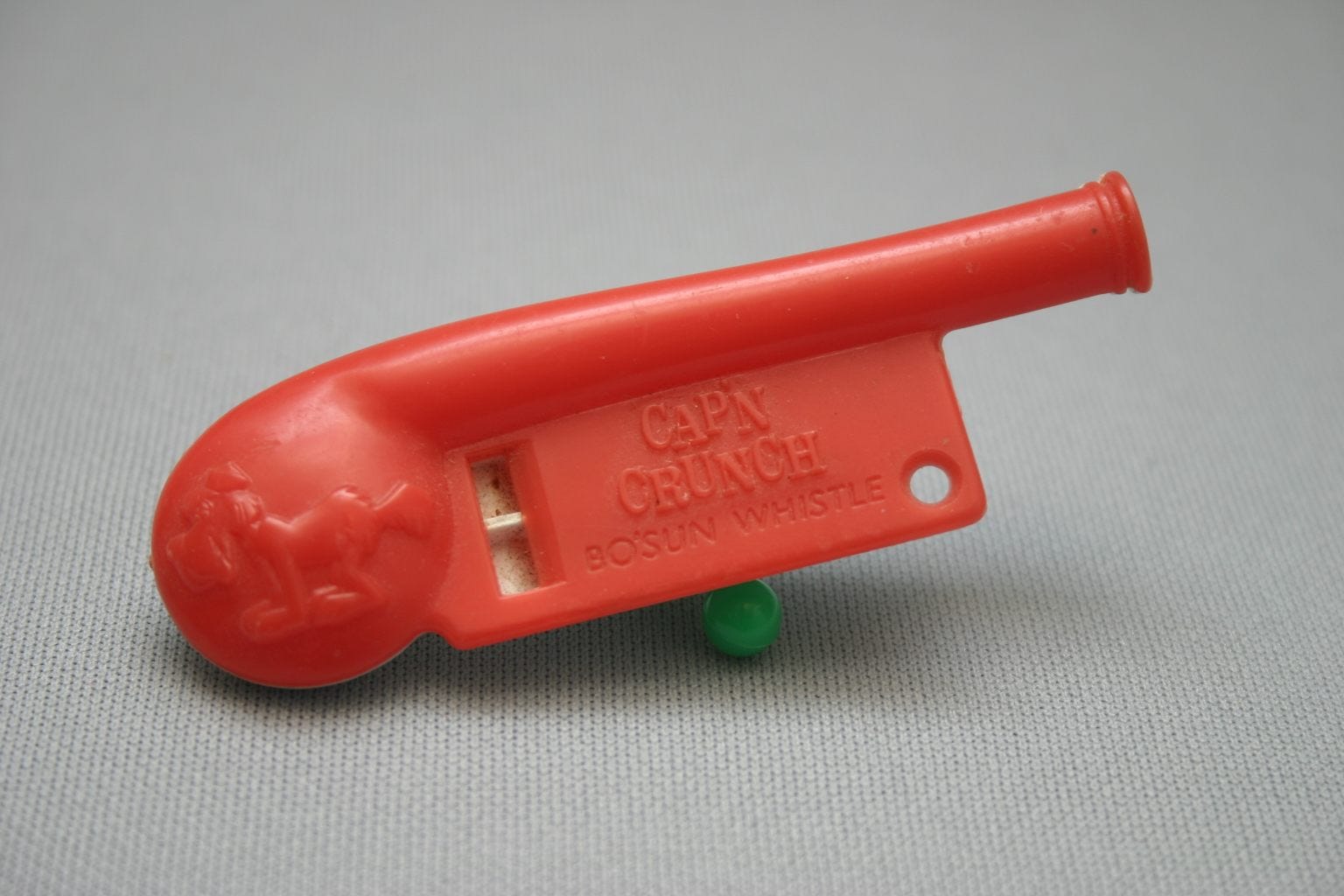
A hacker named John Draper (You can’t make that up) figured out you could blow the whistle into a phone, seize a free trunk line and make calls anywhere in the world for nothing.
He called himself Captain Crunch.
Then got arrested.
But first he told Steve Wozniak and Steve Jobs about it. They built their own blue boxes and sold them to UC Berkeley students.
Apparently Wozniak prank-called the Pope. Got through, impersonated Henry Kissinger and said "I must confess my crimes."
A very confused Vatican clergyman answered.
Jobs later said there would never have been an Apple Computer without blue-boxing.
A cereal box toy accidentally helped invent Apple.
GO BIG OR GO HOME
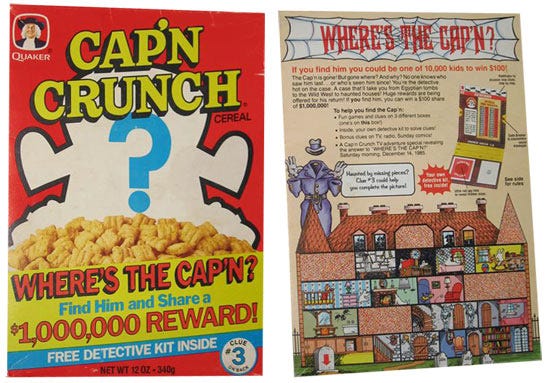
When the cereal launched in 1963, Quaker spent 80% of its entire marketing budget ($5 million).
The big gamble paid off. The Crunch empire was rolling.
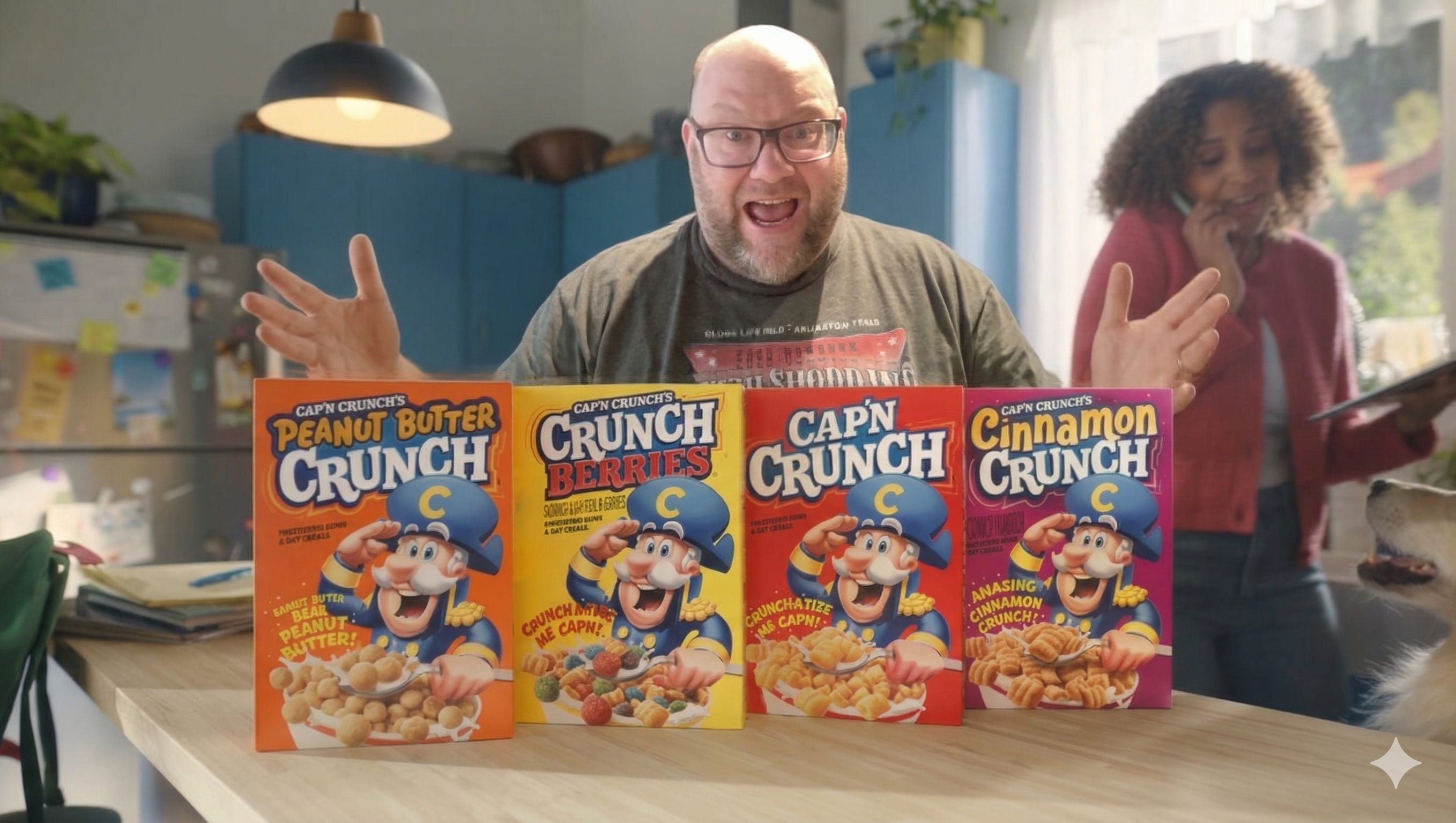
They added Crunch Berries in 1967. Peanut Butter Crunch 1969.
Then in 1985 he disappeared.
Don’t worry. The Old Cap’n was just in the Milky Way.
They liked it enough to run it again in 2000, this time with a CD-ROM game and six months of promotional waves, and a limited-time cereal called Mystery Crunch with magical popping sprinkles that nobody remembers.
PepsiCo acquired Quaker Oats in 2001 and Cap’n Crunch came along for the ride.
By 2011 the cereal was no longer being actively marketed to children. That old crunchberry.
In 2013, the Wall Street Journal pointed out that the Cap'n wears three stripes on his uniform, which makes him a Commander, not even a Captain.
The internet briefly lost its mind.
Last year Elliott Investment Management, the activist firm that took a $4 billion stake in PepsiCo, published a 75-page deck recommending the company shed underperforming brands.
They named names.
Cap'n Crunch and Life cereal were recommended to be divested.
The Soggies were the original villains and soggy cereal was the existential threat in the Crunch world.
It's a little on the nose that the thing that finally beat him wasn't a cartoon villain. It was a bunch of corporate villains during a portfolio review.
This is what they took from us.
THE AD LESSON
The Cap'n Crunch origin is a brief for what happens when you just let creative people make ads and don't interfere.
Jay Ward and hist studio’s only condition was zero creative meddling. They got it.
The result was a character with a full biography (maybe even too much of a backstory), a villain, a sidekick, serialized storytelling and genuine wit in every commercial.
When the creative team left, what remained wasn’t just a mascot. They had built him an entire Navy and nobody at Quaker ever said no.
Remember, a mascot without creative ambition is just a logo with eyebrows.
A mascot with his own navy and the ability to invade the dreams of every seven-year-old in America is a brand that echos into eternity.
THE CAPN’ CRUNCH NAVY GROG
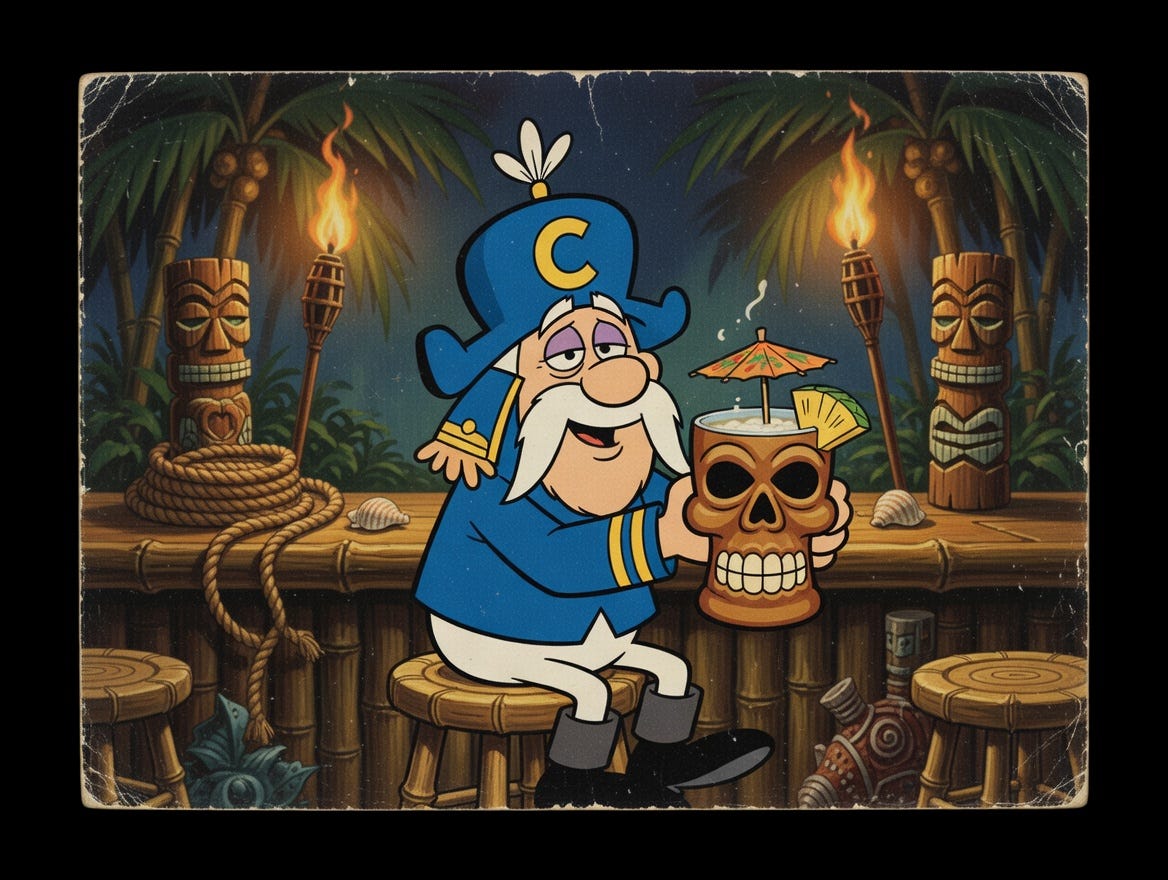
This cocktail starts in 1740 on a British warship.
We are so on theme in this newsletter.
Vice Admiral Edward Vernon had a problem.
His sailors were being issued a daily pint of rum — straight, barrel strength, roughly 75% ABV — twice a day.
They were drunk constantly.
So Vernon ordered it diluted with water. He also suggested adding lime juice and sugar to make it more palatable, which accidentally became one of the first documented treatments for scurvy and the rough blueprint for every rum drink that followed.
Vernon was nicknamed Old Grog — after the grogram cloak he wore everywhere. Thus his watered-down rum became grog. The name has stuck for over three hundred years.
The daily rum ration continued in the Royal Navy until July 31, 1970. The day it ended is still observed as Black Tot Day. For the couple of hundred years the rum tot was being handed out, the Royal Navy was the most powerful fleet in the world. Make of that what you will.
Donn Beach, the dude who invented tiki culture, built the modern Navy Grog around 1941 at Don the Beachcomber in California.
His male customers wouldn’t order anything that looked tropical or fancy. The Navy Grog solved that.
Listed on the menu as “a robust rum punch dedicated to the gallant men of the American navy.” Three rums, citrus, honey. Limited to two per customer.
It was Frank Sinatra’s drink at the Palm Springs Don the Beachcomber.
Richard Nixon drank Trader Vic’s version. The former Navy lieutenant, who served in the South Pacific would have his staff call ahead to Trader Vic’s inside the Capitol Hilton to clear the bar of everyone except one trusted bartender.
Then he’d spend hours drinking Navy Grogs and talking. The bartender never said what Nixon told him.
While the Cap’n wasn’t actually a captain, he still would have been drinking this and maybe that explains the various crashes.
NAVY GROG
1 oz light Puerto Rican rum
1 oz dark Jamaican rum
1 oz Demerara rum
¾ oz fresh lime juice
¾ oz white grapefruit juice
1 oz honey syrup (equal parts honey and hot water)
¾ oz club soda
Shake everything except the soda hard with ice. Strain into a double old fashioned glass over crushed ice. Top with the soda. Mint sprig and lime wheel to garnish.
The three-rum blend is the whole point, each one doing something different. Light rum brings clean sweetness, Jamaican adds funk, Demerara brings weight. Good bottles: Planteray 3 Stars, Appleton Signature and El Dorado 8.
White grapefruit is correct. Ruby red works but the bitterness is softer and the drink loses backbone. White grapefruit season runs December through February.
Honey syrup keeps two weeks in the fridge. Make a batch. Make two. Celebrate Captains and the Capn’.
Happy breakfasting kids.
The Drink Cart. A newsletter version of sitting at a really good bar with someone who thinks too much about advertising and won’t shut up about it. Wednesdays and Fridays.
So fun to read - especially on a Monday morning. Cap'n Crunch is a great cereal. And that grog looks excellent.
That Cap’n Crunch lore is intense!