

Seven brands got marched to brand court this week. Six got acquitted. One actually did the crime.
The internet went after an em dash, a harmless disco ball, a flour bag, an Olipop can, an actress, an egg sandwich and a 30-year-old jingle.
Hyphen Hysteria
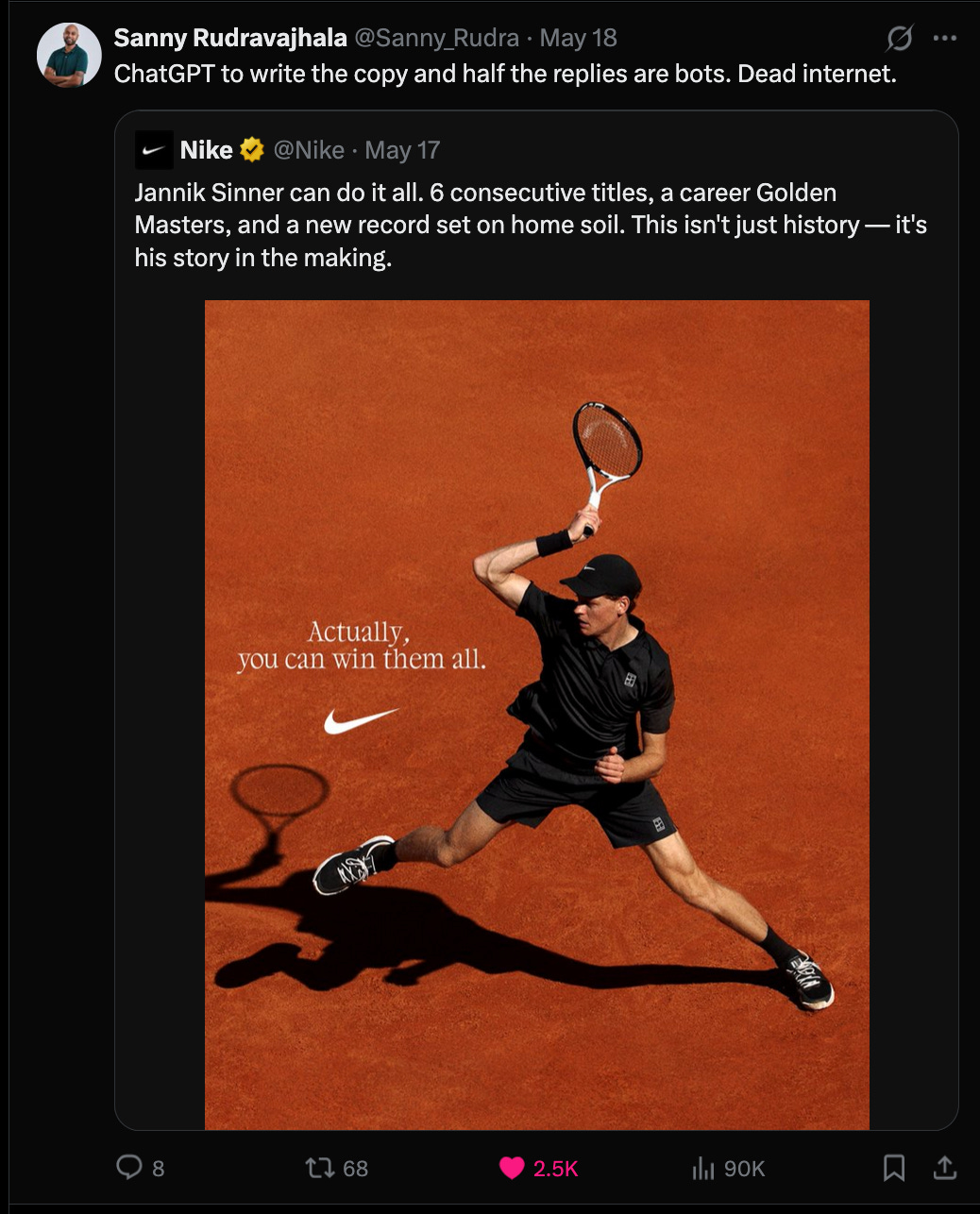
Nike posted Jannik Sinner on the Rome clay last Sunday. Career Golden Masters, six straight titles, the works. Caption: “This isn’t just history — it’s his story in the making.”
Sanny Rudravajhala screenshotted it. “ChatGPT to write the copy and half the replies are bots. Dead internet.” 2,500 likes. The internet decided Nike fed it to a chatbot.
It’s not clear if it really is AI copy. It’s actually worse. It’s lazy copy.
The em dash was a tell long before ChatGPT existed. The line works for Sinner. It also works for Cole Palmer, Caitlin Clark or any random sports moment. When a line works for everyone, it works for no one.
Nike’s social team shipped it because they could. AI isn’t degrading the craft. AI just made them faster to produce.
OpenAI added a setting last November to suppress em dashes because the punctuation got too associated with bot output. So now copywriters are editing their own punctuation to dodge bot accusations. Emily Dickinson would have been flagged. Boo hoo, I can’t use the em dash anymore. Get over it, the em dash will survive like a punctuation cockroach.
The Witherspoon Court Martial
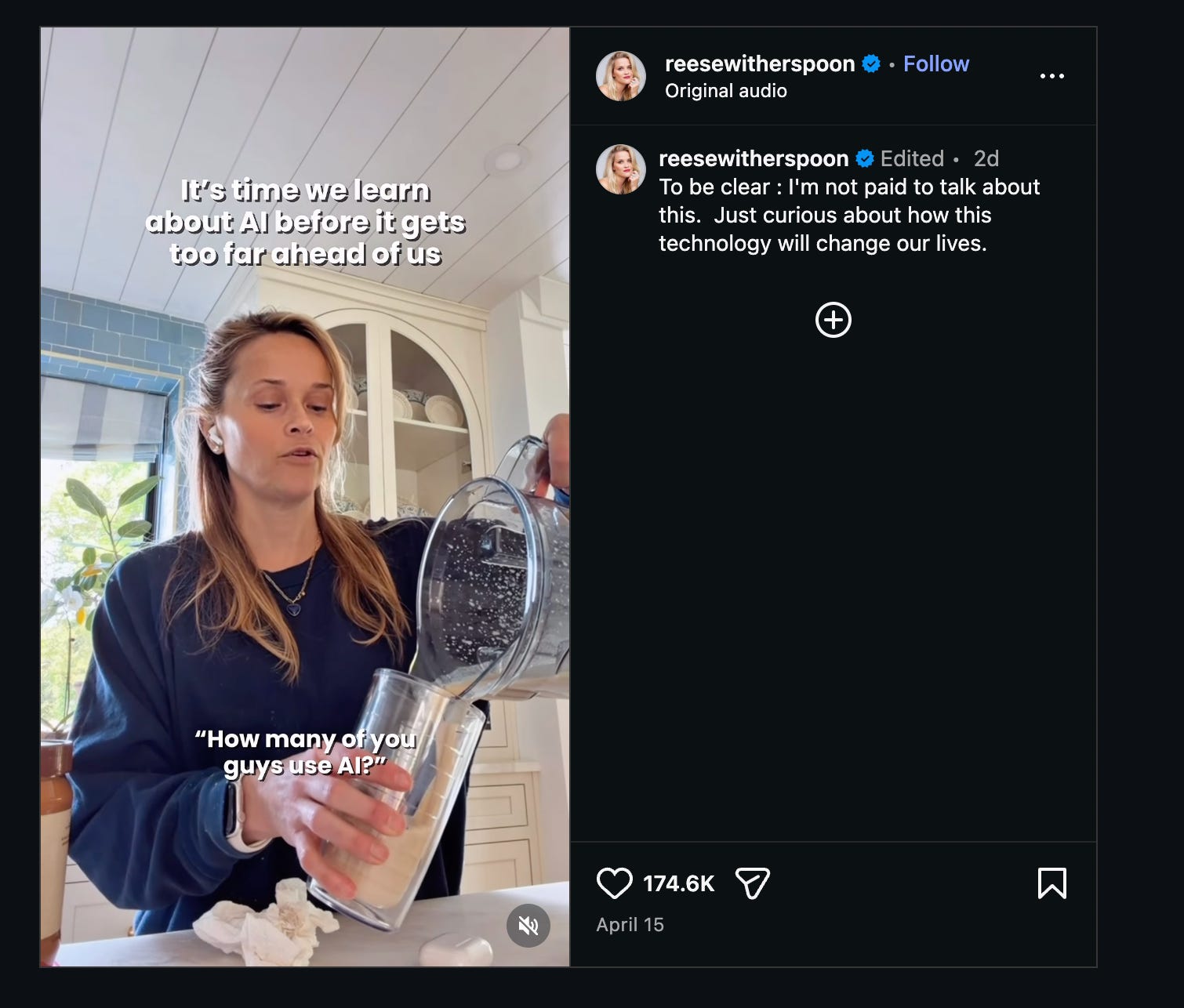
Reese Witherspoon posted on Instagram: women’s jobs are three times more likely to be automated, women use AI 25% less than men, learn it, don’t get left behind.
The internet ate her. Tressie McMillan Cottom in the Times called the whole celebrity-AI-empowerment beat cruel — the 2015 girlboss playbook now selling the technology that will displace the women it claims to empower. Mel Robbins got hit harder in the same piece because her Copilot post was a paid ad. Reese’s wasn’t. Reese followed up Tuesday: “no one is paying me to talk about this. I’m just a curious human.”
Garry Tan rebutted on X by calling Tressie a “Foucault-loving Marxist nutjob.” 22K views. Two camps now yelling about whether an actress should be allowed to recommend a software category.
Hot take: dunking on Reese for this is the lamest beat of the week.
Reese said women should learn a tool that’s going to be in every job in five years. That is not class betrayal. That is normal advice. The same advice every art director got in 2009 when they had to learn InDesign, every copywriter got in 1998 when they had to learn email, every account person got in 2015 when they had to learn social. New tool shows up. The people who learn it earlier do better than the people who learn it later. This has been true for every working generation. It is true now.
The argument that learning AI is “siding with the plutocrats” is the same energy as the people who refused to use computers in the 80s. The luddites lost that round. They are losing this one.
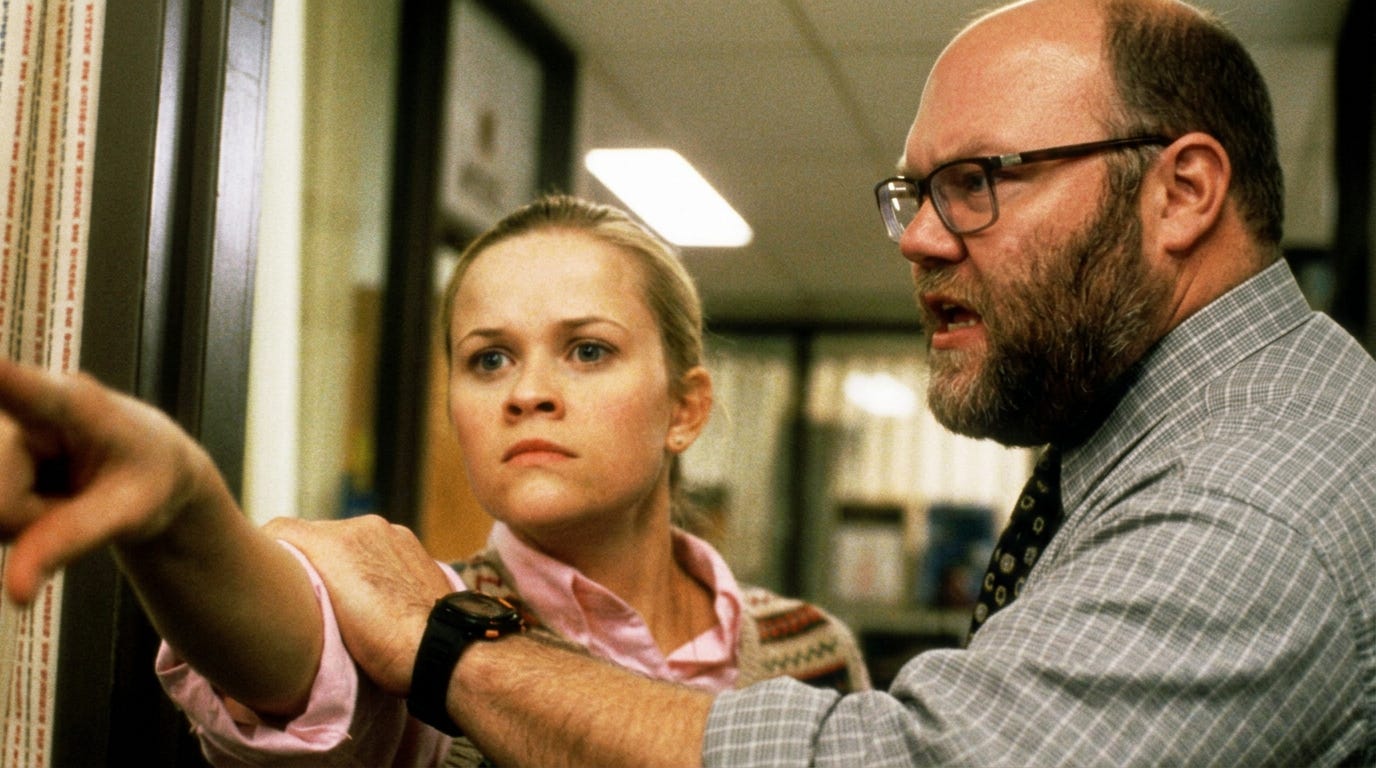
Reese isn’t running OpenAI. She’s a 50-year-old actress with kids who use AI, and she’s saying — accurately — that women who skip the tool are at a disadvantage to women who learn it. Tracy Flick would have learned AI. Tracy Flick would have a Copilot subscription, a Perplexity Pro account and a 47-slide deck about it by Tuesday. Reese knows this because Reese played her.
That’s not selling out. That’s just true. Tressie’s piece has real arguments about how the AI economy extracts value from labour. Those arguments are all important. They have nothing to do with Reese Witherspoon’s Instagram. The people piling on her are doing the same lazy move the em-dash police are doing one slot up. Identify a thing that looks like the bad thing, yell at it, post the screenshot.
They are losing this one. The actress is on the right side of it.
Three Logos On Trial
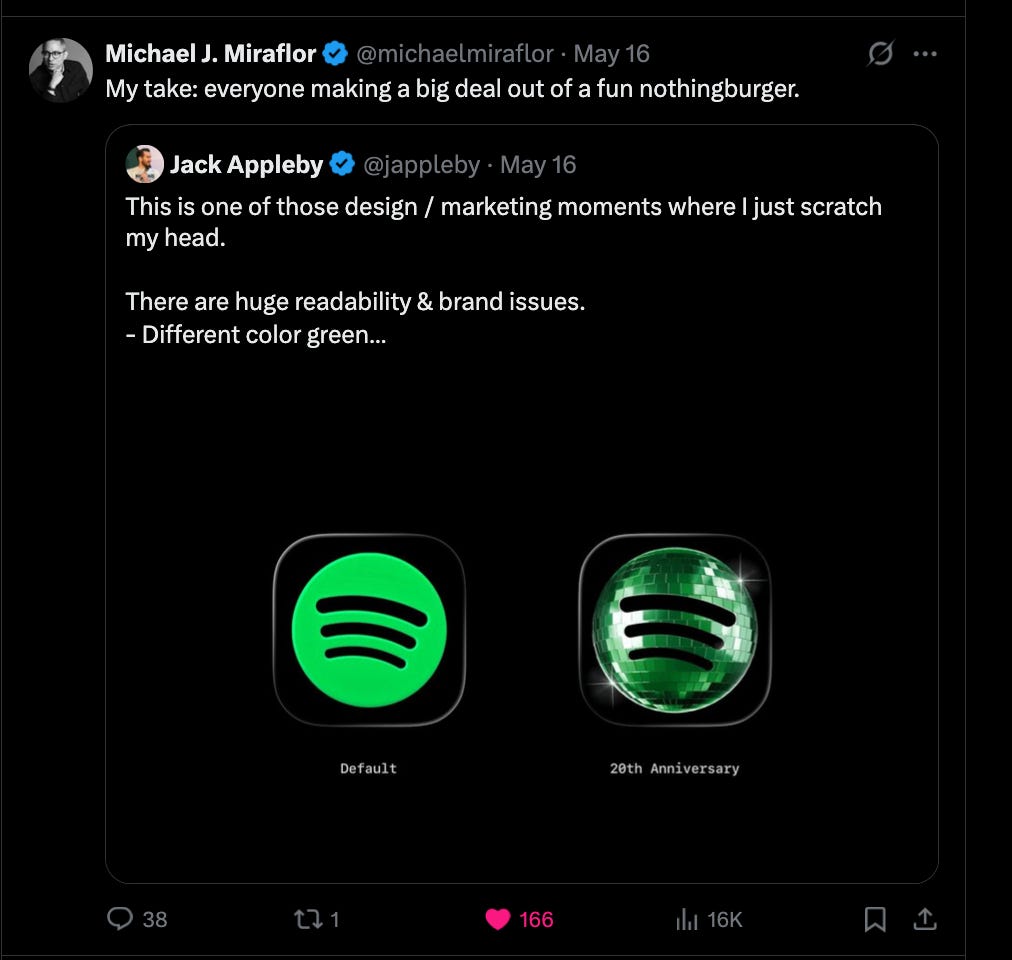
Spotify went first. May 12, anniversary stunt — the green soundwave icon wrapped in a glitter disco ball for the platform’s 20th birthday. Temporary. By May 17 they’d folded. “We know glitter is not for everyone.” The regular icon is coming back. Michael Miraflor in the replies: “Look what you’ve done, dorks. You’ve bullied Spotify into reversing something fun and different (and temporary to begin with). We don’t deserve nice things.”

While this was no Cracker Barrel or Jaguar rebrand. Spotify tried to throw its own birthday party. The audience demanded a reversal in five days. Move on.
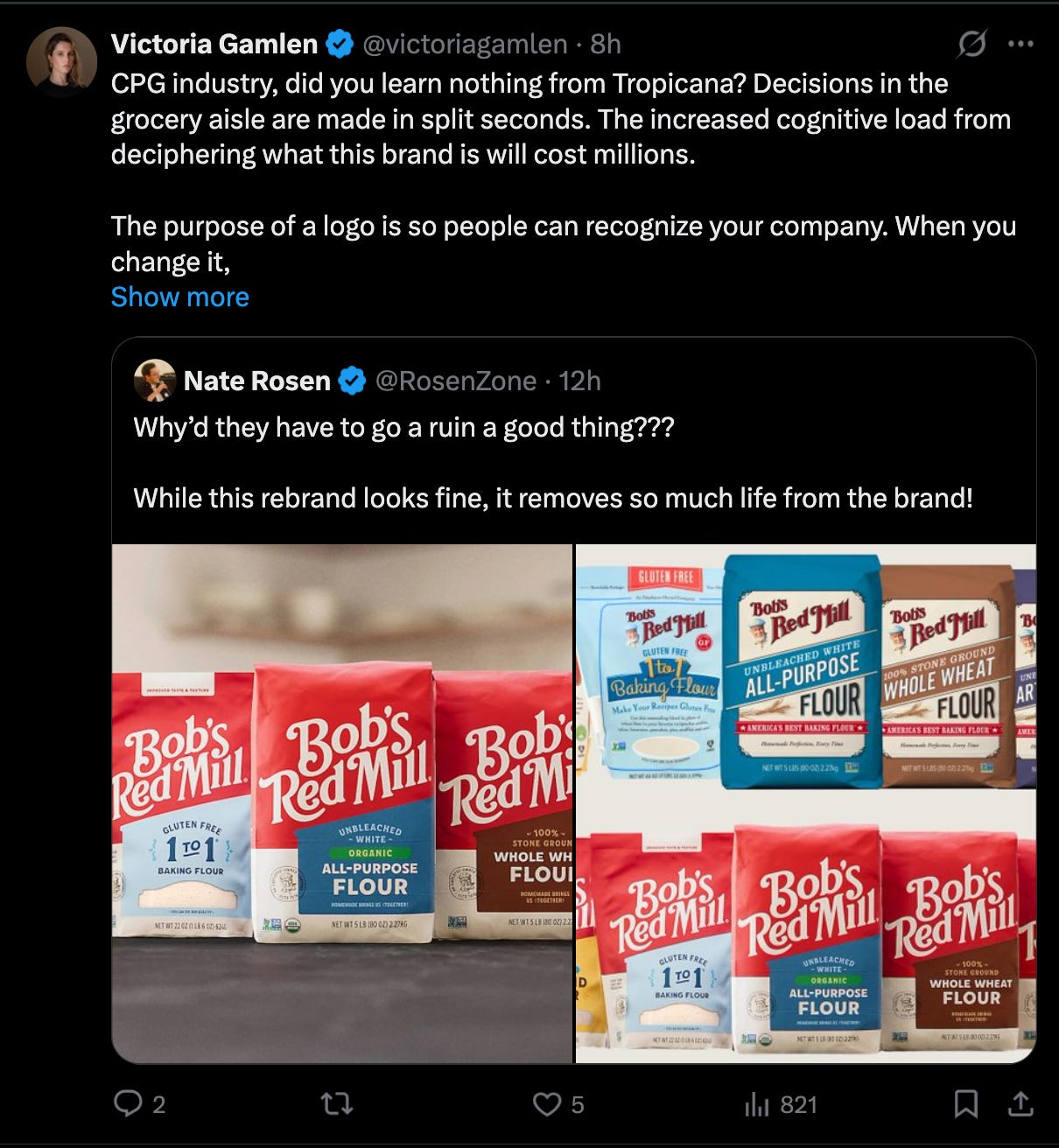
Bob’s Red Mill is the real one. Monday morning. Three-year Turner Duckworth overhaul. Bob Moore’s face — bearded, bolo-tie, on every bag for decades — shrunk down to a tiny “Seal of Quality” on the corner. The company’s own page calls it “a little glow up” and promises it’s “more Bob’s than ever.” More Bob’s than ever, with less Bob.
Two complications. Bob Moore died in February 2024 at 94. The brand is named after him. He gave the company to his employees on his 81st birthday. The new packaging frames the shift as “From Bob to all of us” — a clever pivot that turns the dead founder’s reduced presence into an employee-ownership story. Whatever the design logic, the human read is loud. A brand built on a man’s face is quietly dialing him down two years after his funeral.
Every CPG rebrand since 2009 has been an answer to Tropicana, when PepsiCo replaced the iconic orange-with-a-straw with a clean glass-of-juice. At least they kept Bob in the seal.
The thing that made Bob’s Red Mill different from the rest of the flour aisle was the man on the bag. Now the man is smaller. The bag will sell harder. And the thing that made it feel like a small Oregon mill instead of a corporate CPG entity is now a quarter-inch tall.
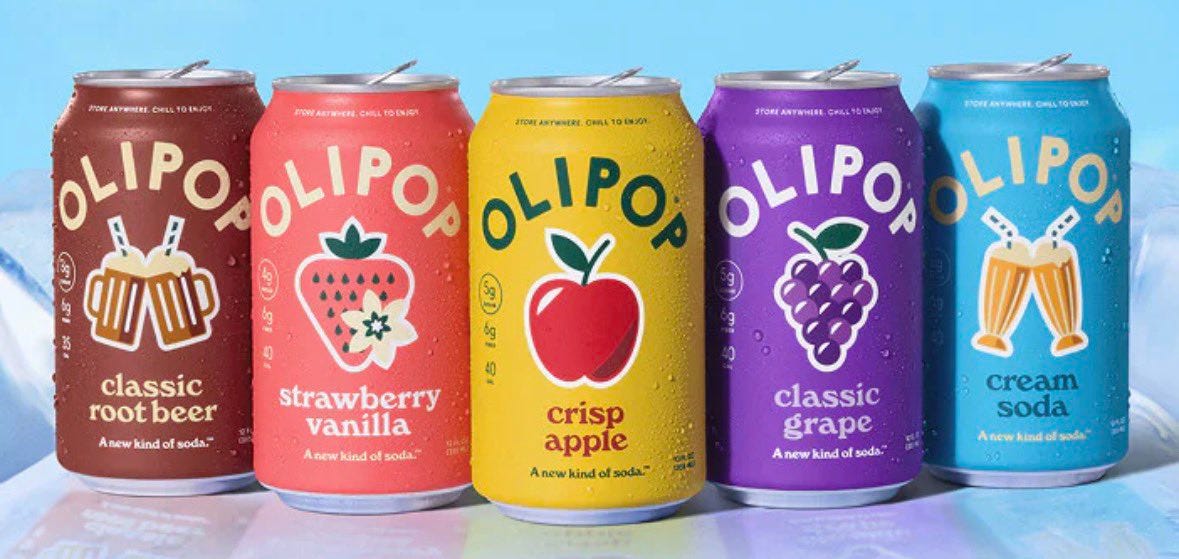
Olipop also dropped a refresh. “Feel Good Soda” platform, richer palette, hand-drawn illustrations I’m surprised people are accusing of being from AI too. SVP Tara Piper, formerly Liquid Death, brought in to evolve a brand designers were already using as the example of how to do CPG in 2023.
Tom Goodwin in the replies: “Did you get bored of the old one already? Nobody else did.”
Brand refreshes are a lot like kitchen renos. You don't tear out the cabinets because the kitchen stopped working. You do it because it's been a while, the finish is looking dated, the new owners want it to feel like theirs and the contractor said now's a good time.
No one cares if the kitchen was fine. They don't even care if you liked it the way it was. Every couple of years the cabinets must come down. Sometimes the result is better. Sometimes it's just newer. Either way it's happening whether you wanted it or not. And it will take three times longer and four times more expensive than you planned.
There’s A New Slut In Town
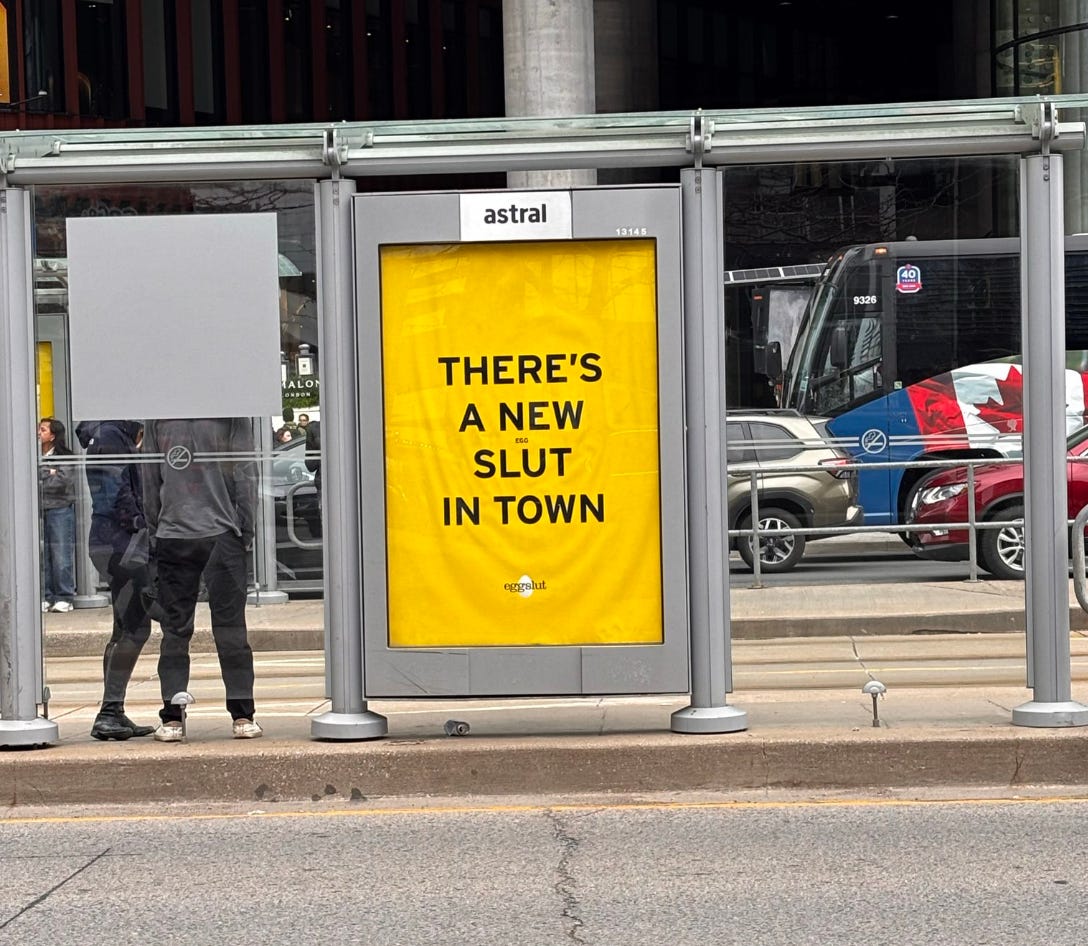
Eggslut opened its first Canadian location on King West last month. Their OOH campaign reads “There’s a new SLUT in town” with “egg” tucked between “new” and “slut” in microscopic font.
The Toronto Sun asked the City of Toronto if there were complaints. The City wouldn’t say. Astral Media runs the shelters. Ad Standards reviews complaints in secret.
The brand has been around since 2011. The outrage is 15 years late for a brand that’s been operating internationally for over a decade. The TTC poster is the headline equivalent of a guy who’s been on the block the whole time and just opened a flagship too loud.
The Quietest Felony of all
This is the actual felony. The jingle that took 30 years to prosecute.
Kars4Kids got banned in California. Civil trial. Found in violation of state false advertising and unfair competition law. Judge’s language: “actionable strategy of deception.”
Quick numbers. Kars4Kids spent $41.5 million on advertising in 2024. Transferred $35.3 million to its affiliated charity, Oorah. Only 41% of expenses went to actual charitable programs.
But people are mad that 60% of funds raised flow to Oorah, a New Jersey Orthodox outreach organization that funds gap-year trips to Israel, adult matchmaking services and a $16.5 million building purchase in Israel. California accounts for 25% of national vehicle intake — about 30,000 cars a year. The charity runs no programs in the state.
Emily Sundberg in Feed Me: “To me, this story shows the power of a good jingle is better than hypnosis — if it’s good enough, people will just give you a 2021 Volvo and not care what you do with it.”
Even the CBC stopped running them here in Canada.
The audience used to be the audience. Now they’re the brand cops, the Ad Standards complaint pile, the algorithm jury and the prosecutor — all running simultaneously, all flagging everything, all at the same decibel.
You can refresh a perfectly-good can and get yelled at by Tom Goodwin.
You can shrink a dead founder’s face and get compared to a $35-million 2009 disaster.
You can write boilerplate agency copy and get accused of being a robot when the actual problem is you’re a hack.
You can tell women a true thing about a tool and get called a class traitor by people who learned the last tool ten years late.
And you can run a 30-year false-advertising scheme with a great jingle worth tens of millions a year and barely register on the same week everyone’s mad about a glitter app icon.
The audience is yelling at everyone at once. Brands respond to volume because volume is the only signal left.
Court is always in session. Court doesn’t care what the crimes are.
COCKTAIL OF THE WEEK: THE HANKY PANKY
Created in 1903 by Ada Coleman, head bartender at the Savoy in London — one of the first famous female bartenders. She made it for the actor Charles Hawtrey, who walked in asking for “something with a bit of punch.” She handed him gin, sweet vermouth and a couple dashes of Fernet-Branca. He tasted it and said: “By Jove! That is the real hanky-panky!” The name stuck.
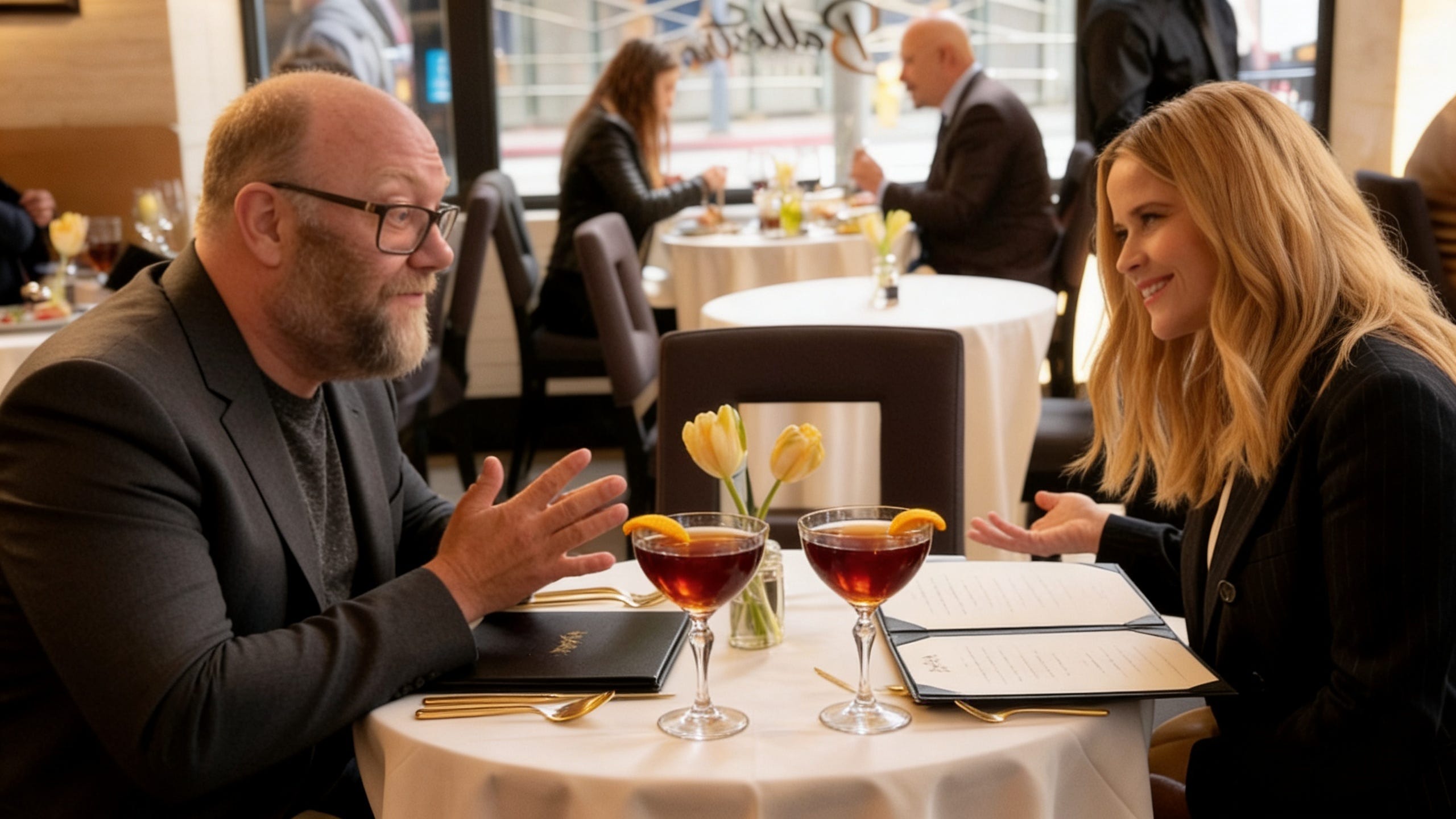
Make one of these and don’t post about it on social media. Especially if you have AI’d yourself into a Morning Show scene with Reese Witherspoon.
1.5 oz gin
1.5 oz sweet vermouth
2-4 dashes Fernet-Branca
Orange peel
Stir with ice, strain into a chilled coupe. Express the orange peel over the surface and drop it in.
Fernet is bitter and herbal. Start with two to four dashes, taste, add more if you want it sharper. This is a drink for anyone in advertising who’s been drinking a while and wants to feel something. You’re welcome.
The Drink Cart is the newsletter version of sitting at a really good bar with someone who thinks too much about advertising and won’t shut up about it. Subscribe to get it on Wednesdays and Fridays.
The Spotify logo change just proves, yet again, that people didn’t like change. Even if it’s temporary. But, we also adapt and get over it.