

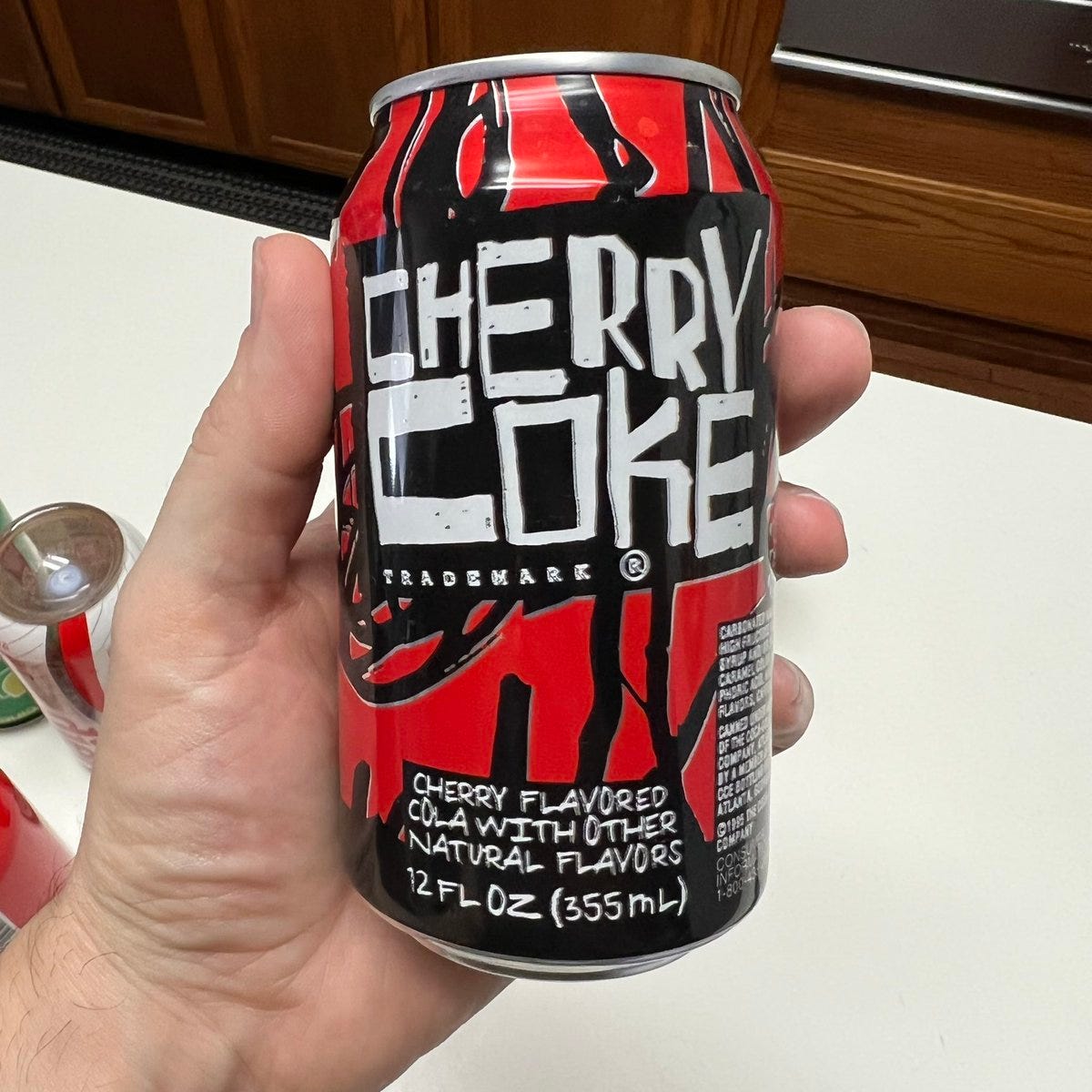
Last week the logo of a can of Cherry Coke from the 1990s stopped me mid-scroll.
The black scrawled letters on a red field, CHERRY COKE.
I decided right then this can deserved a whole issue. Where it came from, who made it famous, who made it at all — and why the internet still won’t let it die.
How could I not? There is a whole Cherry Coke logo timeline and in that universe Poland is apparently using this 90s throwback this year.
WHERE DID CHERRY COKE EVEN COME FROM?
Cherry cola existed for decades in soda shops, diners and even movie theatres, but Cherry Coke only launched in 1985 after years of research, testing it at the 1982 World’s Fair and after thousands of customer requests.
It was a monster. 91% consumer awareness within 10 weeks, a top-10 soft drink by the end of 1986. it is this design that people are wanting today, the one the brand is rolled out this past summer, not the 90s weird timeline and logo anomaly. People want the 80s more than the 90s. I can’t explain it. It’s just science. But there are some.
Some that want rare Cherry Coke 90s logo stickers. It’s no wonder that last year Daniel John at Creative Bloq dared the brand to bring it back writing, “Do it, you cowards.”
What Coke won’t tell you: They didn’t even get there first. Pepsi Wild Cherry beat them to market by weeks, both drinks aimed at ages 12 to 17. The cherry cola wars were fought for the hearts and minds of youth now in their 50s.
The original logo matched the moment. Lowercase “cherry” perched politely on the Coke wordmark. By 1992 those kids had discovered Nirvana and nothing that was mass marketed from big Soda was cool anymore.
BETA-TESTED AND FROM BANGKOK
The grunge redesign didn’t debut in Atlanta. It reportedly launched in Thailand and South America in 1994 and didn’t reach the United States until August 1996.
The most peak-90s artifact this side of a Blockbuster card was test-driven overseas for two years first. By the time the can hit US shelves, Kurt Cobain had been dead for two years already. Coca-Cola was wildly behind the Seattle grunge wave.
They were so worried about losing teenagers in the 90s that it invented a drink from scratch, OK Soda, which launched in 1993 with comic-book cans and a manifesto instead of a slogan.
Teens smelled this corporate dupe effort too. And OK Soda was dead by 1995. The grunge Cherry Coke can came from the same panic but it worked, because Coke wasn't inventing a personality, it was putting a new shirt on a drink kids already liked. OK Soda tried too hard to be your weird friend. Cherry Coke at least didn’t try that hard.
How deep did the panic go? In October 1994, Coca-Cola filed a federal trademark for the phrase THE FLAV RAGE. They never used it.
But somewhere in Atlanta, a room full of adults in ties approved that sentence, signed it and mailed it to the government. There must have been an ancient PowerPoint about it.
THE OSTRICH DESERVES ITS FLOWERS
“Do Something Different” became the full campaign, and Coke handed it to Cliff Freeman and Partners — the “Where’s the beef?” and “Pizza! Pizza!” shop, The most gleefully unhinged comedy agency of the era.
Giving them the misfit soda was the most self-aware thing Coca-Cola did all decade.
The flagship spot features a young man riding an ostrich through a shopping mall, causing considerable consternation. The slogan is oozing 90s: “Do something different.” The copywriter was Ian Reichenthal. He would bring other weirdness to Skittles and Starburst.
Then the focus groups arrived. By 1998, Adweek reported the campaign had evolved: “Research showed we could connect more strongly with teens if we portrayed the kids working toward a goal,” said brand manager Tim Halloran. “We’ve evolved from showing people doing something different just for the sake of being different.”
So Coca-Cola market-researched 90s rebellion and found that youth rebellion needs a goal.
The can doesn’t have much of a paper trail. No credited designer has ever surfaced publicly. Not in the design press, not in the archives, not in thirty years of Cherry Coke nostalgia coverage.
Advertising has always known exactly which of its children it loves.
THE CAN SAYS GOODBYE
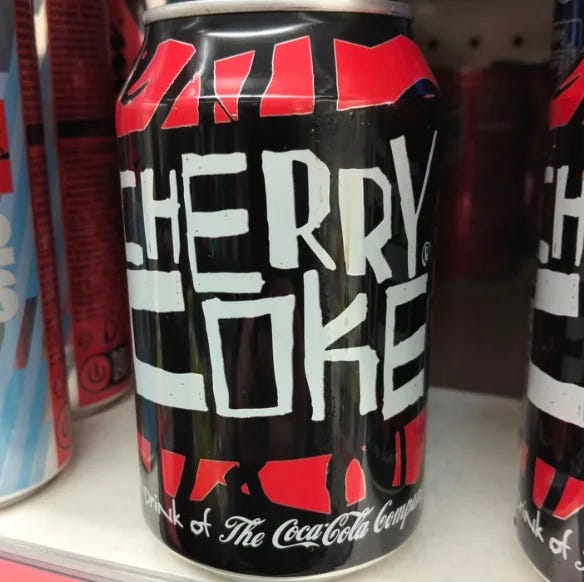
America retired the can around 2002, when Cherry Coke was repositioned to match the newly launching Vanilla Coke. A logo brought into line with the rest of the family.
But Poland kept the grunge design until 2014. And it’s back right now on shelves like the 90s never ended. While American Cherry Coke was being handed to Jay-Z for a rebrand, Polish teenagers were buying the 1994 version like the millennium hadn’t happened.
And with good reason as some Redditors proclaimed, “This can has been scientifically proven to make cherry coke taste better.”
It went viral on X in 2025 — “the hardest any soda branding has ever went,” plus another Redditor argued, “a lot of people think society began to decline after 9/11, but I think the changing of this logo played a huge role as well.”
Why does it hit so hard now? Because it’s everything current branding refuses to be. Textured in an era of flat. Handmade in an era of geometric sans serifs. Every startup logo looks designed to survive legal. This thing looks designed to survive a mosh pit.
COCKTAIL OF THE WEEK: DO SOMETHING DIFFERENT
In 1930, Harry Craddock’s Savoy Cocktail Book printed a strange little drink called the Blood and Sand. Scotch, sweet vermouth, orange juice and Cherry Heering in equal parts, named for the 1922 Rudolph Valentino bullfighting picture.
Nobody knows who invented it. A drink named after pop culture with no credited author, and it outlived nearly every cocktail around it. Sound familiar? It’s one of maybe three Scotch cocktails from the classic era anyone still orders, and the ingredient doing the heavy lifting is the cherry.
That cherry is Cherry Heering, the Danish liqueur Peter Heering started making in Copenhagen in 1818. Backbone of the Blood and Sand, backbone of the Singapore Sling. Two hundred years of doing something different without ever needing a campaign about it.
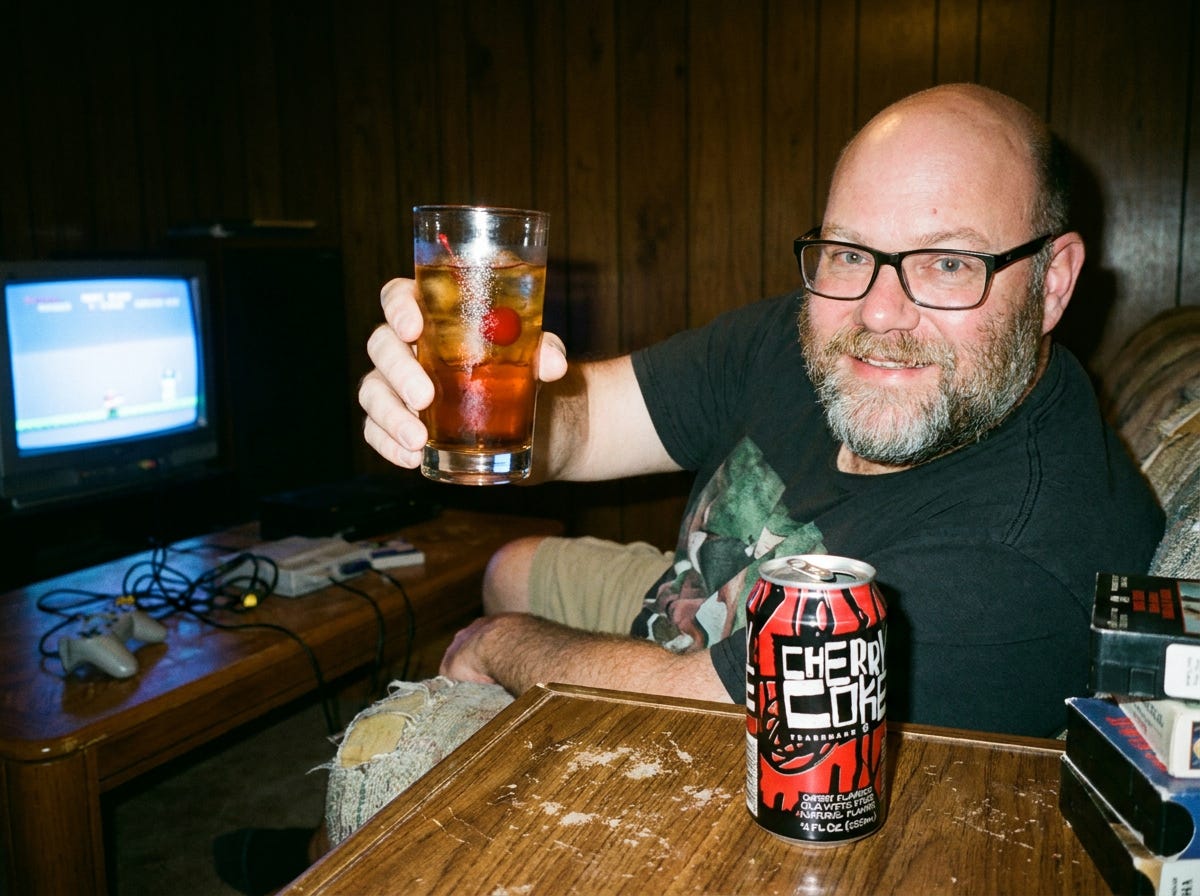
So this week we’re pulling the Heering out of the classics and dropping it into the least interesting drink in America — the bourbon and Coke. Same move 1994 made on the can.
Do Something Different
1 1/2 oz bourbon
3/4 oz Cherry Heering (or Luxardo Sangue Morlacco)
2 heavy dashes Angostura bitters
2 heavy dashes cherry bitters
4 oz Coca-Cola, cold
Brandied cherry
Build the bourbon, Heering and bitters in a highball over ice. One quick stir. Top with Coke, drop in the cherry.
The Drink Cart is the newsletter version of sitting at a really good bar with someone who thinks too much about advertising and won’t shut up about it. Subscribe to get it on Wednesdays and Fridays.
Imagine the budget and process to make that 1986 commercial. Would have been a fun one.