

Here’s a number that stopped me cold.
Between 2005 and 2019, people started talking less. Not a little less. Every year, the average person spoke 338 fewer words a day than the year before. Stack it up and it’s a 28 percent drop. From around 16,600 words a day to under 12,000.
A whole conversation, gone. Every day.
The researchers weren’t even looking for it. They were redoing an old study on whether women talk more than men, and the decline just fell out of the data. Their first reaction was that they’d botched the math. Nope.
Nobody can say exactly why. But look at the window. 2005 to 2019. The texting years. The feed years. The self-checkout, tap-to-order, never-speak-to-a-human years.
We didn’t decide to go quiet. We optimized our way into less words. Keep scrolling, stay home, use a QR code to order. The industry I work in spent fifteen years engineering silence.
So it’s a little rich that this month that same industry flies to the south of France to hand itself trophies for “human connection.”
THE AWARD SHOW WITH NO DARK HORSE
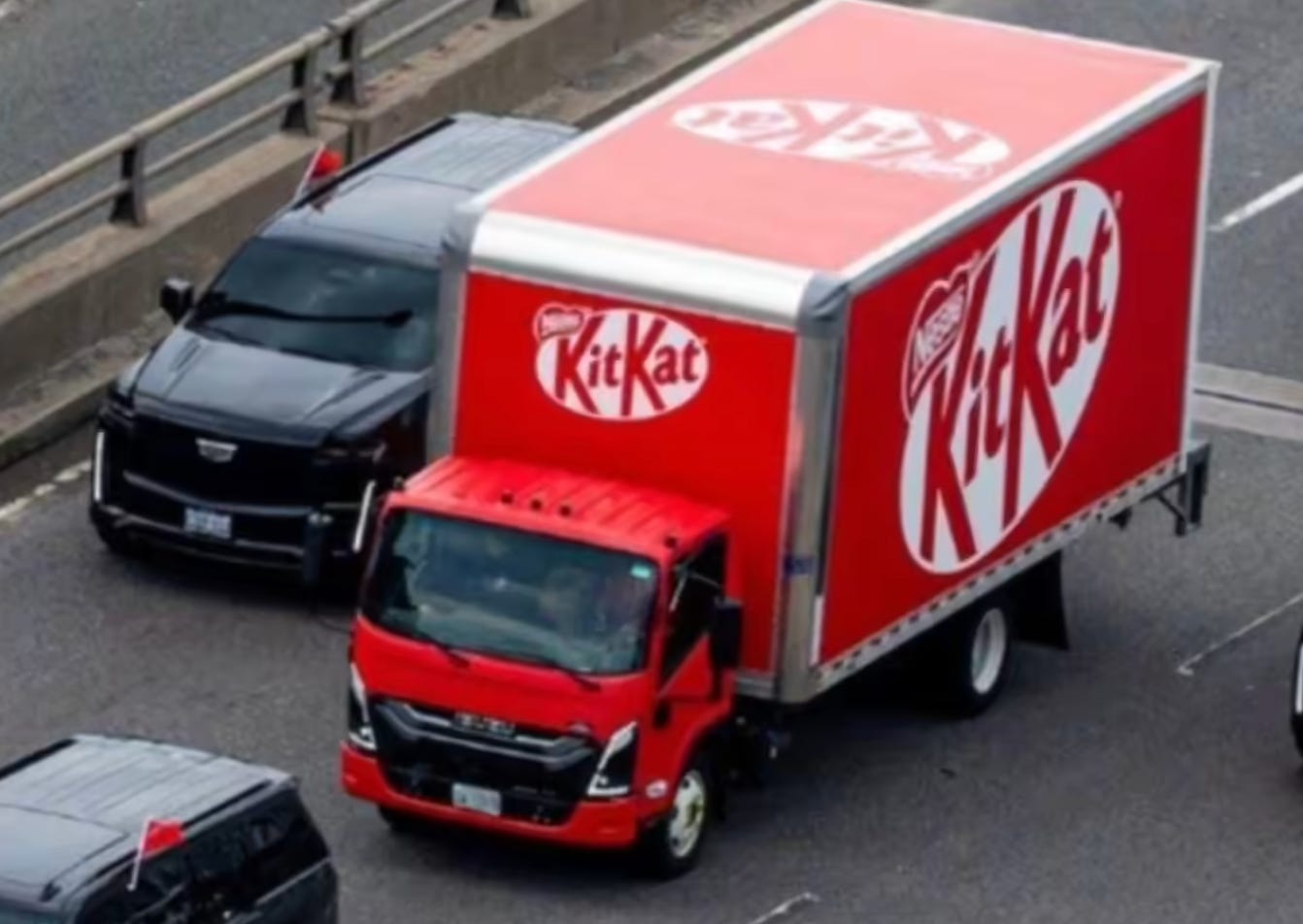
In April a KitKat truck rolled down the Gardiner under a convoy of black SUVs flying little chocolate flags. Presidential security detail. Fake heist protection, real production. It happened in my city, on a road I look at every week.
I found out about it this month. From a French awards shortlist.
I read the Ad Age Cannes predictions where forty chief creative officers picked the work they think takes home metal later this month. Sixty-some campaigns.
I’d seen five of them.
Five.
Everyone reaches for the Oscars comparison with Cannes and I totally get it. The hype, the rosé, the sense that you should’ve kept up and didn’t. I write a twice-a-week newsletter on ads and I missed most of these.
There was a time I’d seen every Best Picture nominee by February and had a position on each one. That ended a while ago, same as it did for you.
The Oscars always have a dark horse, an upset, a snub somebody’s furious about. People who haven’t seen a single nominee still know who got robbed. The whole scam runs on an audience that shows up to be surprised.
Cannes has no dark horses. If an ad doesn’t win an award a very small group of people might be mildly upset.
There is nobody outside ad world to surprise. No normal person knows these campaigns exist, let alone has a favorite. The only people who could call an upset are the forty creative directors doing the voting, and they already know the ending. You can’t have an underdog in a race the public doesn’t know is happening. I would be stunned to think many people can even imagine that there’s a French ad festival where chocolate-truck stunts win trophies.
The five I’d actually seen all ran where people actually were. Claude’s Super Bowl spots. The Squarespace thing with Emma Stone. Instacart’s banana ad. Whatever Apple did. Work that ran in the breaks of things millions of people were already watching. Seeing it was the whole point.
The ones I’d never heard of were the stunts and the films. The KitKat convoy. Chili’s opening a fake “fast food financing” storefront next to a McDonald’s. Channel 4 putting vomiting statues on the Southbank. A nine-minute Gushers horror short. A seven-minute M&M’s documentary about peanuts.
And Spike Jonze co-directing a half-hour Gucci film with the woman who made Babygirl.
Thirty minutes? I’d have remembered thirty minutes.
Most of this is made for the jury. They exist to get written up. Written up in exactly the Ad Age roundup I was reading, by exactly the forty people who’ll vote on it. The work isn’t made to be seen. It’s made to be entered.
That’s not a knock. Some of it’s brilliant. The KitKat thing is genuinely funny and I’m low-key annoyed I missed it. I’d actually eat the heck out of one right now. But “brilliant” and “anyone saw it” stopped being the same measurement somewhere along the way.
While the industry packs for France, two horror movies made by kids from YouTube are eating the box office alive. Backrooms, made for $10 million by a 20-year-old, posted A24’s biggest opening ever. Obsession cost $750,000 — roughly a rounding error next to a Cannes hospitality suite, and it’s grossed more than a quarter-billion, climbing every weekend like it’s 1982 and people just found E.T.
Neither ran a campaign built for a jury. Backrooms put a billboard in the one Wisconsin town where the original creepypasta photo was taken — a detail only the real fans would clock. Obsession built a fake product site, vending machines, a phone number you could text. They didn’t advertise at people. They gave people something to do, in the actual world. People actually showed up. Then came back.
That’s the thing Cannes can’t measure. Not whether forty creative directors admired your craft. Whether anyone bought a ticket and took the ride twice.
An award doesn’t measure whether the work reached anyone. It measures how well you reached the people handing out the awards. Five out of sixty isn’t me being out of touch. It’s a closed room doing exactly what a closed room does.
COCKTAIL OF THE WEEK: THE MARTINI BIANCO SPRITZ
Four days ago Martini launched Jonathan Bailey as its new Martini Man. Multi-year deal, a short film, the coast outside Venice, an original 1970s Martini racing car, the whole sun-drenched Italian summer fever dream. He gets an initiation in sprezzatura, the Italian art of looking like you didn’t try. Then he pours a Bianco Spritz, and that’s the ad.
Martini doesn’t have an awareness problem. Ninety percent of the planet knows the brand, sales north of a billion and a half. What it has is a usage problem — growth’s been flat for years. So the entire job of this gorgeous thing is to get you to order one specific drink. Not to win a jury. To move a spritz.
And it’ll run where people actually are. TV, streaming, social, a summer takeover of Milan, terraces in New York and Berlin. Millions will see it. Some will order the drink. That’s advertising doing its oldest, least glamorous job, out loud, while the trophies go to vomiting fountains.
Sprezzatura is effort dressed up as ease. The exact inverse of a Cannes case study film, which is effort dressed up as even more effort.
THE MARTINI BIANCO SPRITZ
1.5 oz Martini Bianco
1.5 oz prosecco
Splash of soda
Garnish with lemon slice, mint sprig and slices of strawberry.
Build and serve over ice
AN ITALIAN CANNES WOULD ACTUALLY WORK
It’s not just the Martini ad giving us the wonderfully luxurious concept of “Martini Time” but an ad festival in Italy just might work better.
From 1957 to 1977, Italian TV had Carosello. A ten-minute block of commercials, every night, right after the news. Sounds like a punishment. It pulled 20 million viewers.
The rules were the genius. Italian law wouldn’t let you just advertise at people, so each spot had to be a little film (a sketch, a cartoon, a story) and by rule the plot couldn’t be about the product. You earned the attention first. The brand only turned up at the very end, in a few fixed seconds. Sell last. Entertain the whole way there.
And the whole country watched. Kids were sent to bed the second it ended — “dopo Carosello, tutti a nanna.” After Carosello, off to bed. A generation timed their bedtime to the commercials. Try to picture a North American kid begging to stay up for one more ad.
Real directors shot them, anonymously. Famous actors showed up. The last one ever, New Year’s Day 1977, was Raffaella Carrà dancing for a bottle of Stock 84.
That’s the festival I want. Not a few hundred ad nerds in a room in France. A country that actually watched, every night, and could tell you exactly which ones were worth staying up for.
Carosello didn’t have a dark horse either — but for the opposite reason. No upset, because everyone had already seen everything. The jury was the whole country.
That’s the version where winning means something. The work that wins is the work people chose to watch. We traded it for a yacht party. Yes, I’m 100% jealous that I’ve never been.
The Drink Cart is the newsletter version of sitting at a really good bar with someone who thinks too much about advertising and won’t shut up about it. Subscribe to get it on Wednesdays and Fridays.
I would be curious to know if between 2019 and 2026, talking has decreased further…