

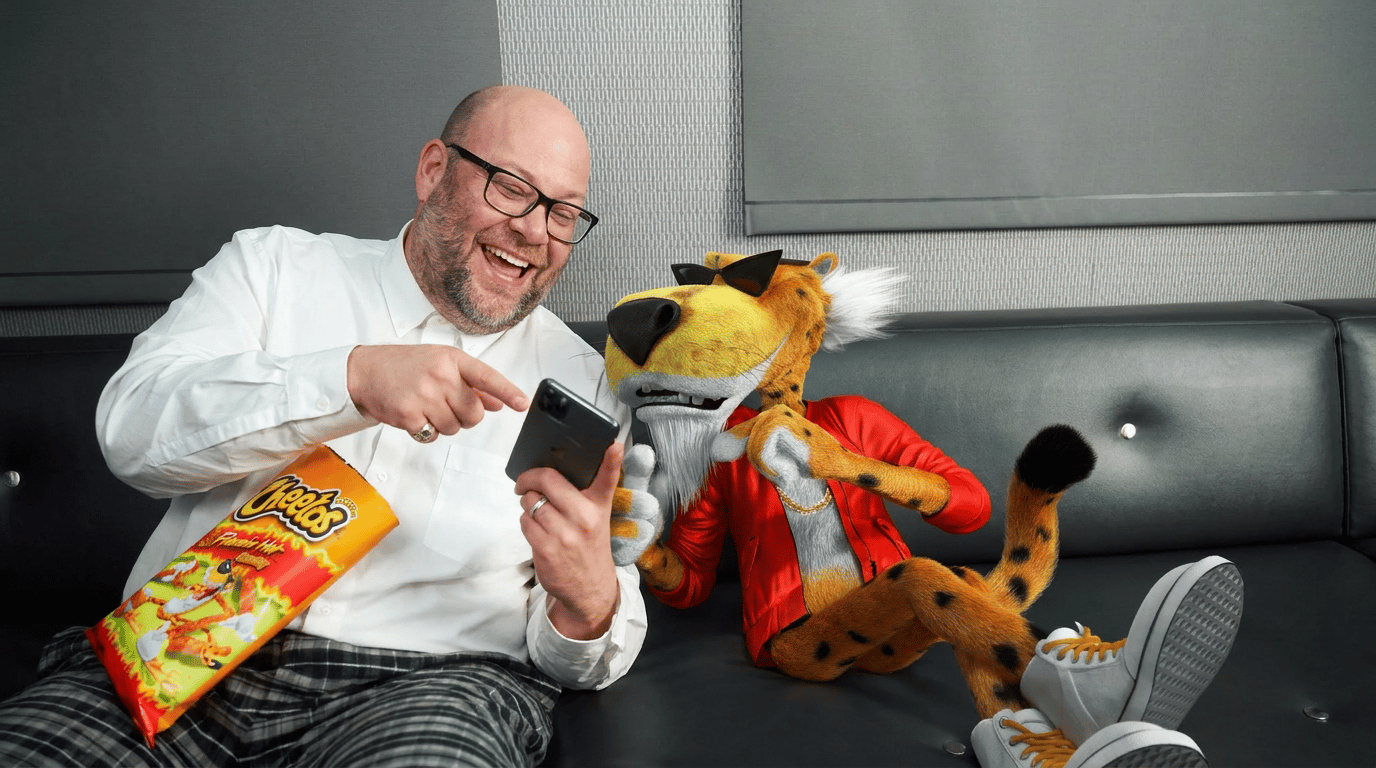
Before Chester Cheetah, Cheetos had a mascot.
Nobody remembers him.
His name was the Cheetos Mouse.
He debuted in 1971.
For a puffed, extruded cornmeal covered in powdered cheese brand, having a stuffy, highfalutin voiced mouse as your mascot was a choice.
He showed up as an inexplicably snooty window washer. He rode a motorcycle through a mountain and the mountain crumbled from the Cheetos crunch. He showed up as a politician.
He ate a Cheeto in space and the moon fell apart. His plane disintegrated mid-flight.
None of this helped.
He was designed by Paul Coker. The MAD magazine illustrator. Same guy who designed Rankin/Bass holiday specials — Santa Claus Is Comin’ to Town, Frosty’s Winter Wonderland, Year Without a Santa Claus.
The guy who drew our childhood Christmas couldn’t move cheese puffs.
By 1979, he was gone. Eight years on the job. Approximately zero cultural needles moved.
Cheetos went without a mascot for the first half of the ‘80s. But the brand needed something.
In 1985, Frito-Lay hired DDB Needham Chicago to fix the problem. Creative director Brad Morgan sketched a sunglasses-wearing cheetah who stole Cheetos from strangers at the beach using elaborate schemes that always backfired. Spectacularly. With full commitment and zero self-awareness.
Stephen Kane wrote the scripts.
Richard Williams — the same Richard Williams who was animation director on Who Framed Roger Rabbit — drew the original 24 frames per second.
The voice was Joel Murray.
Bill Murray’s little brother.
The same Joel Murray who’d later play Freddy Rumsen on Mad Men. The alcoholic copywriter who could play Mozart with his own zipper.
A future fictional copywriter voicing a cheetah who steals snacks so a real agency could sell more snacks. Put that in your Cannes entry.
“It bought my first house,” Joel said about the Chester gig.
The mouse wore a suit and crumbled mountains for eight forgettable years. Chester wore sunglasses, committed petty theft and stayed for forty.
One was forgotten. One sold a billion dollars in cheese puffs.
The campaign structure was pure Looney Tunes. Chester spots someone with Cheetos. Chester devises a plan. Chester executes with complete confidence. Chester fails spectacularly. Reset.
Every commercial. For decades.
He’s Wile E. Coyote. The Cheetos are the Road Runner. The genius is that he never wins. He’s never threatening because he’s never actually a threat.
The original tagline: “It ain’t easy being cheesy.”
Which is remarkable because it’s self-deprecating about the product. Cheetos leave orange residue on your fingers. They’re aggressively artificial. They stain everything. Chester doesn’t pretend otherwise. He leans into the absurdity.
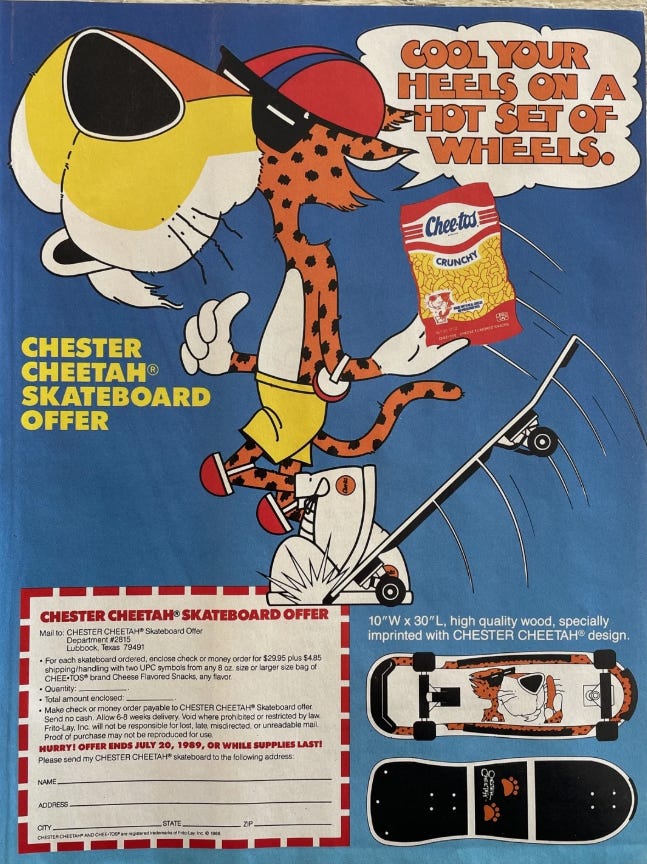
That honesty was the whole strategy.
Sales went from $200 million to $1.2 billion in Chester’s first decade.
THE CHEETLE
In 2008, Chester got a second act nobody expected.
Goodby Silverstein & Partners launched OrangeUnderground.com. Chester appeared as a puppet with a mid-Atlantic British accent, calling himself “Papa Chester,” encouraging people to use Cheetos to commit minor acts of revenge.
Plug the nostrils of a snoring man. Dump a handful into a neat freak’s cubicle.
Future Supernatural star Felicia Day plays a woman in a laundromat. A snarky customer tells her other people are trying to do their laundry too. Chester appears. Suggests she toss a handful of Cheetos into the dryer with the woman’s whites. She does. Chester vanishes.
Slate called it “delightfully creepy.” They weren’t wrong.
The reason it worked: Frito-Lay had hired a neuromarketing firm called NeuroFocus to wire up Cheetos eaters and read their brain activity. The data showed that getting orange dust on your hands triggered a “giddy feeling of subversion.”
Of course the agency built a campaign around it. How could you not.
Cheetos discovered the only insight that ever mattered. People like being a little bit bad. They sold the orange fingers as a feature.
Cheetos gave the orange dust on your fingers an official name.
“Cheetle.”
Got it into Dictionary.com. It’s a real word now. You use it in Scrabble and win.
Inventing a vocabulary word for the thing everyone else would consider a product flaw is pure Chester energy. The flaw is the feature. The feature needs a name. The name is in the dictionary.
The cheetle is still driving a lot of the creative, even if Chester is taking more of a supporting role. But he’s still rocking it out 40 years later.
THE FLAMIN’ HOT MYTH
Here’s the best Cheetos marketing story ever told. It’s also a lie.
Richard Montañez, a janitor at the Frito-Lay plant in Rancho Cucamonga, California, invented Flamin’ Hot Cheetos. Or so the story went. He took unflavored Cheetos home from a broken machine. Added Mexican spices. Cold-called the CEO. Pitched it in person. Saved the brand. Rose from janitor to vice president.
Frito-Lay let the story run for a decade because the story was better than any ad they could have made.
Then the LA Times investigated in 2021.
The product was developed by a team in Texas. Years earlier than Richard claimed. The CEO he said he pitched wasn’t CEO yet. A woman named Lynne Greenfeld actually led the team that named and launched the brand.
Nobody’s directing Lynne’s biopic.
Frito-Lay eventually said they “do not credit the creation of Flamin’ Hot Cheetos” to Montañez. He sued. Settled quietly in 2025.
A snack company accidentally generated the perfect American rags-to-riches story and then had to deny it on the record.
The story was too good. And the story was too good because Cheetos are a brand that generates good stories.
Chester taught them that.
THE AD LESSON
Chester worked for 35+ years because he never pretended Cheetos were something they weren’t. The mascot mirrors the consumer’s actual relationship with the product.
Nobody eats Cheetos ironically. They eat them compulsively, get Cheetle on their fingers, feel mildly guilty and do it again.
Chester is that behavior with sunglasses on.
Sometimes the most honest thing you can do is make the mascot as addicted to the product as your customer.
COCKTAIL OF THE WEEK: THE GARIBALDI
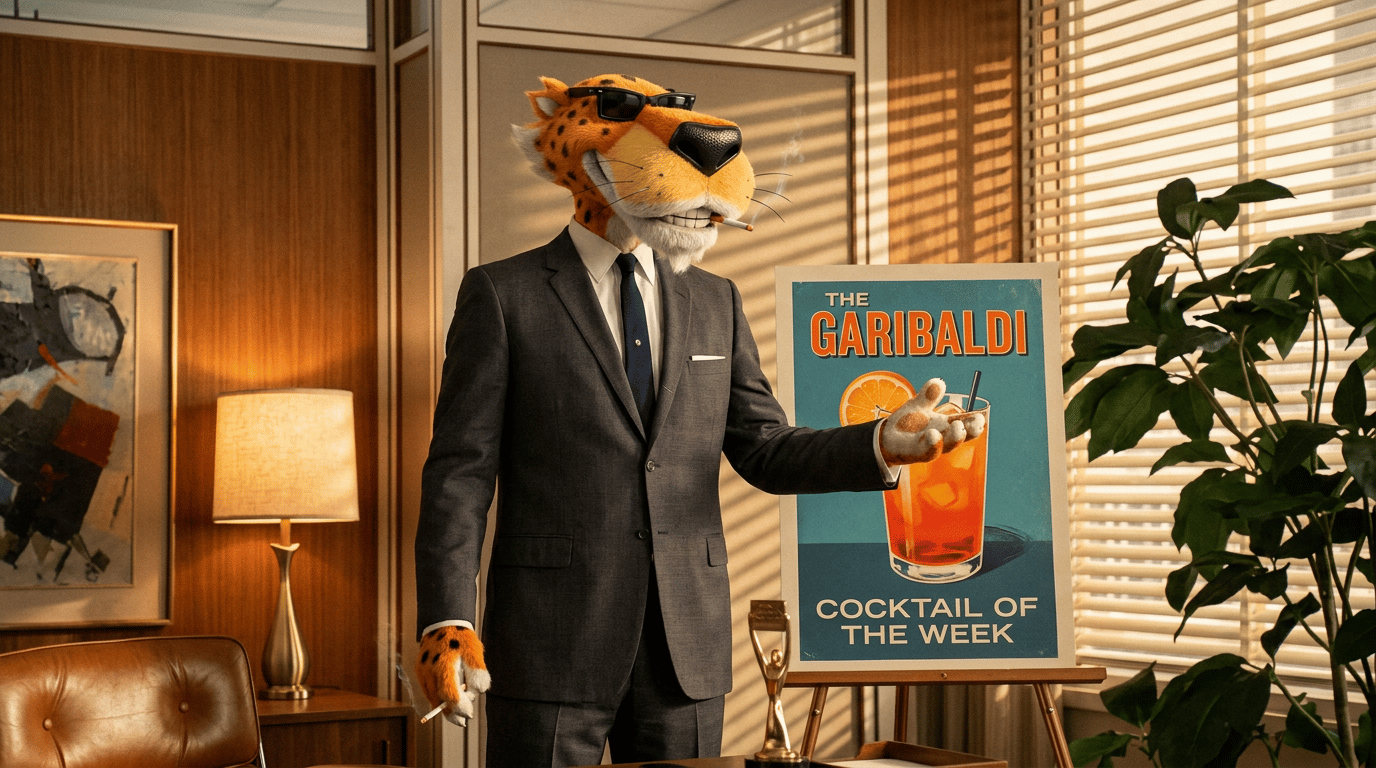
Two ingredients. Campari and orange juice. That’s the whole drink.
It’s named after Giuseppe Garibaldi, the Italian general who unified Italy in the 1860s. Campari is from the north. Oranges are from the south. The drink unifies them in a glass. A cocktail that’s also a geopolitical metaphor.
Try getting that out of a Bud Light.
The trick is the OJ. It has to be “fluffy” — aerated until it foams, almost like dessert. Dante in New York built a Best Bar in the World reputation on this exact drink. Bitter Italian aperitif on the bottom. Cloud of orange foam on top.
The same color as a Cheeto.
The drink Chester would order if he ever set down the cheetos for 5 seconds.
1 1/2 oz Campari
4 oz fresh orange juice
Pour Campari into a highball over ice. Run the OJ through a high-speed juicer or blender for about 30 seconds until it foams up. Pour over the Campari. Don’t stir. Let the foam sit on top like a crown.
No fancy juicer at home? Blend fresh OJ with a few ice cubes for 20 seconds. Strain. You’ll get 80% of the way there.
Go on, drink one for Chester. And the mouse.
The Drink Cart. A newsletter version of sitting at a really good bar with someone who thinks too much about advertising and won’t shut up about it. Wednesdays and Fridays