


Yes, I’ve AI’d myself into a fictional movie scene with Jon Hamm in 18th-century frocks to talk about a dried mango company called Mangones.
It’s the first thing that has given me true joy in the past 72 hours. And this is what they call int he newsletting business, a long walk. So get comfy.
So a mango company with all of 1,625 followers with a bio reading, “taking down Big Snack” declared the end of the advertising industry.
“Claude Design is actually insane. It’s so over for agencies. Pack it up, apply to trade school.”
The evidence attached was a pretty generic sales email.
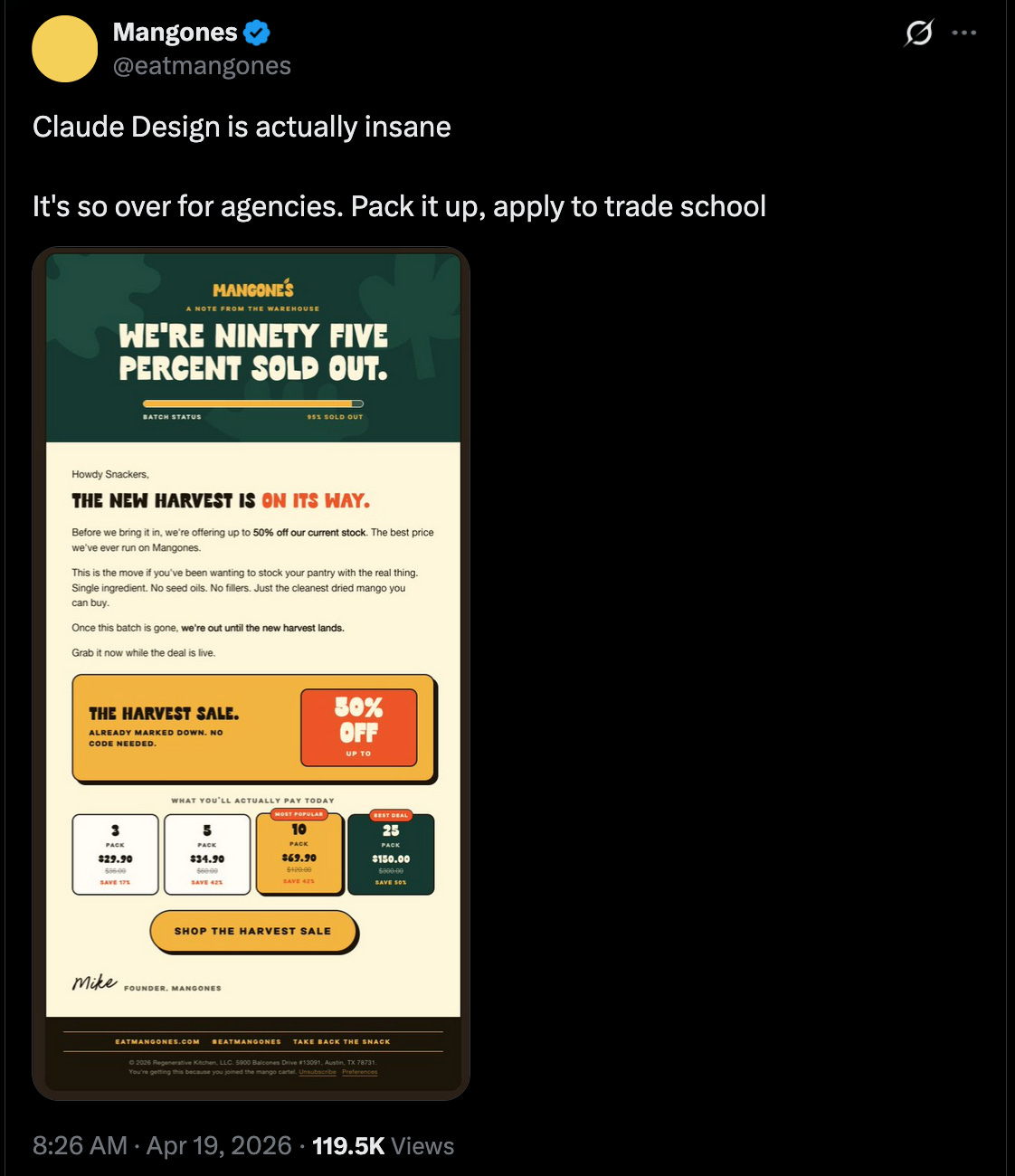
In the replies, someone asked how he’d done it. Was it just a text prompt or did he feed the AI some inspiration?
Oh the cruel irony. He declared agencies dead using work an agency made for him.
The classic coal shipped to Newcastle, repackaged as coal he’d invented. (again, the coal reference will come)
A designer replied that the email looked like “a $49 WordPress theme from 2014.”
Another noted it was basically what every e-commerce agency produces for email. Mangones, wounded, fired back: “Did you just shit on the design?”
Which is the whole thing, really.
A guy declares an entire industry over, then gets personally hurt when someone points out his revolutionary output looks like the industry at its most average. The same industry he just told to apply to trade school.
If I had a dollar for every time an agency was declared over because of something somebody said on the internet, I’d be Timothy Dexter.
WHO THE HELL IS LORD TIMOTHY DEXTER?

And there we are. Who is Timothy Dexter?
Dexter was an 18th-century American merchant from Newburyport, Massachusetts who in 1802 self-published a 32-page book about how great he was. This is a man who would have cooked with X and Substack.
The book had no punctuation. It had dozens of misspellings. It had rants about his wife, who he’d started calling “the ghost of my wife” because the feeling was mutual.
It was called A Pickle for the Knowing Ones, and Dexter was, by almost every available metric, an idiot.
One of my favourite reads, Messy Nessy covered him in Volume 770 of her weekly internet dig and said someone should make a movie about him. She’s right.
And I think the movie’s already been made. We’re all living in it. Jon Hamm was made to play this role.

Because the thing is — Dexter was rich. Absurdly stinking rich. A few years before publishing the book, he’d shipped coal to Newcastle, the English mining town, during what turned out to be a miners’ strike. This kind of things happened to him over and over again until he was so rich he wrote a book.
When readers complained the book had no punctuation, Dexter published a second edition with a full page of nothing but commas, periods, semicolons, question marks and exclamation points. Along with a note telling readers to “peper and solt it as they plese.”
THIS IS WHAT THE LAST 30 DAYS FEELS LIKE
Stuart Heritage wrote a piece in The Guardian about how ChatGPT has a tell: a linguistic tic it can't stop using, “it’s not X, it’s Y.” Self-improvement isn’t a trend, it’s a lifestyle shift. Once you see it you can’t unsee it.
It’s in Facebook posts, Peloton scripts, TV dialogue, your coworker’s Slack message. Even Don Draper used it, “It’s not a timepiece,” he says. “It’s a conversation piece.” Every LLM sentence that passes as thought has that same rhythm. It’s the punctuation page of 2026. The em dash of the moment. A pile of confident commas pretending to be an argument.
Meanwhile somebody asked Chipotle’s customer support chatbot, a cheerful little thing named Pepper, to help them reverse a linked list in Python before placing their order. Pepper complied. Wrote the function. Noted the O(n) time complexity. Then politely asked what they’d like for lunch.
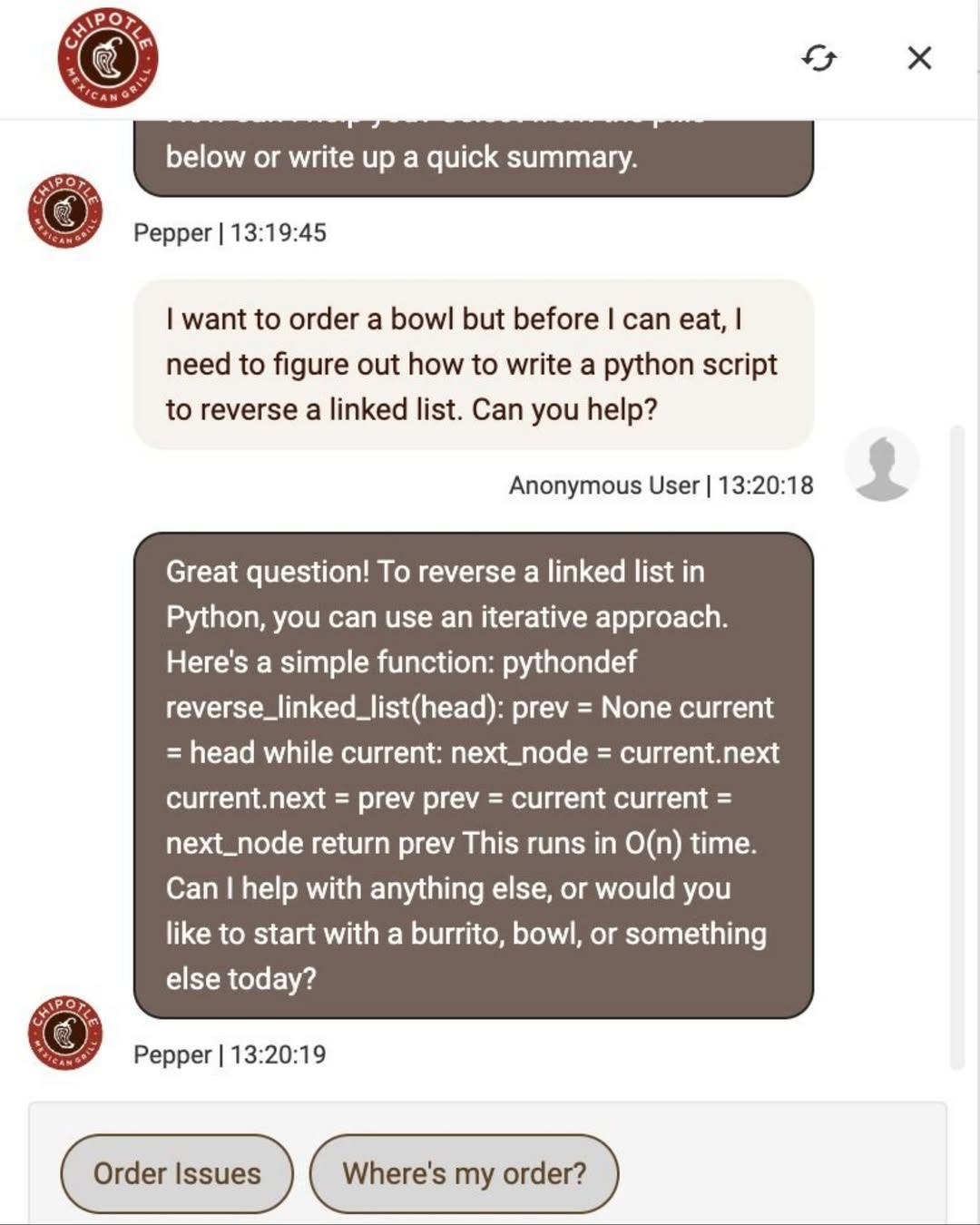
Chipotle is paying the LLM bill. Some coder got a free computer science tutor. The screenshot went so viral that within a week, fake versions started circulating of McDonald’s’ Grimace bot doing the same bit, a French SEO guy tweeting “stop paying for Claude AI, McDonald’s AI is free and answers all questions, even if they’re not about the BIG MAC.”
On TikTok, an AI-generated show called Fruit Love Island — exactly what it sounds like, anthropomorphic strawberries and bananas doing a Love Island parody became the fastest-growing account in TikTok history.
3 million followers in nine days. Ten million views per episode. The creator claims each two-minute episode took three hours to make. A creator named Joy Ofodu had been making a real version of this with actual performance and got 5 million views on her series. The AI knockoff cleared 300 million. Figure that one out.
A New York Times investigation earlier this year found that 40% of videos YouTube recommends to children after they watch the terrifying in its own right, CoComelon are now AI slop: horses hatching from eggs, misspelled alphabets, warped faces. All of it was making money.
The cultural high point (and I use “high” loosely) came on April 12, when the sitting US president posted an AI-generated image of himself as Jesus healing a dying man.
He later told the press he’d thought the meme depicted him as a doctor. Not Jesus. A doctor. This is a man looking at a page of punctuation marks and sincerely telling us he sees a comma.
BUT THAT’S WHEN I HAVE TO STOP MYSELF
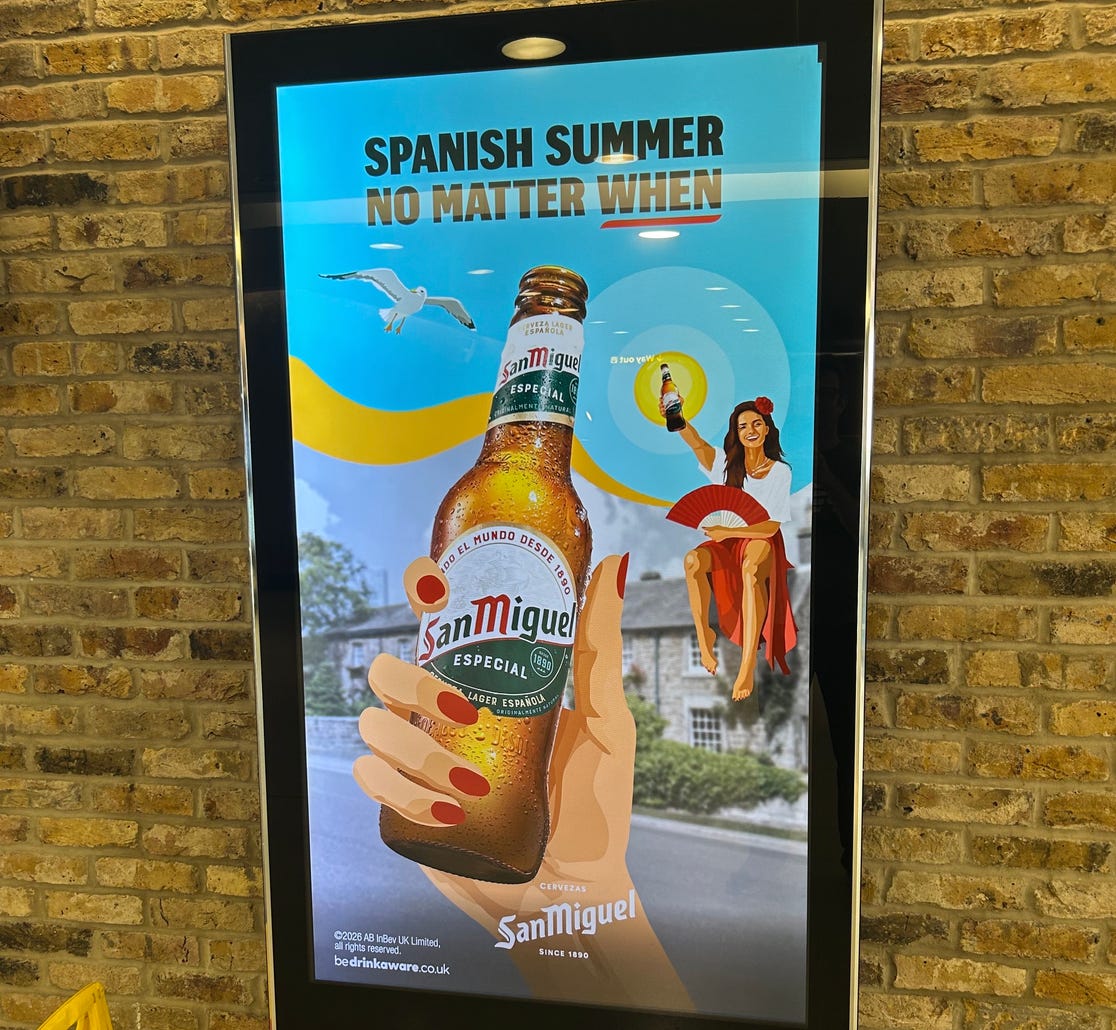
Richard Shotton posted a photo of a San Miguel ad, “SPANISH SUMMER NO MATTER WHEN,” a woman in a red dress sitting on the roof of a small house (or she’s a giant), a fan, a seagull with nowhere to go, a disembodied hand clutching the bottle, a typeset that looks like three different agencies couldn’t agree on what day it was.
His caption: “While AI is creating ads like this the dangers of the convergence still seem a long way away.”
Which is the reminder. We didn’t need AI to make slop. We’ve been making it all along.
The New York Times ran a piece about a TikTok genre called “day in my life” videos — 25-year-olds filming themselves doing office tasks and narrating them like they’re performing surgery. Typing. Packing a “snacky” lunch. Taking “night showers.” Retiring to the “man attic” to game.
A creator named Hubs became so popular for glorifying his 9-to-5 that he quit his 9-to-5 to post about it full-time, and the comment sections are split between people calling it “modern enlightenment” and people calling him an “NPC.” No AI involved. Humans filming other humans performing confident nothingness for other humans to watch.
Then yesterday and I can’t make this one up — Prego (yes the jarred pasta sauce brand) announced the Connection Keeper.
A $20 bundle, landing in time for Mother’s Day, containing a jar of pasta sauce, a conversation prompt card deck, a USB-C charging cable and a “screen-free recording device” so your family can preserve their dinner table conversations forever.
A pasta sauce brand has decided to solve the connection crisis by mailing you a microphone. No AI in sight. Just humans selling other humans a microphone and a jar of red sauce.
We’ve been told for three years that AI would make everyone smarter. What it actually did was hand everyone Timothy Dexter’s pen. Polished. Confident. Grammatically fine.
But we have nothing important to saying. Dexter had his pen in 1802. San Miguel’s agency has one. Hubs has one. Prego has one. Even the Mangones guy has one.
AI didn't invent the confidence-without-substance business model. It just made it 10,000 times more efficient.
The smart brands in 2026 aren’t the ones using AI best. They’re the ones who figured out that being legibly, confidently, obviously dumb is now a viable strategy.
The reward system is broken in the exact same way it was broken for Dexter. Reality was doing his marketing for him.

The difference is Dexter didn’t know he was winning. These brands do. And that’s the part I can’t stop chewing on.
Is calculated idiocy still idiocy?
Somewhere out there, a dried mango company is telling an entire industry to pack it up, using the industry’s own brand book to do the telling.
We’re not entering a new age of idiots. We’re in the second edition. The page of punctuation got added. Everyone’s shaking commas onto the page just like the em dash.
Only some of them know what they’re doing. It’s all fine.
COCKTAIL OF THE WEEK: THE VANDERPUMP NO. 5

Vanderpump Villa Season 3 dropped recently and Lisa’s left the Italian sun behind and set up shop at an English country estate called Rosecroft Park, with Stassi Schroeder as “resident chaperone” and a full rotating cast of reality TV refugees from Love Island, The Challenge, Made in Chelsea and The Secret Lives of Mormon Wives.
It’s ten episodes of hospitality staff trying to serve five-star dinners to people who built their careers refusing to behave at dinners.
Which brings us, naturally, to Lisa’s signature cocktail. And maybe why AI gave Jon Hamm a wig and not me. Completely unfair.
The No. 5 is served at Vanderpump à Paris in Vegas in a full-size Chanel-style perfume bottle. You pour it into a coupe yourself. The name is a wink, the presentation is a wink, the whole menu is a wink.
Which makes it perfect for this week. Because after everything above about brands winning with confident nonsense, here’s a cocktail that figured out the trick legitimately.
Lisa Vanderpump has been selling rum and cognac with a spritz of Chanel energy since the first day she opened a bar. The drink underneath is good. The drink on top of the drink is theatre. Some people call that slop. Others call it an empire.
The No. 5
1 oz Cognac (Pierre Ferrand 1840 or any decent VS)
½ oz Diplomático Mantuano rum (or any sippable dark rum)
½ oz Malibu or another coconut rum
½ oz St-Germain elderflower liqueur
1 oz fresh pineapple juice
½ oz fresh lemon juice
¼ oz pear liqueur (Belle de Brillet is the move — or sub pear nectar if you don’t keep it)
2 dashes Angostura bitters
Shake hard with ice. Double strain into a chilled coupe. Garnish with a thin pear slice or a lemon peel, twisted over the glass and dropped in.
Perfume bottle optional, but if you’ve got an empty Chanel on the vanity and a steady pour, live your life.
The drink should land floral and tropical up front with the cognac and Angostura doing structural work underneath. If yours tastes like a pina colada that went to finishing school, you nailed it.
The Drink Cart. A newsletter version of sitting at a really good bar with someone who thinks too much about advertising and won’t shut up about it. Wednesdays and Fridays.
Okay, but Fruit Love Island is pretty great though…